
Disclosure: This post may contain affiliate links, including Amazon links. As an Amazon Associate I earn from qualifying purchases. Commissions may be earned at no extra cost to you. Content is for informational purposes only and not professional advice.
Life will always bring uncertainty, stress, and unexpected challenges. You cannot control every situation, but you can control how you respond to it. That ability, the capacity to stay grounded, recover quickly, and move forward with clarity, is emotional resilience. It is one of the most important foundations of your inner world, and it shapes how well you navigate everything from daily frustrations to major life changes.
The good news is that resilience is not a fixed personality trait you either have or do not have. According to the American Psychological Association, resilience is the process of successfully adapting to difficult or challenging life experiences through mental, emotional, and behavioral flexibility. In other words, it is a skill, and like any skill, it can be learned, practiced, and strengthened over time.
This post explores what emotional resilience really is, why it matters, and how you can build it through small, intentional practices that fit into real life.
What Emotional Resilience Actually Means
Most people misunderstand resilience. They assume it means never feeling stressed, staying positive all the time, pushing through without rest, or being largely unaffected by challenges. But real resilience looks nothing like that.
Genuine emotional resilience is the ability to feel things deeply, recover fully, and respond with intention rather than reaction. It is the internal flexibility to bend without breaking. It means staying centered when life becomes chaotic, and returning to balance after something knocks you off course.
A useful way to think about it: resilience is not about avoiding discomfort. It is about developing the capacity to navigate discomfort with awareness and stability, so that even difficult moments do not pull you under or derail you for longer than necessary.
Why Emotional Resilience Matters
Your emotional resilience influences more areas of your life than you might expect. It shapes how you handle conflict, how you respond under pressure, how you recover from setbacks, how you manage uncertainty, how you maintain relationships, and how consistently you can pursue long-term goals.
Research published in Frontiers in Psychology describes emotional resilience as the cornerstone of wellbeing in modern life, playing a key role not only in personal health but also in professional performance and career fulfilment. Separately, a comprehensive review by RGA found that resilience is consistently associated with lower rates of depression and anxiety, even among people facing significant stressors such as trauma, illness, or major life transitions.
When resilience is low, small problems can feel overwhelming. When resilience is strong, even big challenges feel more workable. Resilience does not eliminate difficulty. It changes your relationship with it.
The Nervous System Connection
Emotional resilience is deeply tied to the state of your nervous system. When your nervous system is regulated, you think more clearly, make better decisions, and respond to situations with intention rather than impulse. When it is dysregulated, you are more likely to react without thinking, shut down emotionally, or feel overwhelmed by things that would normally feel manageable.
Research on Polyvagal Theory, developed by neuroscientist Stephen Porges, proposes that the autonomic nervous system plays a central role in how we experience safety and stress, and that resilience is closely connected to how efficiently your nervous system can return to a regulated state after disruption. In practical terms, a regulated nervous system feels calm, steady, grounded, and present. A dysregulated one feels tense, scattered, reactive, and overwhelmed.
Resilience, then, is not just a mental skill. It is also a physiological one. The more reliably your nervous system can return to regulation, the more resilient you become in every area of your life.
Micro-Regulation: The Foundation of Resilience
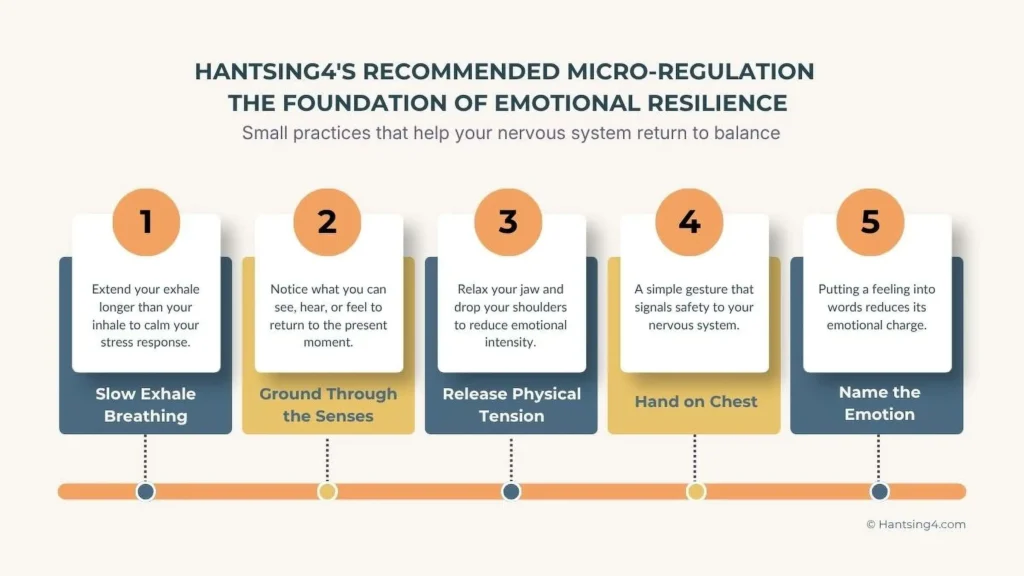
You do not build resilience through dramatic life overhauls. You build it through micro-regulation, which means small, repeatable practices that help your nervous system return to balance throughout the day. Think of these as brief reset moments rather than lengthy routines.
Some of the simplest and most effective techniques include:
- Slow exhale breathing, where extending the exhale is longer than the inhale activates the parasympathetic nervous system and helps calm stress responses
- Grounding through the senses, by noticing five things you can see, hear, or feel right now, which pulls your attention back to the present moment
- Relaxing your jaw and dropping your shoulders, since physical tension and emotional tension tend to amplify each other
- Placing a hand on your chest, a simple gesture that research suggests signals safety to your nervous system
- Naming the emotion you are feeling, because research on affect labeling shows that putting a feeling into words reduces its emotional intensity
These practices take seconds, but used consistently, they gradually strengthen your internal stability and your ability to recover faster from stress. One of the simplest ways to strengthen resilience is through movement practices that stabilize your mood and energy.

The Role of Emotional Awareness
You cannot regulate what you cannot recognize. Emotional awareness is the ability to notice what you are feeling without immediately judging it, suppressing it, or being swept away by it. It is the step most people skip when they go straight to coping mechanisms, but it is the foundation that makes real regulation possible.
Awareness matters because it helps you understand your triggers, identify your patterns, separate the emotion from your identity, and create space to choose your response rather than just react. That space is everything.
A phrase often attributed to Viktor Frankl, though its precise origin remains disputed, captures this well: “Between stimulus and response there is a space. In that space is our power to choose our response. In our response lies our growth and our freedom.”
Whether or not Frankl said those exact words, the idea is well-supported by psychology. Positive psychology research shows that resilience is closely connected to the ability to prioritise emotions and access internal strengths like emotional regulation and meaning-making. Awareness is where that process begins.
Reframing Stress: A More Helpful Perspective
Stress is not always the enemy. In many cases, stress is a signal pointing to something that matters, something that needs attention, something that is misaligned, or something that is changing. The problem is not stress itself. The problem is how we interpret it.
Research published in Frontiers in Integrative Neuroscience supports this view, suggesting that short periods of stress followed by recovery can actually function as exercises for the nervous system, strengthening resilience over time. It is chronic, unrelenting stress without adequate recovery that leads to damage. Brief disruptions followed by return to balance build capacity, not wear it down.
Resilience grows when you stop seeing every stressful moment as a threat and start asking what it might be showing you. Rather than asking “Why is this happening to me?”, try asking “What is this trying to tell me?” That shift turns stress from an enemy into information you can actually work with.
Building Your Emotional Capacity
Emotional capacity is your ability to hold discomfort without shutting down or becoming overwhelmed by it. Like physical fitness, it grows gradually through practice, not through forcing yourself to handle more than you are ready for.
You build emotional capacity by allowing yourself to feel without immediately rushing to fix or escape, by sitting with discomfort for a few moments rather than avoiding it, by practising calm responses to small everyday stressors before they escalate, by giving yourself adequate recovery time after difficult periods, and by gradually strengthening your sense of internal boundaries.
The key word here is gradually. Capacity grows through gentle, consistent exposure, not through pressure or self-criticism. Progress might look like tolerating a difficult conversation without shutting down, or noticing an anxious feeling and letting it pass rather than spiralling into it. Small wins matter.
Resilience becomes easier to maintain when supported by habits that actually last, even during stressful periods.
The Power of Recovery Rituals
Resilience is not only about how you handle stress in the moment. It is equally about how you recover from it. Without adequate recovery, the nervous system stays partially activated and your baseline stress level creeps upward over time.
Recovery rituals are simple, repeatable activities that signal safety to your nervous system and help your mind and body return to balance. They do not have to be elaborate. A short walk, a few pages of a book, journaling, gentle stretching, warm lighting in the evening, a calming playlist, a few minutes of stillness, or a grounding routine before bed can all be effective.
The consistency matters more than the activity itself. When your nervous system learns to associate certain cues with safety and rest, it begins to return to regulation more quickly and more reliably, which is precisely what resilience looks like in practice.
Strengthening Resilience Through Self-Compassion
Self-compassion is one of the most underused and most research-backed tools for building resilience, yet most people overlook it in favour of willpower and discipline.
Dr. Kristin Neff, a leading researcher at the University of Texas at Austin, has spent over two decades studying self-compassion. Her work, including a comprehensive review published in the Annual Review of Psychology, consistently shows that self-compassion supports emotional resilience, reduces anxiety and depression, and improves overall wellbeing. Importantly, her research also dispels the common myth that being kind to yourself makes you less motivated. The opposite tends to be true.
In practice, self-compassion sounds like telling yourself “I am doing the best I can right now,” or “It is okay to feel this way,” or “I do not have to get this perfect to make progress.” When you meet yourself with this kind of understanding instead of harsh self-criticism, your nervous system relaxes. Internal pressure drops. Recovery becomes faster and more natural.
What a Resilient Inner World Feels Like
When your emotional resilience is genuinely strong, the change is not dramatic. It is quieter than that. You notice more steadiness during uncertainty. More clarity during stress. More patience during conflict. More ease after disruption. Challenges do not disappear, but they stop feeling like proof that something is fundamentally wrong.
You navigate them instead of being consumed by them.
Bringing It All Together
Emotional resilience is a skill you build from the inside out, through emotional awareness, nervous system regulation, consistent recovery habits, and the kind of self-compassion that softens internal pressure rather than reinforcing it.
It does not happen overnight, and it does not require a perfectly ordered life. It requires small, repeated acts of returning to yourself. A breath. A moment of awareness. A recovery ritual at the end of a hard day. A kind word directed inward instead of a critical one.
Over time, those small things compound. Your nervous system becomes more adaptable. Your recovery time shortens. Your relationship with stress changes. And your inner world, the one that everything else in your life runs through, becomes more stable, more grounded, and more genuinely your own.
This connects closely with what I explained in The Hidden Patterns That Shape Your Life, which expands the concept further.