

Disclosure: This post may contain affiliate links, including Amazon links. As an Amazon Associate I earn from qualifying purchases. Commissions may be earned at no extra cost to you. Content is for informational purposes only and not professional advice.
Most people think about food in terms of physical outcomes. Weight. Energy levels. Digestion. What they rarely consider is the role that nutrition plays in their emotional life, their ability to concentrate, and their capacity to stay steady when life gets demanding. The connection between what you eat and how you feel on the inside is not a wellness trend. It is biology, and the research behind it is growing more compelling every year.
Your inner world is not separate from your nutrition. It is directly shaped by it. Every meal you eat becomes raw material your brain uses to think, regulate emotion, and function through the day. When that raw material is consistently poor, the effects show up not just in your body but in your mood, your mental clarity, and your ability to stay consistent with the habits that matter to you.
This post explores how food influences your emotional and mental foundation, and how small, intentional nutritional shifts can create a more stable, focused, and grounded inner life.
Your Brain Runs on What You Eat
Your brain accounts for roughly two percent of your body weight, but as research published in Frontiers in Nutrition notes, it consumes somewhere between 20 and 25 percent of your daily energy. That energy comes entirely from the food you eat, and the quality of that fuel has a direct bearing on how well your brain performs.
When your nutrition is consistently supportive, the effects are noticeable: clearer thinking, steadier mood, better focus, more emotional resilience, and fewer of the energy crashes that make afternoons feel like a battle. When your nutrition is unstable, the opposite tends to follow. Irritability, brain fog, mood swings, low motivation, and inconsistent energy are not personality flaws or signs of weakness. They are often nutritional signals worth paying attention to.
Your brain is also in a constant state of renewal. It is continuously rebuilding neural connections and producing the chemical messengers that regulate how you feel and think. The nutrients you consume are the building blocks for that work. Every meal, in a very real sense, becomes part of your emotional and cognitive foundation.
Blood Sugar: The Hidden Driver of Mood and Focus
One of the most significant and least discussed factors affecting your inner stability on a daily basis is blood sugar. When your blood sugar rises and falls sharply, your mood, energy, and focus tend to follow the same pattern, often without you fully connecting the two.
A blood sugar spike feels like a burst of energy, a sense of restlessness, and a short window of motivation. What follows is the crash: irritability, anxiety, fatigue, and a difficulty concentrating that can make even simple tasks feel effortful. Research published in the Pritikin Longevity Center’s review of blood sugar and mood explains the mechanism clearly: a sudden rise in blood glucose triggers insulin release, which can subsequently cause levels to fall too rapidly, activating stress hormones like adrenaline and cortisol and producing exactly the kind of emotional volatility that makes steady habits harder to maintain.
Stabilizing your blood sugar is one of the most practical and accessible ways to strengthen your inner foundation. When your glucose levels remain relatively steady throughout the day, you think more clearly, react less impulsively, and find it significantly easier to stay consistent with the behaviors that support your wellbeing.
Foods That Support Emotional Stability
Certain foods help regulate your nervous system, support the production of mood-related brain chemicals, and create a sense of internal steadiness. They tend to share a common quality: they provide slow, sustained energy rather than sharp peaks and rapid drops.
The categories worth building your meals around include protein-rich foods such as eggs, fish, chicken, tofu, and legumes; healthy fats from sources like avocado, nuts, seeds, and olive oil; complex carbohydrates including oats, quinoa, sweet potatoes, and whole grains; leafy greens such as spinach, kale, and arugula; fermented foods including yogurt, kefir, kimchi, and sauerkraut; and colorful berries and vegetables, which provide antioxidants that support brain health.
As nutritional psychiatry research from the Eating Recovery Center describes, your brain relies on amino acids, healthy fats, and micronutrients, including B6, magnesium, tryptophan, omega-3s, zinc, and iron, to produce serotonin and dopamine, the neurotransmitters most closely associated with mood stability, focus, and emotional steadiness. Supportive foods give your brain the building blocks it needs to produce these chemicals consistently.
Foods That Disrupt Your Inner Stability
Just as some foods support your emotional baseline, others work against it. Sugary snacks, refined carbohydrates, heavily processed foods, excessive caffeine, alcohol, and artificial sweeteners all have the potential to create internal disruption, primarily by causing blood sugar instability, promoting inflammation, or interfering with neurotransmitter balance.
A 2024 analysis of data from the US National Health and Nutrition Examination Survey found a consistent link between higher added sugar intake and elevated depression scores, though researchers were careful to note that the relationship is not simply one of direct causation. Overall dietary patterns, sleep quality, and physical activity all play a role. The practical takeaway is that these foods do not need to be eliminated entirely. They are best approached with awareness, particularly when you are working on emotional regulation or building more consistent habits.
Your goal is not dietary perfection. It is nutritional steadiness. Even modest reductions in the foods that create instability tend to produce noticeable improvements in mood and focus over time.
The Gut-Brain Connection
Perhaps the most striking development in nutrition science over the past decade is the growing body of research on the gut-brain axis, the bidirectional communication network that connects your digestive system to your central nervous system. The implications of this connection for mental and emotional health are significant and still being fully understood.
A comprehensive review published in Frontiers in Nutrition describes the brain-gut-microbiota system as a progressively recognized factor in mental and brain health, one that influences not only nutrient absorption but also cognitive processes, mood regulation, and neuroplasticity through neural, hormonal, and immune communication pathways. In simpler terms: the health of your gut has a measurable effect on how you think and feel.
Your gut also produces a significant portion of your body’s serotonin, which is why digestive imbalance often shows up not just as physical discomfort but as irritability, low mood, brain fog, and heightened sensitivity to stress. Supporting your gut through fiber-rich foods, fermented foods, and reducing heavily processed inputs is one of the most effective long-term investments you can make in your emotional baseline.
Small Nutritional Shifts That Make a Real Difference
You do not need a complete dietary overhaul to begin experiencing the benefits of more supportive nutrition. Small, consistent changes tend to produce meaningful improvements, and they are far more sustainable than dramatic interventions.
Some of the most impactful shifts you can make include:
- Adding a source of protein to your breakfast to stabilize blood sugar from the start of the day
- Including healthy fats in your main meals to support sustained energy and brain function
- Drinking water before caffeine in the morning to begin the day in a hydrated state
- Choosing whole foods over processed ones where the option exists
- Adding one serving of leafy greens per day as a reliable source of micronutrients
- Reducing sugary snacks and replacing them with whole-food alternatives
- Eating at consistent times to give your body the predictability it responds well to
These shifts work not because they are individually dramatic but because they compound. Your body and brain thrive on consistency. When your meals become steadier, your energy and emotional baseline tend to follow.
For many people, targeted supplements can reinforce their nutritional foundation, especially when paired with supportive wellness habits.

The Role of Hydration in Mental Clarity
Hydration is one of the most overlooked contributors to cognitive performance and emotional stability, and the effects of mild dehydration set in earlier than most people expect.
Research published in the Annals of Nutrition and Metabolism found clear and consistent mood worsening during mild dehydration in adults, characterized primarily by increased sleepiness, reduced sense of wellbeing, and greater difficulty with tasks requiring sustained attention. The brain is approximately 75 percent water, and even modest fluid loss affects how it functions. Irritability, difficulty focusing, headaches, low energy, and a heightened stress response are all common early signs of inadequate hydration, often appearing before the sensation of thirst.
The practical implication is straightforward: drinking water steadily throughout the day rather than reactively when thirst arrives supports more consistent cognitive performance and emotional regulation. Starting the morning with water before caffeine is one of the simplest and most effective habits you can adopt for your inner foundation.
Eating for Emotional Regulation
The way you structure your eating has a direct bearing on your emotional stability throughout the day. Skipping meals, pairing fast-digesting carbohydrates with nothing to slow their absorption, and eating irregularly all create the physiological conditions that make emotional regulation harder.
A few practical principles are worth building into your routine. Pairing carbohydrates with protein or fat slows the absorption of glucose and prevents the sharp spikes and crashes that destabilize mood. Choosing slow-digesting whole foods over refined ones provides the steady, sustained energy your brain needs to regulate itself effectively. Eating mindfully, without distraction when possible, supports better digestion and a more attuned relationship with your own hunger and satiety signals. Creating simple, predictable meal routines removes the decision fatigue that often leads to less supportive choices when energy and willpower are already depleted.
Emotional regulation begins with physiological regulation. When your body is steady, your emotions become meaningfully easier to manage.
Building a Supportive Eating Routine
A supportive eating routine does not need to be complicated or perfectly optimized. It needs to be predictable, nourishing, and realistic enough to maintain consistently. Here is a simple structure that covers the essentials:
- Start the day with protein and healthy fats to establish a stable energy baseline
- Eat balanced meals every three to four hours to avoid the blood sugar dips that disrupt mood and focus
- Include colorful vegetables in at least two meals each day for micronutrient and antioxidant support
- Keep snacks simple and whole-food based, such as nuts, fruit, or yogurt
- Drink water steadily throughout the day, beginning before your first coffee
- Reduce caffeine after midday to protect sleep quality, which has its own significant effect on mood and emotional resilience
- End the day with a calming, grounding meal that supports rest rather than stimulating it
Routines reduce decision fatigue. When your meals are predictable, your mind has more space for the clarity and focus that carry you through everything else.
What Supportive Nutrition Feels Like
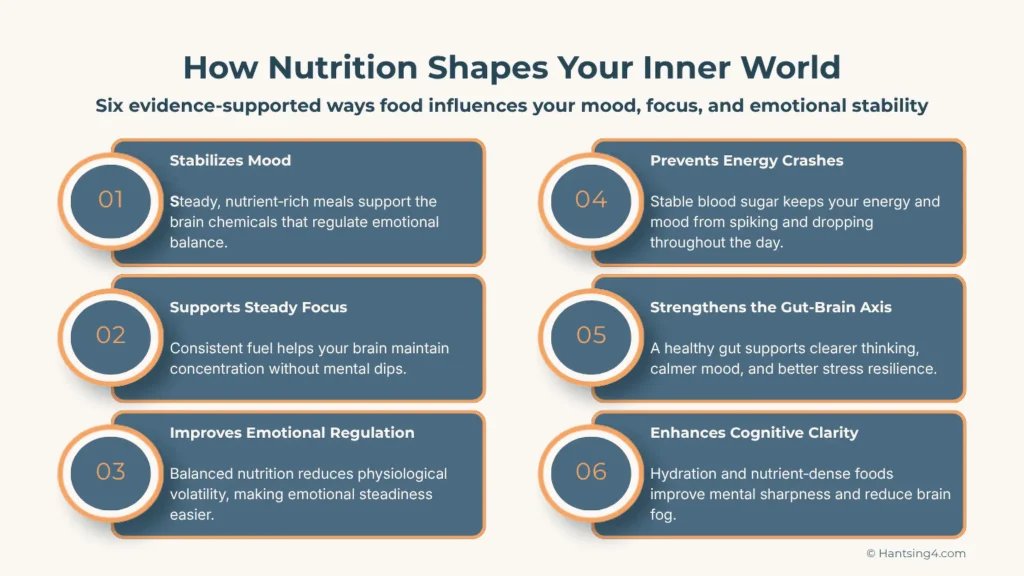
When your nutrition begins to consistently support your inner world, the shift is gradual but unmistakable. Steady energy through the day replaces the peaks and crashes. Thinking feels clearer, particularly in the afternoons. Mood swings become less frequent and less pronounced. Emotional reactions feel more proportionate and easier to manage. Focus becomes more available when you need it. Habits that once required significant willpower begin to feel more natural.
These changes are not the result of a perfect diet. They are the result of a consistent nutritional foundation that gives your brain and nervous system what they need to function well. You feel more grounded and more capable, not because your external circumstances have changed, but because your body is no longer working against you.
If you’re ready to put this into action, these tools in 10 Tools to Make Meal Prep Easy will help you get started immediately.
Bringing It All Together
Nutrition is not separate from your inner life. It is one of its primary inputs. The food you eat shapes your mood, your focus, your emotional stability, and your capacity to stay consistent with the habits and routines that support your wellbeing.
You do not need to transform your diet overnight to begin experiencing the benefits. Small, intentional choices, made consistently over time, create a cumulative effect that is far more powerful than any short-term intervention. Add protein to your breakfast. Drink water before caffeine. Choose whole foods where you can. Support your gut. Eat at regular times.
When you nourish your body with care and consistency, your inner world becomes steadier, clearer, and significantly easier to navigate. That stability is not a luxury. It is the foundation everything else is built on.
This is a great moment to explore Training for Inner Strength and The Support System Within, which adds another layer to this discussion.