

Disclosure: This post may contain affiliate links, including Amazon links. As an Amazon Associate I earn from qualifying purchases. Commissions may be earned at no extra cost to you. Content is for informational purposes only and not professional advice.
Most people think of exercise as something they do for their body. To get stronger. To lose weight. To stay healthy. The physical benefits are real and well documented, but they are only part of the story. Movement is also one of the most powerful and most accessible tools available for shaping your inner world. The way you move affects your mood, your mental clarity, your emotional resilience, and your capacity to stay grounded when life gets difficult.
What makes this particularly significant is how quickly it works. Unlike many forms of inner work, which require sustained practice before results become noticeable, movement can shift your internal state within minutes. A short walk, a few minutes of stretching, a focused strength session: each of these sends immediate signals to your nervous system and brain chemistry that change how you feel from the inside out.
This post explores the science behind why movement strengthens your inner foundation, and how consistent, intentional physical practice creates a more stable, grounded, and emotionally resilient version of you.
Your Body Is the Gateway to Your Inner World
Your emotional and mental state is not separate from your physical state. They are part of the same system, constantly influencing each other. When your body is tense and contracted, your mind tends to follow. When your body is grounded and mobile, your mind tends to settle. This is not metaphor. It is physiology.
Movement influences your nervous system, your stress response, your emotional regulation, your mental clarity, and your sense of internal stability in ways that no purely mental practice can fully replicate. Your body is often the fastest route to changing how you feel, faster than thinking your way through a problem or waiting for a difficult emotion to pass on its own.
Understanding this connection changes how you relate to physical practice. It is no longer just about what your body looks like or what it can do. It becomes part of how you manage your inner world every day.
Movement and Your Nervous System
Your autonomic nervous system governs your stress response. When it is dysregulated, you feel reactive, overwhelmed, or anxious. When it is regulated, you feel calm, present, and capable of responding to challenges with intention rather than impulse. Movement is one of the most reliable ways to bring a dysregulated nervous system back into balance.
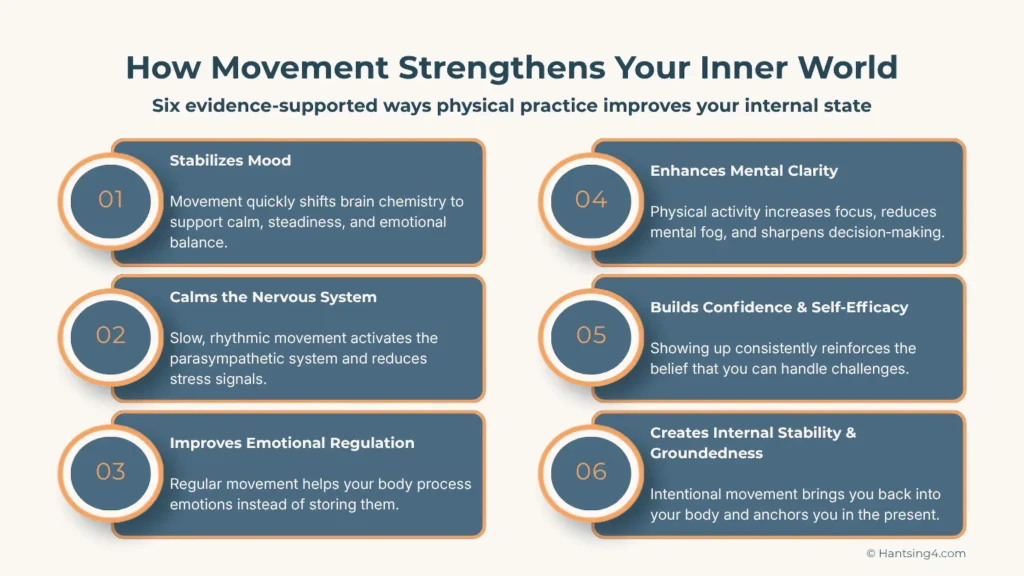
Physical activity works through multiple pathways simultaneously. It reduces circulating levels of cortisol and adrenaline, the stress hormones that keep your system in a state of high alert. It activates the parasympathetic nervous system, sometimes called the rest-and-digest state, which counteracts the fight-or-flight response. Slow, rhythmic movement in particular, such as walking, gentle stretching, yoga, and breath-linked mobility work, is especially effective at triggering this shift.
A comprehensive review published in the British Journal of Sports Medicine found that exercise should be considered a first-line treatment for depression, anxiety, and psychological distress, based on analysis of nearly 100 meta-reviews of randomized controlled trials. The effect is not subtle. It is consistent, measurable, and well-supported across a wide range of movement types and populations. When your body settles, your mind tends to follow.
The Neurochemistry of Movement
One of the reasons movement has such a reliable effect on mood and emotional regulation is the cascade of neurochemical changes it produces. Understanding these mechanisms helps explain why even a short session can shift your internal state so meaningfully.
Exercise stimulates the release of endorphins, which are natural mood-elevating chemicals that reduce the perception of pain and produce a sense of wellbeing. It increases serotonin production, which supports calm, emotional steadiness, and a general sense of stability. It elevates dopamine, which underpins motivation, focus, and the experience of reward. These effects are well established, but they represent only part of the picture.
Perhaps the most significant neurochemical effect of movement is its impact on brain-derived neurotrophic factor, or BDNF. A ScienceDirect review of exercise, BDNF, and brain health describes BDNF as a protein essential for neuron survival, growth, and synaptic plasticity, and notes that aerobic activity elevates BDNF levels in key brain regions including the hippocampus, which is critical for memory and emotional regulation, and the prefrontal cortex, which governs decision-making and executive function. Higher BDNF levels support neuroplasticity, the brain’s ability to form new connections and reorganize in response to experience. In practical terms, regular movement does not just make you feel better in the moment. It makes your brain structurally more capable of managing stress and regulating emotion over time.
Strength Training: Building Resilience From the Inside Out
Strength training occupies a particular place in the landscape of movement and mental health because of the specific psychological qualities it develops alongside its physical ones. When you train your body to handle resistance, you are simultaneously training your mind to handle discomfort, delay, and the slow, non-linear nature of genuine progress.
Movement helps you process emotions instead of storing them. It gives your body a way to release what your mind is holding. This is why even a short walk can shift your entire emotional state. Regular movement is one of the most reliable ways to build emotional resilience, especially during stressful periods.
A 2023 meta-analysis published in Frontiers in Psychiatry found that in young people, 30 to 60 minutes of resistance training three to four times per week was the most effective form of exercise for improving depression and anxiety, outranking aerobic exercise, mixed training, and mind-body exercise, though all showed benefits. A separate IntechOpen review of resistance training and mental health describes the psychological mechanisms involved as both neurochemical, including the release of endorphins and BDNF, and psychosocial, including improved self-efficacy and the confidence that comes from observable progress.
That confidence is worth examining more closely. Every time you show up for a strength session, complete a set that was difficult, or add a small amount of weight to a movement you have been practicing, you are building evidence that you can do hard things. Not just physically but in every area of your life where persistence and tolerating discomfort are required. The weight does not just build muscle. It builds a different relationship with yourself.

The Mind-Body Feedback Loop
Movement works not only through direct neurochemical effects but through a self-reinforcing cycle that compounds over time. When you move, physical tension decreases. Decreased tension calms the nervous system. A calmer nervous system improves emotional regulation. Better emotional regulation leads to clearer decisions. Clearer decisions support the habits and routines that keep you moving.
Each pass through this loop strengthens it. Research on the relationship between physical activity, self-efficacy, and wellbeing describes the positive impact of physical exercise on wellbeing as being largely mediated through enhancements in self-efficacy and resilience, with the self-efficacy pathway grounded in what social cognitive theory calls mastery experience: engaging in progressively challenging physical tasks builds and strengthens your belief in your capacity to overcome difficulties in general.
This is why people who move consistently often describe a generalized sense of capability that extends well beyond the gym or the track. The physical practice is training something deeper than fitness. It is training the internal confidence that your body and mind can handle what comes.
Consistency Matters More Than Intensity
One of the most important and most liberating findings from the research on movement and mental health is that intensity is far less important than consistency. You do not need long sessions, advanced programming, or the discomfort of pushing to your limits to benefit meaningfully from physical practice. What matters is showing up regularly.
A 2025 systematic review published in Frontiers in Psychology found that moderate intensity exercise had the most significant and consistent effect on mood across different populations, and that even brief activities, such as stair climbing, produced measurable increases in feelings of energy and wellbeing. The implication is straightforward: ten minutes of intentional walking, a short mobility routine, a handful of bodyweight exercises, or a few minutes of breath-linked stretching all count. They all move the needle on your inner world.
Small, consistent actions build internal stability in a way that occasional intense effort does not. Your body and nervous system respond to what you do regularly, not to what you do once.

Movement as a Grounding Practice
There is a specific quality of movement that is particularly valuable for the inner world, and it is less about intensity or duration than about presence. Grounding movement is intentional, deliberate, and slow enough to keep your attention anchored to the physical experience rather than the mental noise running in the background.
Slow intentional walking, deep breathing paired with movement, gentle stretching, mindful mobility work, and deliberate strength training all share this quality when approached with attention. They bring you back into your body at moments when your mind is scattered, overactive, or pulled toward worry and distraction. They provide what is, for many people, the most reliable reset available: a few minutes of physical presence that interrupts the loop of anxious thought and returns you to the steadier ground of direct physical experience.
On difficult days, this kind of movement is often more valuable than any ambitious training session. Its purpose is not performance. It is return.
Training as an Anchor for Your Day
When movement becomes consistent enough to be a genuine part of your daily rhythm, something shifts in its relationship to your inner world. It stops being something you do when you feel motivated and becomes an anchor: a stabilizing constant that gives structure to your day and a reliable reset point when things feel difficult.
An anchor practice does not need to be long or demanding. It needs to be predictable. The predictability is where its power comes from. When your nervous system learns to associate a certain time, certain movements, or certain cues with the experience of returning to regulation, it begins to access that state more readily. The practice becomes a form of internal training that extends beyond the session itself.
Over time, the identity that comes with consistent movement also compounds. Every time you choose to show up for your practice, you reinforce a self-concept that includes reliability, self-care, and the capacity for follow-through. That identity, quietly built one session at a time, becomes part of how you navigate everything else.
To make this process easier, we have listed our top recommended products in 10 Ways to Workout From Home or Anywhere.
Bringing It All Together
Movement is not just physical training. It is one of the most direct and evidence-supported ways to strengthen your inner foundation. It regulates your nervous system, elevates the neurochemicals that support mood and focus, builds BDNF that supports long-term brain health and neuroplasticity, develops the self-efficacy that carries into every area of your life, and creates the kind of consistent, embodied practice that compounds in ways that purely mental approaches cannot fully replicate.
You do not need a perfect fitness routine to access these benefits. You need enough consistency that movement becomes a reliable part of your life. Small and regular. Intentional and present. Chosen even on the days when motivation has gone quiet.
That choice, made consistently over time, is what builds inner strength from the outside in.
This is a great moment to explore The Energy Equation and The Support System Within, which adds another layer to this discussion.