
Disclosure: This post may contain affiliate links, including Amazon links. As an Amazon Associate I earn from qualifying purchases. Commissions may be earned at no extra cost to you. Content is for informational purposes only and not professional advice.
Walk into a room with a clean desk, good light, and your notebook sitting open and ready. Now walk into a room where the desk is buried under clutter, the lighting is dim, and your phone is the first thing you see. Everything about what you are likely to do next is different, and none of it requires a conscious decision. Your environment has already made the choice for you.
This is the central insight of environmental design as a behavioral science: your physical space is not a neutral backdrop to your life. It is an active participant in it. It shapes what you reach for, what you avoid, how long you focus, how easily you start, and how consistently you follow through. Understanding how this works gives you a powerful and practical lever for building the habits you actually want.
This post explores what the research reveals about how your physical environment influences your behavior, and how to apply that knowledge to design a home and workspace that quietly supports the life you are building.
Your Environment Is Full of Behavioral Cues
Every space you spend time in is loaded with cues, visual and physical signals that trigger automatic responses without any deliberate thought required. When you see your phone on the desk, you are more likely to pick it up. When a book is on your nightstand, you are more likely to read before sleep. When healthy food is at eye level in the refrigerator, you are more likely to choose it. When a gym bag is packed and visible by the door, you are more likely to use it.
These cues work because habitual behavior is largely context-dependent. As research on habit formation in adults has consistently shown, habits are triggered by environmental cues encountered in familiar settings, which is why the same behavior tends to happen in the same place at the same time of day. The environment is not just a setting. It is a signal system, and most of its signals are operating below the level of your awareness.
The practical implication is significant. You do not need more motivation to build better habits. You need better cues. When you place cues intentionally, you guide your behavior without relying on willpower. And when you remove cues for the behaviors you want to reduce, you lower the likelihood of those behaviors occurring without having to fight against them directly.
The Mechanics of Friction
In behavioral science, friction refers to the ease or difficulty of initiating a behavior. The higher the friction, the less likely the behavior is to happen, regardless of intention. The lower the friction, the more naturally the behavior flows. Your physical environment is one of the primary sources of friction in your daily life, either creating it or removing it for every habit you are trying to build or break.
The Fogg Behavior Model, developed by Stanford researcher Dr. BJ Fogg, identifies three elements that must converge for any behavior to occur: motivation, ability, and a prompt. Of the three, ability, meaning how easy the behavior is to perform in the moment, is the one most directly shaped by your environment. When your space makes a behavior easy to start, it requires less motivation to do it. When it makes a behavior difficult or inconvenient, even high motivation may not be enough to overcome the resistance.
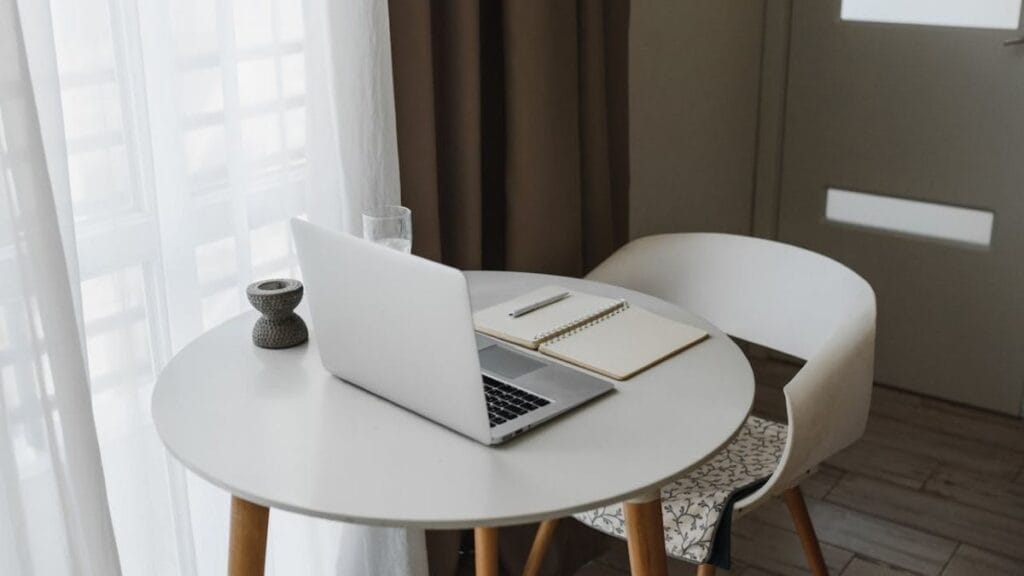
Reducing friction for positive habits looks like keeping your journal open on your desk so starting feels effortless, preparing your gym clothes the night before so the morning decision is already made, storing healthy snacks at eye level rather than behind other items, and keeping your workspace set up and ready so beginning work requires no preparatory effort. Increasing friction for habits you want to reduce looks like keeping your phone in another room during focused hours, putting the television remote in a drawer, storing snack foods out of sight, and removing social media apps from your home screen.
These small changes make good habits easier to start and maintain. Many positive habits become easier to maintain when supported by simple organization systems that reduce friction.
None of these changes require motivation in the moment. They require one deliberate act of design, after which the environment does the work.
What Clutter Actually Does to Your Brain
The impact of a cluttered environment on focus, mood, and decision-making is more significant than most people realize, and it is well documented. Clutter does not just take up physical space. It competes for cognitive attention.
Research from the Princeton University Neuroscience Institute found that multiple stimuli present in the visual field at the same time compete for neural representation in the brain, reducing the capacity for sustained attention and increasing cognitive load. A cluttered environment creates a constant, low-level demand on your attention that accumulates throughout the day, contributing to mental fatigue and reduced ability to focus on what matters.
The effects extend beyond focus. In a study of 60 dual-income couples published in Personality and Social Psychology Bulletin, people who described their homes as cluttered or unfinished had measurably higher cortisol levels throughout the day than those who described their homes as restful and restorative. The physical state of their space was directly reflected in their physiological stress levels, and those with higher stress profiles showed patterns associated with adverse health outcomes over time.
This does not mean your home needs to be perfectly minimal. It means it should feel intentional. When your surfaces are clear and everything has a place, your nervous system registers it as an environment under control. The mental quietness that follows is not aesthetic. It is physiological.
How Lighting Shapes Your Energy, Focus, and Sleep
Light is one of the most powerful and most underestimated environmental variables in your home, and its effects on behavior, mood, and sleep quality operate largely through your body’s circadian system.
Your circadian rhythm is a roughly 24-hour internal clock that regulates your sleep-wake cycle, hormone production, alertness, and mood. It is synchronized primarily through light. Research published in Nature’s npj Biological Timing and Sleep describes how light directly affects the circadian clock, which in turn regulates daily rhythms of biochemical and physiological processes that ultimately impact both mood and behavior. Bright, blue-enriched light in the morning and during daylight hours promotes alertness, supports circadian phase alignment, and is associated with better mood and sleep quality. Warm, dim light in the evening signals the brain to begin winding down and supports the natural rise of melatonin that prepares your body for sleep.
The practical implications for your home are direct. Dim environments during the day are associated with sluggishness and reduced motivation. Bright, cool lighting during working hours supports focus and energy. Exposure to blue-enriched light from screens and overhead lighting in the evening delays the circadian clock, reduces melatonin production, and makes it harder to fall asleep and wake feeling rested. Shifting your home lighting to match your intended activity, brighter and cooler during productive hours and warmer and dimmer as the evening progresses, is one of the most impactful and lowest-effort changes you can make to your daily environment.
Zones: Teaching Your Brain What to Do in Each Space
Your brain learns to associate spaces with activities. This association is part of what makes habits so automatic in familiar environments: the context itself becomes a cue. When you sit down at your desk, your brain shifts into work mode. When you lie on your bed, it shifts toward rest. When you walk into the kitchen, it shifts toward food.
The principle of spatial zoning uses this association deliberately. When you create a dedicated space for a specific activity, you strengthen the neural link between that context and the behavior, making it easier to enter the right mental state and harder to get distracted by competing behaviors in the same space. A reading corner, a clearly defined workspace, a dedicated area for movement: each of these creates a context signal that your brain learns to respond to with less deliberate effort over time.
You do not need a large home to apply this principle. Zones can be created through layout, lighting, or simple physical cues in even the smallest spaces. What matters is consistency: using the same space for the same activity, repeatedly, until the association becomes automatic. The space then does a portion of the motivational work for you.
Your Space Reflects and Reinforces Your Identity
There is a deeper layer to environmental design that goes beyond the mechanics of cues and friction. Your physical space also reflects, and continuously reinforces, the identity of the person who lives in it.
Research on identity-based habit formation shows that framing behaviors in terms of who you are rather than what you want to achieve increases long-term habit adherence significantly. Your environment can support or undermine that identity framing at every turn. A visible yoga mat is a quiet daily reminder that movement is part of your life. A well-organized bookshelf signals that learning is something you prioritize. A clean, prepared workspace signals that focused work is how you operate.
These are not trivial aesthetic choices. They are environmental statements about the person you are choosing to become. When your space is designed to reflect that person, the gap between who you currently are and who you are working toward narrows a little every time you walk into the room.
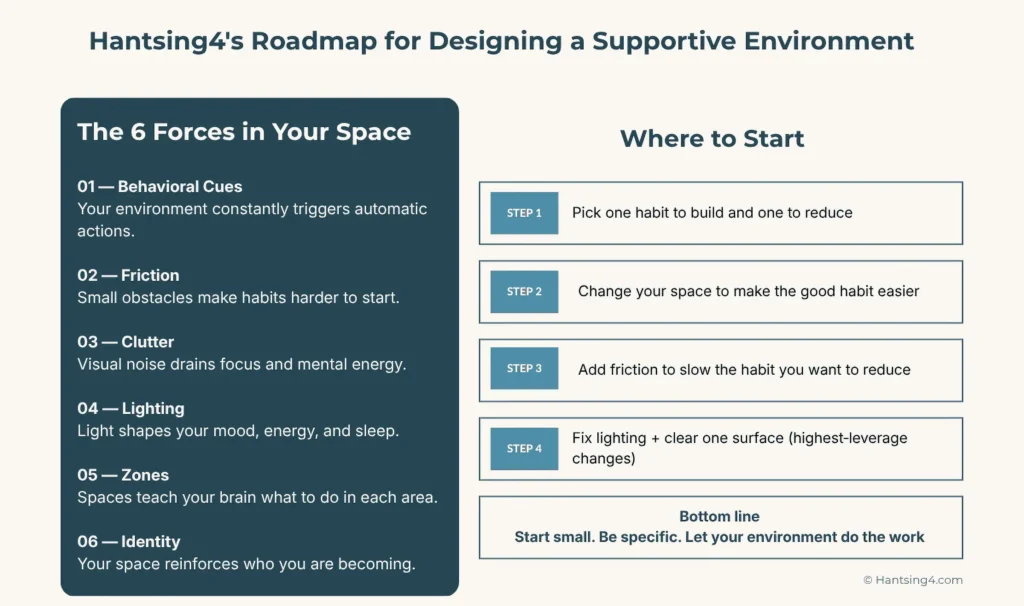
Our roadmap below puts together the concepts covered here in an easy-to-follow format.
Where to Start
You do not need a renovation or a minimalist overhaul to begin applying these principles. The most effective environmental changes are often small, specific, and immediately actionable.
Identify one habit you want to build and one you want to reduce. For the habit you want to build, ask what single change to your physical space would make it easier to start. For the habit you want to reduce, ask what change would add just enough inconvenience to slow the automatic reach. Make those two changes first, before anything else.
Then look at your lighting and your clutter. These are the two highest-leverage areas for most people, because they affect not just individual habits but the baseline quality of your focus, mood, and stress throughout the entire day. Clearing one surface and adjusting your evening lighting are both changes you can make today, and both will produce noticeable effects within a few days.
Start small. Be specific. Let the environment do the work that motivation cannot sustain on its own.
Bringing It All Together
Your physical space is always influencing you. The question is whether it is doing so by accident or by design. When your environment is shaped with intention, cues support the habits you want, friction works in your favor, lighting aligns with your natural rhythms, zones teach your brain how to focus, and your space reflects the person you are becoming. The result is not a perfect home. It is a more supportive one, a space that quietly and consistently makes the right behaviors easier and the default ones better.
That is what behavioral science has been demonstrating for decades. The most reliable path to lasting change does not run through willpower. It runs through your front door.
For a related perspective that strengthens this concept, explore Why Designing Your Environment Is More Powerful Than Relying on Motivation.