

Disclosure: This post may contain affiliate links, including Amazon links. As an Amazon Associate I earn from qualifying purchases. Commissions may be earned at no extra cost to you. Content is for informational purposes only and not professional advice.
Almost everyone has started a habit with genuine intention and watched it quietly disappear within a few weeks. You were motivated when you began. You knew why it mattered. You told yourself this time would be different. And then life got busy, or one day got skipped, and the whole thing unraveled.
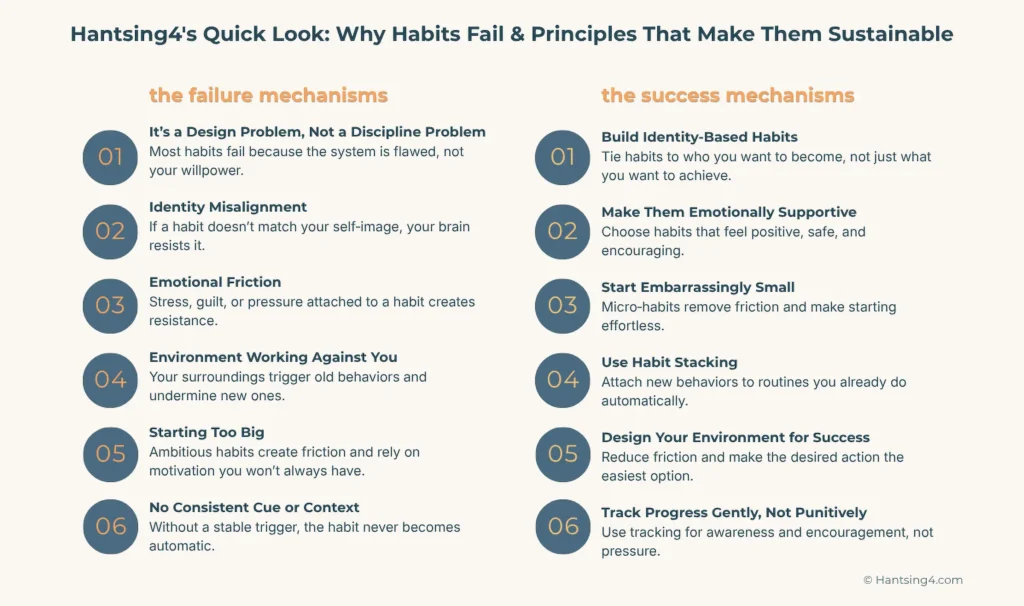
This is not a character flaw. It is not a discipline problem. It is a design problem.
Most habit advice focuses on the surface layer: do the habit, track the habit, stay consistent. What it rarely addresses are the deeper layers that actually determine whether a habit survives or collapses. The identity behind it. The emotional relationship with it. The environment that either supports it or quietly works against it. When these deeper layers are misaligned, even the simplest habit requires constant effort to maintain, and constant effort is not sustainable.
This post explores what the research actually says about why habits fail, and how to build habits that feel natural, sustainable, and genuinely rooted in who you are becoming.
Why Most Habits Fail Before They Start
The common explanation for habit failure is a lack of willpower or motivation. But the research points to something more structural. A 2024 systematic review of health behavior habit formation published in PMC Healthcare found that the development of new habits involves a gradual adjustment period where individuals must repeatedly engage in a behavior before it becomes automatic, and that frustration and diminished motivation during this adjustment phase are among the primary reasons habits collapse before they take hold.
In other words, most people abandon habits precisely during the window when the habit is still fragile and has not yet become self-sustaining. They interpret the effort required during early repetitions as evidence that the habit is not working, when in fact it is simply not yet automatic.
Understanding this shifts the entire approach. The goal in the early stages of habit formation is not to feel motivated. It is to get enough repetitions in a consistent context that the behavior begins to happen with less deliberate effort. That is what automaticity means, and it is what makes a habit genuinely sustainable rather than dependent on willpower that will eventually run out.
Identity: The Foundation Every Habit Rests On
Beneath every lasting habit is an identity that supports it. You do not maintain a habit through effort alone over the long term. You maintain it because it has become part of how you see yourself.
Research published in the Journal of Personality and Social Psychology found that framing habits in terms of identity rather than outcomes increased habit adherence by 32%. The shift is subtle but significant. Telling yourself you want to exercise more is an outcome-based frame. Telling yourself you are someone who moves their body regularly is an identity-based one. The first requires ongoing motivation to sustain. The second is self-reinforcing, because you act in alignment with who you believe yourself to be.
This is also why habits that conflict with your existing identity tend to fail regardless of how motivated you are at the start. If you hold a deep narrative that you are not a disciplined person, or that consistency is not something you are capable of, that narrative will eventually win. The more sustainable path is to begin building evidence for a different identity through small, repeated actions that gradually shift the story you carry about yourself.
The Emotional Layer Most People Skip
Habits do not exist in isolation from your emotional world. They interact with it constantly, and when a habit consistently triggers stress, shame, guilt, or a sense of pressure, your brain will build a resistance to it that no amount of motivation can fully overcome.
This emotional friction is one of the most common and least discussed reasons habits fail. A workout routine that feels punishing rather than supportive. A journaling practice that turns into a space for self-criticism. A nutrition habit that comes with guilt every time it is not perfectly maintained. Each of these creates a negative emotional association that your brain learns to avoid.
The adjustment is straightforward in principle, though it requires honest self-examination. Choose habits that feel supportive rather than punishing. Start small enough that the early repetitions do not feel overwhelming. Connect the habit to a genuinely positive feeling rather than a fear-based motivation. Remove guilt from missed days entirely, because research on habit formation consistently shows that the automaticity required for lasting habits develops through repeated positive reinforcement, not through self-criticism. When a habit feels emotionally safe, your brain embraces it rather than resisting it.
Why Environment Matters More Than Motivation
Motivation fluctuates. It rises and falls with your sleep, your stress, your mood, and the unpredictable demands of daily life. Your environment, by contrast, is relatively constant. It is influencing your behavior every day whether you notice it or not, and it is a far more reliable driver of habit than motivation will ever be.
Decades of psychological research summarized in a foundational paper in the British Journal of General Practice show that habits are formed through repeated actions in consistent contexts, and that once a behavior becomes associated with a contextual cue, it is triggered automatically upon encountering that cue, with far less reliance on conscious motivation. The context does the initiating. Your conscious mind just has to follow through.
What this means practically is that designing your environment for the habits you want is more effective than trying to motivate yourself into them. A cluttered workspace makes focus difficult. A kitchen that makes unhealthy options the easiest reach makes nutritional habits harder. A bedroom overloaded with screens disrupts sleep habits before you have made a single conscious decision. By contrast, an environment that makes your desired habit the path of least resistance removes the moment-to-moment battle entirely. Your surroundings should be doing the motivational work so you do not have to.

The Power of Micro-Habits
One of the most consistent findings in habit research is that people who start too ambitiously fail more often than those who start almost embarrassingly small. The impulse to make meaningful change through significant effort is understandable, but it creates the exact conditions where habits collapse: high friction, high cognitive demand, and a strong dependence on motivation that will not always be available.
Micro-habits remove this friction by making the initial behavior so small that starting it requires almost no effort at all. Two minutes of stretching. One page of reading. A single glass of water before coffee. Writing one sentence. The purpose of these tiny starting points is not the output itself. It is the repetition. Each repetition, however small, builds the neural pathway that will eventually make the behavior automatic, and each completion sends a small reinforcing signal that you are someone who does this thing.
Research tracking gym attendance across more than 12 million observations, published in the Proceedings of the National Academy of Sciences, found that it typically takes months rather than weeks to form the habit of going to the gym, but weeks to form simpler behavioral habits. Complexity and consistency both determine the timeline. Starting micro keeps the behavior simple and the consistency achievable, which is precisely the combination that allows automaticity to develop.
Habit Stacking: The Most Reliable Way to Build Consistency
One of the most research-supported strategies for establishing new habits is habit stacking: the practice of attaching a new behavior to an existing one that already happens automatically. The existing habit acts as a reliable cue, and the new behavior piggybacks on a neural pathway that the brain has already built and reinforced through years of repetition.
A large study published in the British Journal of Health Psychology found that performing a behavior consistently after an existing routine significantly increases the likelihood of it becoming automatic over time. The mechanism is cue-based learning: your brain builds habits by linking cues with actions through repetition. When the cue is already embedded in your day as an automatic behavior, the new habit has a stable anchor to attach to, and your brain does not need to create a new trigger from scratch.
The formula is simple: after I do this existing thing, I will do this new thing. After I make coffee, I will stretch for two minutes. After I brush my teeth, I will write one sentence in my journal. After I sit at my desk, I will take three slow breaths before opening my email. Each of these pairs a new behavior with a reliable daily anchor. The consistency of the anchor drives the consistency of the new habit.
Removing Friction: The Practical Side of Habit Design
Friction is anything that makes starting a habit harder than it needs to be. The more steps between you and the behavior, the less likely it is to happen consistently, regardless of how much you intend to do it. Removing friction is not about making habits effortless in the sense of requiring no effort. It is about removing the unnecessary resistance that stands between intention and action.
Prepare the environment the night before. Keep the tools for your habit visible and within reach. Simplify the habit to its smallest viable version. Remove the competing cues that draw your attention elsewhere. Each of these is a small act of environmental design that pays dividends every single day. When friction is low, consistency becomes significantly more natural, and consistency is the only thing that builds the automaticity that makes a habit genuinely lasting.
Tracking Progress Without Turning It Into Pressure
Habit tracking can be a genuinely useful tool for building consistency, but only when it is used to inform and encourage rather than to judge and pressure. The distinction matters more than most habit advice acknowledges.
Healthy tracking looks like noticing patterns in when your habit happens most reliably, celebrating the consistency you have built, identifying the friction points that make certain days harder, and adjusting the habit design when something is not working. Unhealthy tracking looks like accumulating guilt over missed days, treating streaks as a measure of personal worth, and applying the kind of pressure that turns a habit into a source of stress rather than a source of stability.
The research on positive reinforcement in habit formation is clear on this point: behavioral change studies consistently show that teams and individuals who celebrated habit milestones showed significantly higher habit maintenance rates than those who focused primarily on accountability and performance. Your tracking system should feel like a conversation with your own growth, not a performance review.
What Lasting Habits Actually Feel Like
When a habit is genuinely aligned with your identity, your emotional world, and your environment, the experience of maintaining it changes qualitatively. It stops feeling like something you are pushing yourself to do and starts feeling like something you simply do, a natural expression of who you are rather than an ongoing act of willpower.
The effort does not disappear entirely. Habits still require showing up, especially on the days when energy is low or life is demanding. But the quality of that showing up is different. There is no internal battle. There is no negotiation about whether today is the day. There is simply the cue, the behavior, and the quiet reinforcement of an identity that is growing more solid with each repetition.
That solidity is what lasting habits are actually building, beneath all the practical mechanics of cues and friction and stacking. They are building a more stable relationship between who you are and how you live. And that, in the end, is what makes any habit worth building.
Bringing It All Together
Habits fail not because of weakness but because of misalignment: between the habit and your identity, between the habit and your emotional experience of it, and between the habit and the environment designed to support it. When these layers are working together rather than against each other, consistency becomes far less dependent on motivation and far more the natural result of a well-designed system.
Start smaller than feels significant. Build on habits that already exist. Design your environment to remove the friction that stands between intention and action. Frame every habit in terms of who you are becoming, not just what you are trying to achieve. And treat missed days as design feedback rather than personal failure.
The habits that last are not the ones maintained through the most discipline. They are the ones that gradually stop requiring discipline at all.
To deepen your understanding of this topic, explore our guide on The Hidden Patterns That Shape Your Life: Understanding Your Inner Foundation and Identity Shifts: The Missing Ingredient in Personal Growth.