

Disclosure: This post may contain affiliate links, including Amazon links. As an Amazon Associate I earn from qualifying purchases. Commissions may be earned at no extra cost to you. Content is for informational purposes only and not professional advice.
Most people who want to change their lives focus on the outer layer first. New habits. Better routines. A different environment. And while all of those things matter, they rest on something deeper, a layer that rarely gets examined. Beneath your habits and routines lies a set of internal patterns, beliefs, narratives, and emotional defaults that have been shaping your behavior, often without your awareness, for most of your life.
Your inner foundation is not something you consciously built. It formed gradually through experience, repetition, and the stories you absorbed about yourself and the world around you. Some of those patterns serve you well. Others quietly work against the life you are trying to create. The ones you have not examined are the most powerful of all.
This post explores what the inner foundation is, how its hidden patterns operate, and what it actually takes to begin strengthening it from the inside out.
Why Your Inner Foundation Shapes Everything Else
Before any conscious decision gets made, your inner foundation has already been at work. It shapes how you interpret a situation, what emotions arise in response, and which actions feel possible or impossible given who you believe yourself to be. It is the operating system running underneath everything you do.
When your inner foundation is stable, life feels navigable. You recover from setbacks more quickly, make decisions with greater clarity, and maintain a sense of groundedness even when circumstances are difficult. When it is unstable or built on patterns that no longer serve you, even small challenges can feel disproportionately overwhelming. The problem is rarely the challenge itself. It is the lens through which the challenge is being processed.
Most people try to change their outer world without addressing the inner patterns driving their behavior. They change the routine but not the belief that makes consistency difficult. They set a new goal but not the internal narrative that undermines it. Real and lasting change tends to require both layers. The outer work and the inner work, not as separate projects, but as parts of the same system.
The Patterns You Live By Without Noticing
Your inner foundation is built largely on patterns that formed without deliberate intention. They were shaped by early experience, by the emotional environments you grew up in, by feedback you received, and by the conclusions you drew about yourself and your capabilities over time. By the time you reach adulthood, many of these patterns are so familiar that they feel like personality rather than programming.
The most common ones include your default reactions, which are the automatic ways you respond to stress, conflict, or uncertainty before conscious thought has a chance to engage. They include your internal narratives, the stories you carry about who you are, what you are capable of, and what you deserve. They include your emotional habits, the feelings you return to most reliably, whether that is worry, calm, frustration, or quiet confidence. They include your self-talk patterns, the tone and language you use when speaking to yourself, and your expectation patterns, what you unconsciously assume will happen before it does.
None of these are fixed. Research on neuroplasticity, the brain’s capacity to reorganize and form new neural connections throughout life, consistently shows that patterns embedded through experience can be reshaped through new experience, repeated practice, and intentional attention. Your patterns are not your personality. They are practiced responses. And practiced responses can be changed.
Awareness: The Starting Point for Everything
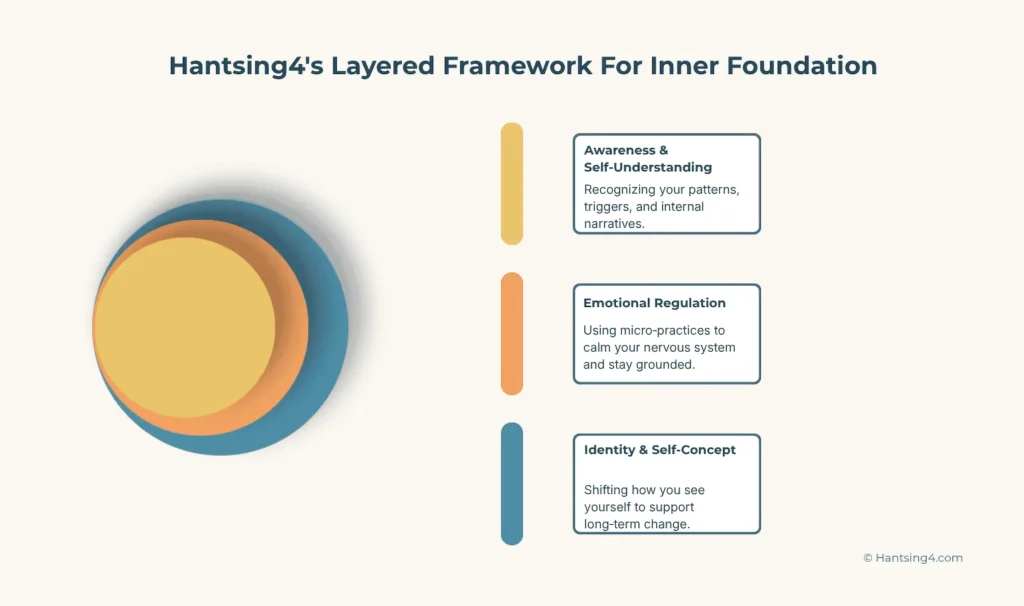
You cannot change what you do not notice. Awareness is not a soft or passive skill. It is the foundational act that makes every other form of inner work possible. Without it, patterns continue running on autopilot, quietly shaping behavior while remaining invisible to conscious examination.
Building awareness means learning to observe your internal experience without immediately judging, suppressing, or being swept away by it. It means noticing what triggers you, what drains your energy, what thoughts tend to repeat, and what emotional states show up most reliably in certain situations. It means watching the patterns rather than simply living inside them.
Research on affect labeling, the practice of putting emotions into words, consistently shows that naming what you are feeling reduces its intensity and creates a small but meaningful space between the emotion and your response to it. That space is where choice lives. Awareness does not resolve your patterns. It gives you access to them. And access is the prerequisite for change.
The Role of Identity in Your Inner Foundation
Of all the elements that make up your inner foundation, your sense of identity, how you see yourself and what you believe yourself to be capable of, is one of the most powerful. You act in alignment with who you believe you are, even when those beliefs are outdated, limiting, or simply inherited from a version of your life that no longer exists.
If you carry a narrative that you are someone who always gets overwhelmed, you will tend to interpret situations in ways that confirm that story. If you believe you are someone who cannot stay consistent, you will unconsciously create the conditions that reinforce that belief. The identity does not just reflect behavior. It generates it.
The encouraging finding from research on identity-based motivation is that this relationship runs in both directions. Framing behaviors in terms of identity rather than outcomes, thinking of yourself as someone who prioritizes their health rather than someone trying to lose weight, increased habit adherence by 32% in research published in the Journal of Personality and Social Psychology. Identity shifts do not happen through force or affirmation alone. They happen through evidence: small, repeated actions that gradually build a new and more accurate picture of who you are becoming.
How Your Environment Interacts With Your Inner World
Your inner foundation does not exist in isolation. It is in constant interaction with the physical and social environment around you. A cluttered, chaotic space tends to amplify internal disorganization. A calm, ordered environment tends to reinforce internal clarity. The people you spend regular time with either support or subtly undermine your sense of who you are and what you are capable of.
This is why inner work and environmental design are most effective when they happen together rather than separately. When your surroundings reflect the person you are working to become, the inner patterns that support that identity are reinforced consistently and passively, without requiring active effort every time. The environment does a portion of the work that willpower alone cannot sustain.
Your inner world shapes your outer world, and your outer world continuously shapes your inner world in return. They are not separate systems. They are two sides of the same one.
Building Emotional Stability Through Micro-Practices
Emotional stability is not the absence of difficult emotions. It is the capacity to experience them without losing your center. It is the ability to feel what arises and return to groundedness without being destabilized for longer than the situation genuinely warrants.
This capacity is built gradually, through small and repeated practices rather than through dramatic interventions. A three-second pause before reacting interrupts the automatic response and creates space for a more considered one. Naming the emotion you are experiencing, as the affect labeling research above describes, reduces its intensity. Slow, extended exhale breathing activates the parasympathetic nervous system and helps regulate the body’s stress response. Redirecting attention to something neutral or grounding when a thought spiral begins trains the mind in a skill that becomes more reliable with repetition.
Each of these practices is small individually. Their power comes from consistency. Over time, they train your nervous system to return to regulation more quickly and your mind to engage with difficulty more skillfully. That is not a philosophical aspiration. It is a measurable change in how your inner world functions.

Rewriting the Narratives That Hold You Back
Your internal narratives shape your reality more directly than most people realize. They influence what you believe is possible, what you attempt, and what you avoid. They are self-fulfilling not because of any mystical property but because they guide your attention, your interpretation of events, and the actions you take or decline to take.
Rewriting a narrative does not begin with replacing it wholesale with something more positive. It begins with identifying the current story clearly and honestly. What does the narrative say? When did it form? Is it still accurate, or is it a conclusion drawn from an earlier version of your life that no longer applies?
From there, the new narrative is built through evidence rather than assertion. Not “I am confident” declared in the absence of supporting experience, but “I handled that difficult conversation better than I expected to, and that matters.” Small wins, noticed and acknowledged deliberately, gradually shift the story your brain tells about who you are. As neuroplasticity research from ScienceDirect’s Awareness Integration Theory describes, self-awareness is instrumental in directing the brain’s capacity for change, guiding the formation of new neural pathways that support a more accurate and more functional self-concept.
Your brain believes the story it hears most often. The work is to make sure that story is one worth believing.
Strengthening Your Foundation Through Daily Alignment
One of the most consistent sources of inner stability is alignment: the felt sense that how you are spending your time and energy reflects what actually matters to you. When your actions and your values are pointing in the same direction, your inner world feels coherent. When they are not, a persistent low-level tension tends to follow, one that can be difficult to name but is hard to ignore.
Building alignment does not require a perfectly optimized life. It requires small, deliberate choices made consistently. Identify one or two values that feel genuinely central to who you want to be. Then choose one small action each day that reflects those values. Notice how it feels when your behavior is congruent with what you care about. Use that feeling as a signal and a reinforcement.
Alignment builds identity. Identity builds consistency. Consistency builds the inner foundation that makes everything else in your life more sustainable.
If you’re exploring this topic more seriously, you’ll appreciate the insights in Identity Shifts: The Missing Ingredient in Personal Growth.
What a Strong Inner Foundation Feels Like
When your inner foundation is genuinely strong, the change is noticeable but not dramatic. You do not become a different person. You become a more stable version of yourself.
Challenges feel more workable. Setbacks feel more temporary. Your emotional responses feel more proportionate and more recoverable. You make decisions with greater clarity because you are not navigating through the fog of unexamined beliefs and unresolved patterns. You feel more grounded, not because your circumstances are perfect, but because your relationship with your own inner world has become more honest, more intentional, and more stable.
That stability is not a destination you arrive at once. It is a quality you build, day by day, through awareness, practice, and the willingness to keep examining what is actually shaping your experience from the inside.
Bringing It All Together
Your inner foundation is the quiet architecture beneath everything you think, feel, and do. Most of it was built without your conscious participation. But all of it can be examined, and much of it can be reshaped with awareness, intention, and the kind of small, consistent practices that compound over time.
You do not need to overhaul your inner world to begin strengthening it. You need to start noticing the patterns. Name what you observe. Question the narratives that limit you. Build evidence for the ones that serve you better. Align your daily actions with the values that actually matter to you.
The outer work of building a good life is important. But it rests on the inner foundation. And when that foundation is strong, everything built on top of it becomes more durable, more sustainable, and more genuinely yours.
To see how this fits into a broader lifestyle strategy, explore our guides below:
Training for Inner Strength
The Energy Equation
The Support System Within
How to Build Emotional Resilience