
Disclosure: This post may contain affiliate links, including Amazon links. As an Amazon Associate I earn from qualifying purchases. Commissions may be earned at no extra cost to you. Content is for informational purposes only and not professional advice.
Most people approach change the same way. They wait until they feel ready. They look for a surge of motivation strong enough to carry them through. And for a day, sometimes a week, it works. Then life gets busy, energy dips, and the habit quietly disappears. The motivation faded, and without it, the behavior had nothing to stand on.
This is not a discipline problem. It is a design problem.
Why It Matters
The most reliable way to change your behavior over the long term is not to generate more willpower or wait for the right mood. It is to shape the environment around you so that the behaviors you want become the path of least resistance. When your surroundings are designed to support the life you are building, you stop fighting against your space and start being carried by it.
This post explores why environmental design works, what the research behind it says, and how to apply it practically across the spaces and systems that make up your daily life.
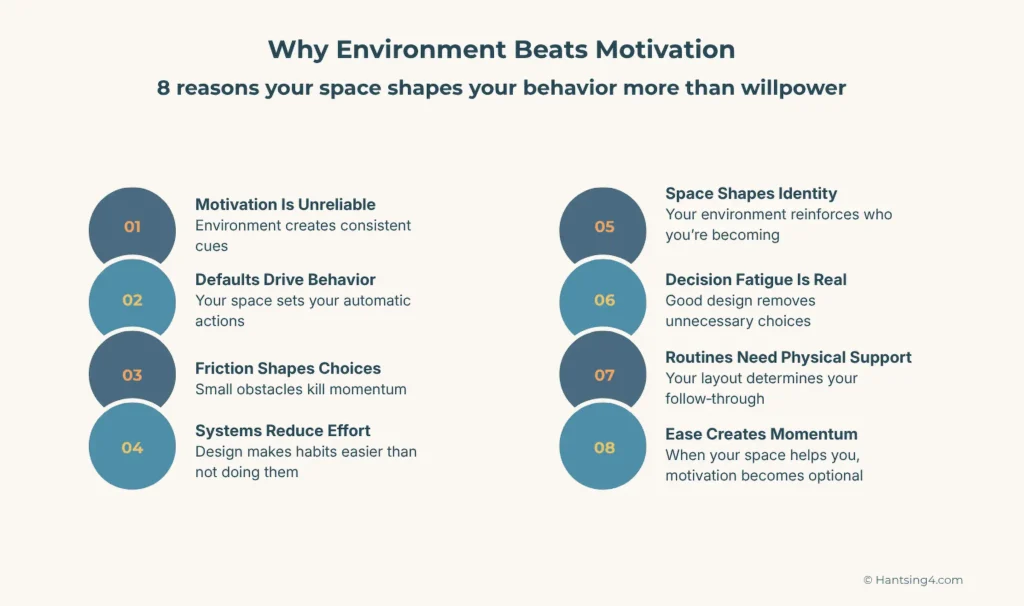
Motivation Is a Spark, Not a System
Motivation is valuable. It initiates things. It gives you the initial push that gets a new habit off the ground. But it is also inherently unstable. It rises and falls with your sleep quality, your stress levels, your mood, and the hundred small variables that make any given day feel easier or harder than the last.
Dr. BJ Fogg, founder of the Behavior Design Lab at Stanford University and author of Tiny Habits, has spent decades studying why behavior change succeeds and fails. His research makes a clarifying distinction: motivation fluctuates by nature, and designing habits that depend on consistently high motivation is a setup for inconsistency. The more reliable strategy is to reduce the ability required for a behavior, meaning to make it easier to do, so that even low-motivation days do not prevent it from happening.
Motivation is emotional. Environment is structural. And structure, applied consistently, outlasts emotion every time.
When your environment is designed intentionally, it naturally supports habits that stick without relying on willpower.
Your Environment Creates Default Behaviors
Every space you inhabit has built-in defaults, the actions that happen almost automatically because the environment is set up to make them easy. A couch positioned directly in front of a television makes watching television the default evening activity. A kitchen counter covered in snacks makes snacking the default response to mild hunger. A desk buried in clutter makes procrastination the default when concentration is required.
These defaults shape your behavior more reliably than motivation does, because they operate below the level of conscious decision-making. You are not choosing them deliberately. You are simply following the path your environment has already laid out.
This is the core insight of environmental design: when you change the defaults, you change the behavior. You do not need more willpower. You need a space that points in a different direction.
The Science of Friction and How It Shapes What You Do
In behavioral science, friction refers to anything that increases the difficulty of performing a behavior. The higher the friction, the less likely the behavior is to occur, regardless of how much you intend to do it. The lower the friction, the more naturally the behavior flows.
Research on habit formation consistently shows that environmental design works by structuring surroundings to facilitate desired behaviors while minimizing the resistance that prevents them. In practical terms, this means two complementary moves: reducing friction for the habits you want to build, and increasing friction for the habits you want to reduce.
Reducing friction looks like keeping your journal open on your desk so starting feels effortless, preparing your gym clothes the night before so the morning decision is already made, keeping healthy food at eye level in the refrigerator, or placing your book on your pillow so it is impossible to miss at bedtime. Increasing friction looks like keeping your phone in another room during focused work, storing snacks in a cabinet rather than on the counter, removing apps from your home screen, or placing the television remote in a drawer.
None of these changes require motivation in the moment. They require one deliberate act of design, and then the environment does the work for you.
This is why so many people find success when they build simple home systems that reduce friction and guide behavior automatically.

How Environment Shapes Identity, Not Just Habits
There is a deeper layer to environmental design that goes beyond the mechanics of friction. Your surroundings do not just influence what you do. Over time, they influence who you become.
Research published in the Journal of Personality and Social Psychology in 2024 found that framing habits in terms of identity rather than outcomes increased habit adherence by 32%. When a behavior becomes part of how you define yourself, the consistency required to maintain it shifts from effortful to natural. And your environment is one of the most powerful tools for reinforcing that identity, because it surrounds you with constant cues about who you are and how you live.
A reading corner signals that you are someone who reads. A clean, organized workspace signals that you are someone who works with focus. A visible yoga mat signals that movement is part of your day. These are not just aesthetic choices. They are quiet, constant reminders of the person you are choosing to become. When your environment reflects that person, your actions tend to follow with far less resistance.
Environmental Design and Decision Fatigue
Every decision you make throughout the day draws on the same finite pool of mental energy. The more decisions you face, the more depleted that resource becomes, and the lower the quality of the decisions that follow. This phenomenon, rooted in what psychologist Roy Baumeister described as ego depletion in his foundational research on self-control, has practical implications for anyone trying to build better habits in a demanding daily environment.
A cluttered, disorganized, or cue-rich environment multiplies the number of small decisions you face. Where did I put that? What should I do next? Should I check my phone? Each of these micro-decisions draws on the same resource that you need for the choices that actually matter. By the time you reach a decision about your habits in the evening, that resource may already be significantly depleted.
Designing your environment to reduce unnecessary decisions is a direct way to protect mental energy for the things that deserve it. A designated place for everything eliminates the daily search. A simplified wardrobe removes the morning outfit decision. A structured workspace routine removes the question of where to start. A meal plan removes the daily negotiation over what to eat. Each of these design choices is small individually. Collectively, they free up a meaningful amount of mental bandwidth and make consistent, intentional behavior significantly easier to sustain.
Creating Momentum When Motivation Is Absent
One of the most underappreciated qualities of a well-designed environment is that it creates momentum on the days when motivation has completely abandoned you. You do not need to feel inspired to follow a path that has been laid out clearly in front of you. You just need to begin, and your environment makes beginning easy.
Research on minimal viable habits found that people who started with small, environment-supported behaviors and scaled gradually were 2.7 times more likely to maintain those habits over the long term compared to those who began with ambitious targets relying on motivation to sustain them. The design does the heavy lifting. Motivation gets the credit, but the environment is what keeps things moving.
This is why people who have invested in deliberate environmental design often describe their habits as feeling effortless. The habits have not become effortless. The environment has simply removed most of the effort.
Practical Areas to Design
Environmental design is not a single project. It is an ongoing practice that applies across the different spaces and systems that shape your daily experience. A few of the highest-leverage areas to start with:
Your physical workspace is where focused work either happens or gets derailed. A clean surface, good lighting, and the removal of visual distractions are not aesthetic preferences. They are performance conditions. Design your workspace to make the work you want to do the obvious thing to do when you sit down.
Your home layout shapes the habits of your off-hours. Where you place equipment, food, books, and devices determines what you naturally gravitate toward in the spaces between obligations. A visible fruit bowl, a yoga mat in a clear space, a bookshelf in the main living area: each of these is a passive cue that nudges behavior without requiring a decision.
Your digital environment is increasingly where default behaviors live. The apps on your home screen, the notifications enabled on your phone, the tabs open in your browser: all of these create friction or reduce it for certain behaviors. Designing your digital space with the same intentionality you would bring to a physical room is one of the highest-leverage and most overlooked areas of environmental design.
Your social environment is also part of your design. The people you spend time with, the conversations you are regularly part of, the norms of the groups you belong to: all of these create ambient pressure that either supports or works against the behaviors you are trying to build. This is the hardest layer to design deliberately, but it is worth being honest about its influence.
The Shift From Fighting Your Space to Being Supported by It
Most people experience their environment as something neutral at best, and actively resistant at worst. They are trying to build new behaviors in spaces that were never designed to support them, and they interpret the friction as a personal failing rather than a design problem.
The shift that comes from intentional environmental design is not dramatic on any single day. It is cumulative. Over weeks and months, the small cues and reduced friction begin to compound. Habits that once required significant effort start to feel natural. The space begins to feel like it is working with you rather than against you.
That is the real promise of environmental design. Not a perfect life or a frictionless existence, but a daily environment that quietly and consistently points you in the direction you have chosen. You still have to show up. But the showing up becomes significantly easier when your space has been designed to make it so.
Bringing It All Together
Motivation will always have a role in change. It initiates, it energizes, and it can carry you through difficult moments. But it is not a system, and it cannot be the foundation of a sustainable life.
Your environment, designed with intention, is that foundation. It creates defaults that work in your favor, reduces the friction that derails good intentions, reinforces the identity you are building, and protects the mental energy you need for the decisions that matter. It does not replace your effort. It amplifies it.
The most effective thing you can do for the life you are trying to build is often not to try harder. It is to look around at the space you inhabit every day and ask honestly: is this environment designed to support the person I want to become?
If the answer is not yet, that is where the work begins. For a deeper look at how this plays out in daily life, take a moment to read Simple Home Organization Tips for Busy People and The Art of a Comfortable Home.