
Disclosure: This post may contain affiliate links. Commissions may be earned at no extra cost to you. Content is for informational purposes only and not professional advice.
In the field of instructional design, we recognize that the physical environment is a silent but powerful facilitator of learning. To optimize a learner’s cognitive baseline, we must look beyond digital tools toward our biological origins. This concept is known as Biophilia.
Biophilia is the hypothesis that humans possess a biological “hardwiring” developed through millennia of adaptive evolution. It suggests that our nervous systems are inherently programmed to respond positively to natural features because our ancestors relied on these cues for survival.
Biophilic Design is the applied practice of integrating these natural elements into the built environment to modulate our physiological response and enhance wellbeing.
5-Minute Version
- Biophilia explains why humans think and feel better in environments that resemble nature. Our nervous systems evolved outdoors, so natural materials, warm light, and greenery reduce stress and support clearer thinking.
- Research shows that nature‑aligned spaces improve productivity by six percent, creativity by fifteen percent, and wellbeing by fifteen percent. Natural wood lowers anxiety, plants reduce cognitive fatigue, and warm 3000K light lowers stress markers. These effects compound when used together.
- A learning space benefits from natural cues because they reduce cognitive load. Place your desk near a window, add a plant, use warm lighting, incorporate natural wood textures, and add soft textiles to improve acoustics. These small choices create a calmer baseline for sustained focus.
- A working environment needs both cognitive support and physical safety. Ergonomics is the foundation. Keep feet flat, thighs parallel, elbows near ninety degrees, and the monitor at eye level. Once the body is supported, layer biophilic elements like natural materials, warm light, greenery, and soft textiles to reduce stress and improve clarity.
- The cumulative effect is what matters. One plant or one warm bulb will not transform your day, but a space built from several natural cues and ergonomic fundamentals will. Biophilic design is a cognitive strategy that aligns your environment with your biological origins, helping you stay grounded, focused, and mentally clear in both learning and working contexts.
The Evolutionary Science Behind Better Thinking
Humans evolved in environments filled with natural light, organic textures, and diverse plant life. Our nervous systems were shaped by these surroundings long before modern buildings existed. Biophilia is the idea that our brains still respond positively to natural features because they once signaled safety, resources, and stability.
Biophilic design applies this biological insight to indoor spaces. It uses natural materials, warm light, and greenery to reduce physiological stress and support cognitive performance. This is not decoration. It is a way of aligning your environment with your evolutionary history so your mind can operate at a calmer baseline.
Research consistently shows that nature‑aligned environments improve productivity, creativity, and wellbeing. Natural wood reduces anxiety. Plants improve creativity. Warm light lowers stress markers. These effects are small individually but powerful when combined. A learning or working space built around natural cues creates a steady cognitive baseline that supports focus and deep work.
Why Your Learning Space Shapes Your Mind
Your surroundings act as a background processor for your brain. When a room is dominated by hard, reflective, synthetic materials, your nervous system receives no natural anchors. This increases cognitive load and makes sustained focus harder.
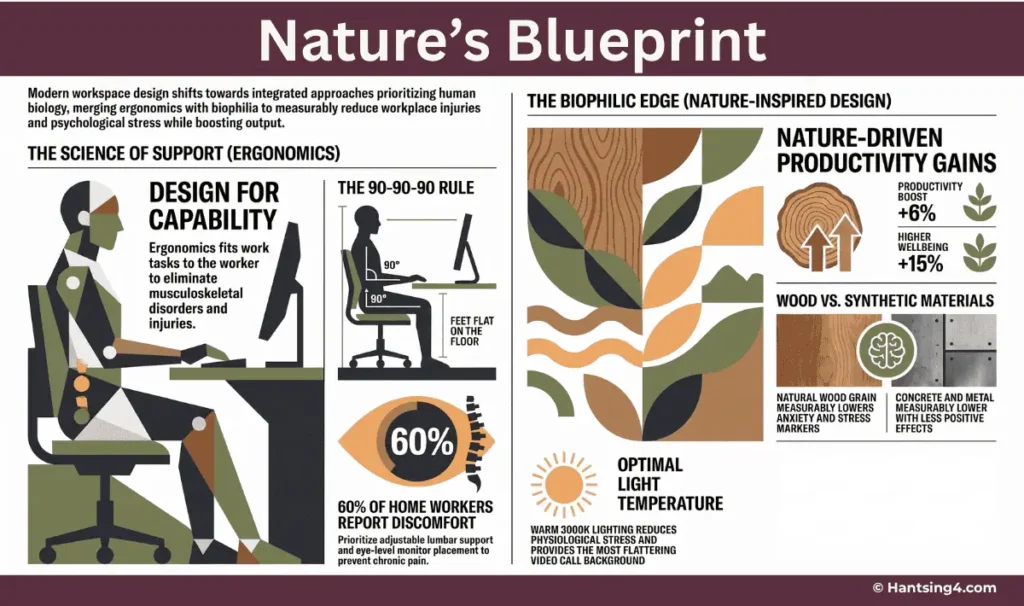
Studies from the University of Minnesota and Human Spaces show measurable improvements when natural elements are added to a workspace. Productivity increases by six percent. Creativity increases by fifteen percent. Overall well-being increases by fifteen percent. These gains come from reduced stress and improved cognitive clarity.
Material science reinforces this pattern. Natural wood produces the strongest calm‑emotion outcomes. Concrete and metal are linked to higher stress and reduced cognitive performance. Warm light around 3000K lowers physiological stress compared with cooler, blue‑toned light. These environmental choices shape your mental baseline before you even begin a task.
Nature on a Grand Scale: Famous Biophilic Landmarks
Biophilic principles are scalable from a single desk to massive architectural projects. The following landmarks demonstrate how high-level design can prioritize the inhabitant’s biological needs:
- Apple Park (Cupertino, California): This ring-shaped headquarters utilizes expansive glass to bring in natural light from all angles, while thousands of trees planted across the campus ensure that employees are never isolated from a view of the natural world.
- The Spheres (Seattle, Washington): Amazon’s unique workspace consists of three transparent greenhouses packed with a diverse array of plant life. This “tropical” environment is specifically intended to boost inventive thinking by breaking the sterility of traditional office design.
- Singapore: As the world’s first “biophilic city,” Singapore integrates water, wildlife, and vegetation into the very fabric of its urban infrastructure, including the eco-friendly PARKROYAL COLLECTION Pickering Hotel.
- Rolls Royce Headquarters (Chichester, England): This facility features one of the world’s largest green roofs. Beyond its aesthetic value, the thousands of square feet of native plant species provide essential functional biophilia by insulating the building and managing stormwater runoff.
While these are grand examples, the underlying logic that nature facilitates focus remains the prerequisite for any productive environment, starting with the most basic physical setup.

Applying Biophilia to a Learning Space
A learning space benefits from natural cues because they reduce cognitive fatigue and help the mind reset. You do not need a full redesign. You need a few deliberate choices that support your biology.
Place your desk near a window or add nature photography to create a visual connection to the outdoors. Add a plant or two to introduce organic texture and greenery. Swap cool lighting for warm bulbs around 3000K to reduce stress during long study sessions. Use natural wood textures for your desk or organizers. Add soft textiles like linen or wool to absorb sound and create a calmer acoustic environment.
These choices work together. They reduce stress, improve focus, and create a space that supports sustained learning.
Applying Biophilia to a Working Environment
A working environment needs both cognitive support and physical safety. Ergonomics is the foundation. If the body is uncomfortable, the brain cannot maintain deep focus. Roughly six in ten home‑based workers report musculoskeletal discomfort tied to their setup, which makes ergonomics a non‑negotiable baseline.
Follow established ergonomic fundamentals. Keep feet flat on the floor. Position thighs parallel to the ground. Maintain elbows near a ninety‑degree angle at the keyboard. Place the monitor at eye level and roughly an arm’s length away. These adjustments reduce strain on muscles, nerves, and joints.
Once the body is supported, layer biophilic elements to improve cognitive performance. Use natural wood for your desk or shelving. Add greenery to reduce stress. Choose warm lighting around 3000K for a calmer baseline. Use soft textiles to reduce echo and improve sound quality during calls. These choices create a workspace that supports both physical comfort and mental clarity.
The Cumulative Effect: Why This Works
Biophilic design works because it aligns your environment with your biological hardwiring. Natural materials, warm light, and greenery reduce stress and support cognitive performance. Ergonomics reduces physical strain and frees mental resources for deep work. Together, these elements create a steady baseline that supports learning, creativity, and focus.
This cumulative effect is the real advantage. A single plant or a single warm light bulb will not transform your day. A space built from several natural cues and ergonomic fundamentals will. It becomes a learning and working environment that supports your mind rather than competing with it.
Putting It All Together
A high‑performance environment is built on two pillars. Ergonomics supports the body. Biophilia supports the mind. When these elements work together, they create a space that reduces stress, improves focus, and enhances creativity.
This is not an aesthetic trend. It is a cognitive strategy. By aligning your environment with your biological origins, you move from a state of constant low‑grade stress to a baseline of clarity and calm. Whether you are studying, working, or creating, a biophilic environment helps you stay grounded and think more clearly.
If you are looking for a practical design approach that applies these biophilic principles to a home office, see the companion article: Warm Minimalist Home Office: Moving Beyond Cold, Sterile Workspaces.