
Disclosure: This post may contain affiliate links, including Amazon links. As an Amazon Associate I earn from qualifying purchases. Commissions may be earned at no extra cost to you. Content is for informational purposes only and not professional advice.
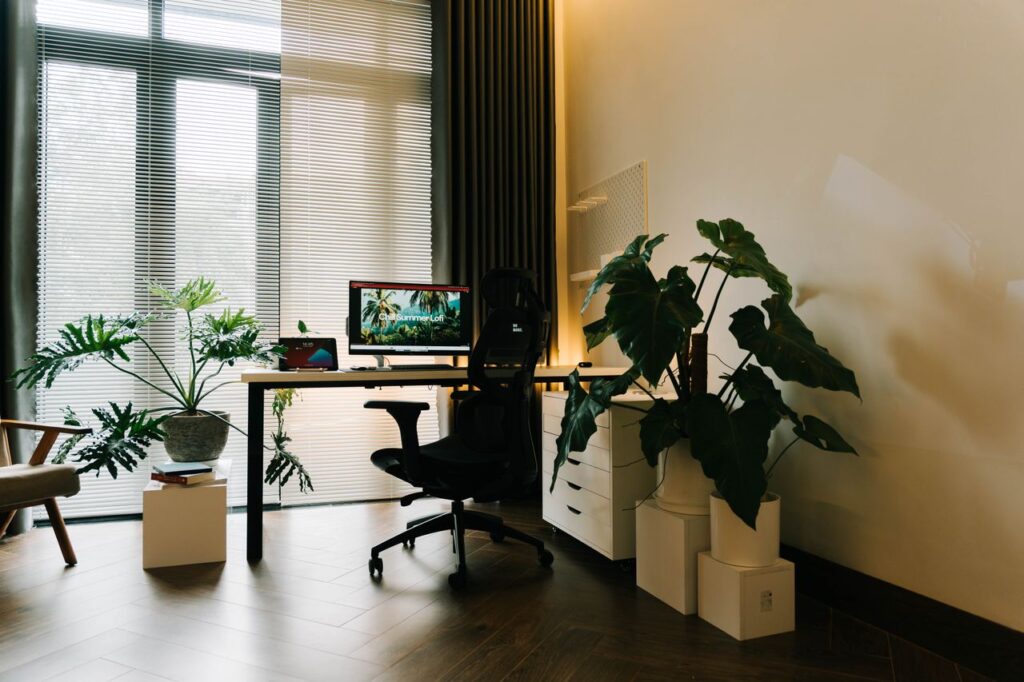
A lot of home offices still look like they were furnished from a spreadsheet: white laminate, brushed metal legs, a chair built for a call center floor. The warm minimalist home office is the correction to that instinct. It keeps a minimalist’s discipline about clutter, then rebuilds the material palette around wood grain, texture, and light that a body can actually settle into.
5-Minute Version
- Warm minimalism swaps stark white and metal for wood tones, texture, and soft light without losing a clean, uncluttered layout.
- Research links wood and natural materials to lower stress and better cognitive performance than concrete or metal interiors.
- Roughly six in ten home-based workers report musculoskeletal discomfort, so ergonomics has to stay the foundation, not an afterthought.
- Ergonomic chairs, desks, and monitor arms now come in fabrics and finishes built to disappear into a room’s design.
- Warm, dimmer lighting around 3000K is shown to lower physiological stress markers, and it also happens to be the most flattering light for video calls.
- The choices that make a space feel calming in person, wood tones, warm light, soft textures, are the same ones that make a strong video call background.
What Makes a Home Office Feel Warm and Minimalist Instead of Cold and Sterile?
A warm minimalist home office feels warm because it replaces hard, reflective materials with natural ones, and it stays minimalist because it never confuses more objects with more comfort. The two ideas used to feel like opposites. Minimalism got associated with all-white rooms and bare surfaces, while coziness got associated with clutter, layered textiles, and a dozen throw pillows. Warm minimalism keeps the restraint and drops the sterility.
Trend coverage heading into 2026 backs up what a lot of homeowners are already feeling in their own rooms. Industry reporting on 2026 home office design points to a clear move away from white laminate desks and metal frames toward finishes that feel more natural and calming, with wood, soft neutral walls, and textured fabrics becoming the standard rather than the upgrade.
The distinction that actually matters is between minimal and bare. A bare room has fewer things in it because nobody has finished furnishing it yet. A minimalist room has fewer things in it because someone made deliberate choices and stood by them, choosing one substantial wood desk over three mismatched pieces, one piece of art at scale instead of a gallery wall that never quite got hung. Warm minimalism applies that same discipline to material and light instead of just object count.
Part of why this shift is happening now, rather than five years ago, comes down to how permanent home offices have become. A desk set up as a temporary fix in 2020 was allowed to look temporary. A desk that has now hosted five years of meetings, deadlines, and video calls has earned a place in the home’s actual design, not just its function.
Why Does a Warm Minimalist Home Office Actually Feel Better to Work In?
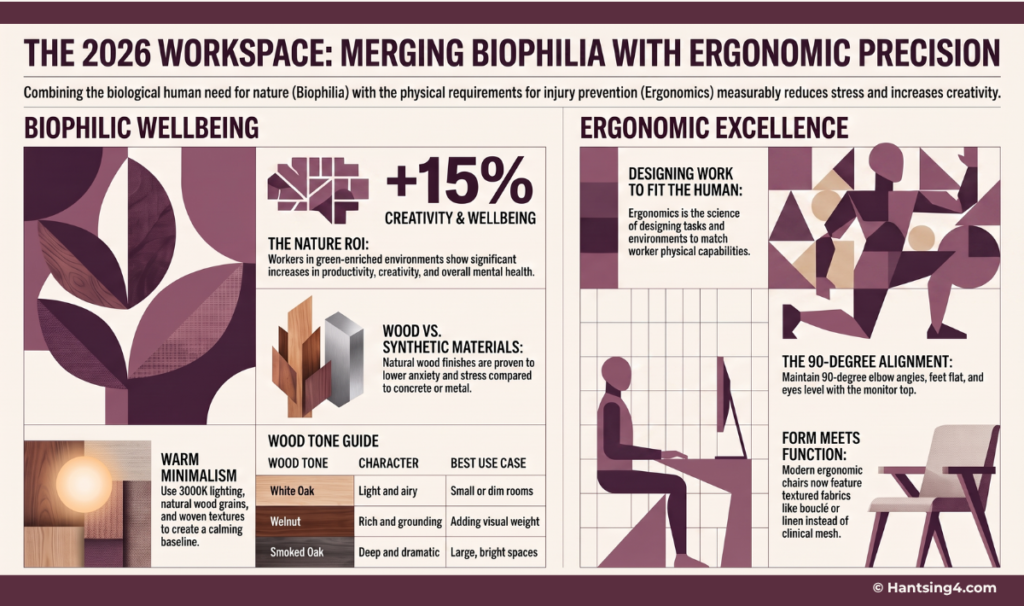
A warm minimalist home office feels better to work in because its materials and light are doing measurable work on the nervous system, not just setting a mood. Employees in workspaces with more natural elements and greenery report being 6 percent more productive, 15 percent more creative, and 15 percent higher in overall wellbeing compared with workers in more conventional office environments, according to research compiled by the University of Minnesota Landscape Arboretum.
Wood specifically carries its own effect. A randomized controlled trial comparing a wood-finished room with an otherwise identical room found that participants reported lower anxiety in the wooden room after completing the same stress-inducing cognitive tasks in both spaces. Related research comparing natural wood, processed wood, concrete, and metal found that natural wood produced the strongest cognitive and calm-emotion outcomes of any material tested, while concrete and metal were linked to reduced cognitive performance and higher stress.
Light temperature plays a similar role. Office lighting research measuring physiological stress markers found that warm, dimmed lighting around 3000K measurably reduced stress compared with brighter, cooler lighting, even though cooler light showed a slight edge for narrow, alertness-based tasks. For a home office used for deep work, meetings, and everything in between, warm light is the better default, with a brighter task lamp added for detail work when needed.
None of these effects are dramatic on their own. A single wood shelf will not transform a stressful week, and one warmer light bulb will not replace a real break. What the research points to is a cumulative effect: a room built from several natural, warm elements at once tends to produce a steadier baseline than a room with one nice feature surrounded by cold, hard surfaces. That compounding is the actual argument for treating warm minimalism as a full room strategy rather than a single decor upgrade.
Which Warm Wood Furniture Choices Fit a Minimalist Home Office?
Warm wood furniture fits a minimalist home office when it replaces multiple smaller pieces rather than joining them. One substantial desk in a wood with visible grain does more for the room than a desk plus a separate cart plus a side table, even though the second option often costs less upfront. Fewer, better pieces is the actual minimalist move, and it happens to be the one that reads as most intentional in photos and on video calls alike.
How Do You Avoid the Furniture Showroom Look?
Avoiding the showroom look comes down to mixing finishes instead of matching them exactly. A desk, shelf, and chair in the identical wood tone from the same collection can read as staged rather than lived in. Pairing one primary wood tone with a second material, black metal hardware, woven rattan, a leather chair seat, gives the room depth without adding clutter. Keep cable management, paper trays, and chargers out of sight in closed storage, since visible cords are one of the fastest ways to undercut an otherwise calm room.
Which Wood Tones Are Trending Right Now?
Three wood tones show up repeatedly in current home office design coverage: white oak, walnut, and smoked oak, each suited to a different kind of room.
| Wood Tone | Character | Pairs Well With |
|---|---|---|
| White oak | Light and airy, keeps small or dim rooms feeling open | Warm white walls, black hardware, linen textiles |
| Walnut | Rich and grounding, adds visual weight and contrast | Cream or warm white walls, brass accents, wool rugs |
| Smoked oak | Deep and dramatic, best in larger or brighter rooms | Warm neutrals, leather, matte black fixtures |
Smaller offices and corner setups generally do better with white oak or a similarly light finish, since dark wood in a small room without much natural light can start to feel heavy rather than warm. Larger rooms with good daylight can handle walnut or smoked oak without losing the airiness that keeps warm minimalism from tipping into a dark, cluttered study.
Solid wood and wood veneer over engineered cores also tend to outlast laminate furniture by years, which matters for a piece of furniture used daily rather than occasionally. Treating the desk as a long-term investment, the way a dining table gets treated, rather than a disposable purchase, tends to produce better material choices on its own.
Can an Ergonomic Office Setup Actually Look Good?
Yes, and ergonomics and aesthetics only feel like a trade-off when ergonomic hardware gets treated as equipment instead of furniture. This matters more than it might seem: roughly six in ten home-based workers report musculoskeletal discomfort tied to their setup, according to a peer-reviewed survey of home workers. Comfort here is a health outcome, not a style preference layered on top of one.
Federal occupational health guidance centers on a short list of fundamentals: feet flat on the floor, thighs roughly parallel to the ground, monitor at eye level and roughly an arm’s length away, and elbows near a 90-degree angle at the keyboard. None of that requires visible plastic adjustment levers or a chair that looks like it belongs in a hospital waiting room. It requires a chair, desk, and monitor arm with the right range of adjustment, styled in materials that match the rest of the room.
Chair, Desk, and Monitor: Where Style and Support Actually Meet
An office chair with proper lumbar support, adjustable seat depth, and armrest height no longer has to look like a mesh task chair. Upholstered options in boucle, linen, or leather now offer the same adjustability in a mid-back, less visually bulky silhouette that tucks under a desk instead of dominating the room. A desk with built-in height adjustment removes the need for a separate standing desk converter, which is one less object competing for space. A slim monitor arm in a matte or wood-toned finish holds the screen at eye level while keeping the desk surface clear, which does double duty for both ergonomics and the uncluttered look the room is going for.
- Choose a chair with adjustable lumbar support, seat depth, and armrest height, upholstered in a fabric that matches the room’s palette.
- Position the monitor an arm’s length away with the top of the screen at or slightly below eye level.
- Keep the desk surface clear by routing cables and chargers into closed storage or a cable tray underneath.
- Add a footrest only if the desk cannot lower enough for feet to sit flat on the floor.
Height-adjustable desks deserve a specific mention here, since they are one of the easiest places for a warm minimalist office to slip back into looking clinical. Many sit-stand frames still default to exposed metal legs and a laminate top, which undoes the material work happening everywhere else in the room. Look for frames finished in a matte neutral rather than bare steel, paired with a solid wood or wood veneer top, so switching between sitting and standing does not mean switching styles as well.
How Do You Design a Video Call Background That Matches This Look?
A video call background that matches a warm minimalist home office needs the same two things the room needs in person: warm, even light on the face, and a background with just enough texture to read as intentional rather than empty. A blank wall behind a webcam looks just as sterile on camera as a bare laminate desk looks in person, even if the rest of the room is warm and well designed.
Lighting is the bigger lever of the two. The same warm, roughly 3000K light that measurably lowers stress in person is also the most flattering light for video, since it avoids the flat, slightly blue cast that overhead fluorescents and cool LED panels tend to produce on camera. The main light source should sit in front of the face, not behind it, since a bright window or lamp behind the camera turns a face into a silhouette. Facing a desk toward a window, or adding a warm desk lamp at roughly eye level, solves most lighting problems without any extra equipment.
Behind the camera, one piece of wood shelving, a single framed piece of art, or a textured wall treatment gives the background enough visual interest without turning it into clutter. The goal is the same restraint used everywhere else in the room: one or two intentional elements, not a wall of objects competing for attention on a small video window.
Sound matters almost as much as light, even though it never shows up on camera directly. Hard surfaces like bare walls and uncovered floors let voices echo, while a rug, upholstered chair, and a few soft textiles absorb enough sound to make a voice sound clearer on the other end of the call. The same warm, textured materials chosen for how the room looks tend to be the ones that make it sound better too.
Putting It All Together
None of the individual pieces here are complicated on their own: a warmer wood tone, a chair that happens to be both supportive and upholstered well, a light bulb swapped for a warmer temperature. What makes warm minimalism different from a simple decor update is that every one of those choices is doing two jobs at once, shaping how the room looks and shaping how the body and mind respond to spending hours in it.
That double duty is also what separates this approach from either extreme it replaces. A sterile, all-white, metal-framed office optimizes for looking clean in photos while ignoring how draining it can feel to sit in for eight hours. A cluttered, maximalist home office optimizes for coziness while making it hard to focus or find anything. Warm minimalism asks a room to do both jobs without picking one over the other.
Start with whichever piece feels most out of place right now, a chair that has never been comfortable, a desk that photographs cold on every video call, a wall that has been blank since move-in, and build outward from there. A home office does not need a full renovation to stop feeling like a corporate leftover. It just needs a few deliberate, well-chosen changes.
If you are working through a larger reset of how your home supports the way you actually live and work, our guide to intentional home design covers how to align a space’s layout and choices with your broader goals, not just the room you start in.