
Disclosure: This post may contain affiliate links, including Amazon links. As an Amazon Associate I earn from qualifying purchases. Commissions may be earned at no extra cost to you. Content is for informational purposes only and not professional advice.
Editor's Update, July 2026: Google renamed NotebookLM to Gemini Notebook on July 16, 2026. It's the same tool with the same features under a new name, so every "NotebookLM" reference below still applies. Google has also released Gemini 3.1 Pro as its current flagship, succeeding the Gemini 3.0 Pro referenced throughout this piece.
The Death of the Tab Hopping Era
Modern professionals lose enormous cognitive energy to fragmented context silos. We jump between chatbots for synthesis, design tools for visuals, and automation platforms for workflows. Every switch requires reloading context, which creates subscription fatigue and slows down meaningful work.
The evolution of the Google Gemini ecosystem represents a fundamental shift. It is no longer a collection of isolated tools. It is a unified Human Intelligence System that acts as a virtual operations team. Research, grounding, reasoning, specialization, creativity, and execution now operate inside one connected environment. Instead of a scattered workday, Gemini creates a streamlined architecture where information flows across functions without friction.
This guide breaks down seven ways the ecosystem is transforming productivity and why it represents the end of the tab hopping era.
1. Context Engineering is the New Prompt Engineering
Early generative AI relied on prompt engineering. Success depended on crafting the perfect sentence. With Gemini 3.0 Pro, the bottleneck has shifted to context engineering.
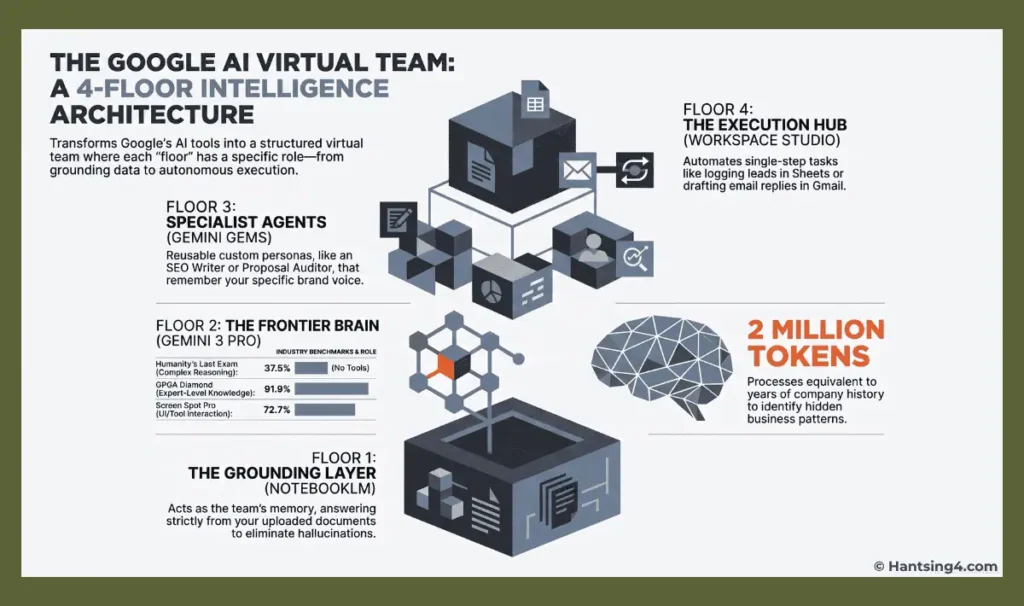
Gemini 3.0 Pro can hold roughly 1,500 pages of data in active memory. This allows you to load a decade of financial history or thousands of customer transcripts at once. Extended Thinking mode lets the model plan its reasoning before generating output. Instead of searching for a needle in a haystack, the model understands the entire harvesting season.
2. The Receipt for Truth: NotebookLM and Absolute Grounding
The greatest risk in AI is machine fog, where hallucinations undermine decision making. NotebookLM eliminates this by serving as the grounding layer.
NotebookLM is anchored strictly to your uploaded PDFs, URLs, and transcripts. Every claim includes a citation that shows the exact passage in the source. This creates a fact checked memory vault that reflects your proprietary data rather than generalized web training. With bidirectional sync between NotebookLM and Gemini, your research and exploratory chats finally share the same nervous system.
3. Organizing Behavior, Not Just Files: The Power of Gems
Traditional productivity systems organize files. The Gemini ecosystem organizes behavior.
Gems are custom personas that remember their roles, rules, and your brand voice across sessions. With Personal Intelligence enabled, Gems understand your history across Gmail, Drive, and Calendar. Linking a Gem to a NotebookLM notebook creates a specialist brain. A folder remembers where a file is. A Gem remembers who you are and how you think.
4. The Agent Mode Leap: From Transcription to Execution
We are entering the era where AI moves from junior assistant to autonomous mission control. This is the execution layer.
Gemini 3.0 Pro can reason through multi step workflows. Early proof of this appears in agentic development tools that plan, execute, and verify code. The same logic is expanding into general productivity. Gemini can analyze a hand drawn flowchart and identify logical gaps or missing conditions. It does not simply transcribe meetings. It identifies the gaps in the mission.
5. The Content Flywheel: Cross Functional Interoperability
The content flywheel demonstrates how the ecosystem maintains contextual continuity.
A single long form input, such as a video or report, can be transformed into a week of content. Workspace Studio drafts outputs directly into Gmail or Docs, eliminating manual transfers. The system handles drafting and filing while you maintain oversight.
Workspace Studio is a no code platform for single step automations. It cannot send emails automatically and it does not support batch processing. It is designed to augment human oversight, not replace it.
6. Studio Quality Creativity: Nano Banana Pro and Vids 3.1
The creative layer has reached studio quality.
Nano Banana Pro solves the historical problem of illegible AI text rendering. It produces 4K visuals with clean typography. Vids 3.1 introduces native audio generation where soundscapes synchronize perfectly with visuals. A scene in a cafe includes the hiss of an espresso machine and the clinking of cups. This eliminates manual foley work and creates cinematic consistency for product demos and promotional videos.
7. Dead Zone to Learning Zone: Interactive Audio Overviews
Retention requires moving information from focus mode to diffused mode. The ecosystem achieves this through interactive Audio Overviews.
This feature converts documents into a two host conversational audio experience. Unlike a static recording, you can interrupt the conversation to ask questions or redirect the topic. Commutes and downtime become high value learning sessions where you internalize long reports without touching a screen.
Conclusion: Mechanics vs Meaning
The Gemini ecosystem forms a complete Human Intelligence System structured across four functional layers: grounding with NotebookLM, exploration with Gemini Pro, specialization with Gems, and execution with Workspace Studio.
As this architecture takes over the mechanics of your workday, such as research, drafting, filing, and summarizing, a deeper question emerges. AI can manage the mechanical aspects of productivity, but it cannot provide meaning or the initial creative spark. When the mechanics are handled by a virtual operations team, you finally gain the space to focus on meaningful work.
Where to Go Next: Deep Dive Guides
This base post introduces the full ecosystem. The following three guides explore how the architecture applies to different domains.
Solopreneur Intelligence System
How to run a solo business using Google’s AI ecosystem.
Learning Intelligence System
How to master complex subjects using Gemini and NotebookLM.
Organizational Intelligence System
How to deploy specialist AI roles across teams and enterprises.