

Disclosure: This post may contain affiliate links, including Amazon links. As an Amazon Associate I earn from qualifying purchases. Commissions may be earned at no extra cost to you. Content is for informational purposes only and not professional advice.
The Three Forces Reshaping Modern Work
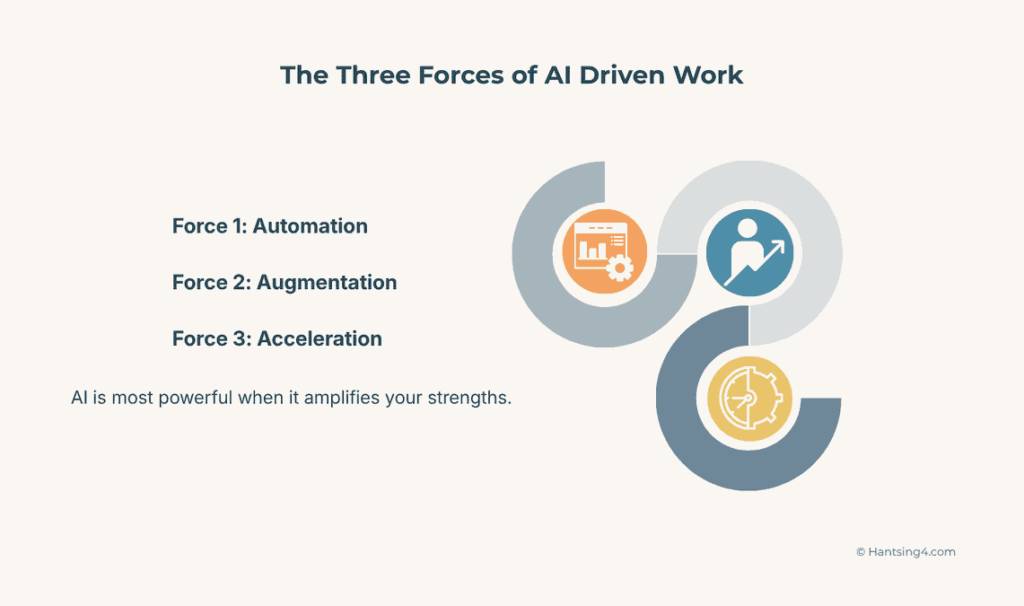
Artificial intelligence (AI) is changing work through three forces.
Automation removes repetitive tasks.
Augmentation enhances human capability.
Acceleration increases the speed of learning and execution.
When you understand these forces, you can use AI to amplify your value instead of competing with it.
Artificial intelligence has changed the way we work, learn, and solve problems. It has reshaped industries, accelerated workflows, and created new expectations for speed and efficiency. But the biggest misconception about AI is the idea that it will replace everyone. The truth is more nuanced. AI will not replace people who know how to use it. It will replace people who refuse to adapt.
Common Mistakes People Make With AI
- Avoiding AI because it feels overwhelming
- Using AI only for simple tasks instead of strategic work
- Relying on AI answers without developing judgment
- Treating AI as a shortcut instead of a skill
- Learning tools but not workflows
- Expecting AI to replace practice and expertise
- Waiting for perfect readiness before experimenting
Why This Matters
AI is not a threat to your career. The real threat is falling behind people who learn to use it effectively. AI multiplies the output of anyone who adopts it early. When you learn to work with AI instead of resisting it, you gain leverage, speed and adaptability in a world that rewards efficiency.
The real risk is not AI itself. The real risk is being outperformed by someone who uses AI as a tool to work faster, think clearer, and operate at a higher level. This post explores how AI is reshaping the workplace, what skills matter most, and how to stay relevant in a world where technology evolves quickly.
The Real Impact of AI on Work
AI is not a single technology. It is a collection of tools that automate tasks, analyze information, generate content, and support decision making. These tools are becoming more accessible every year. They are no longer limited to technical roles. They are used in writing, marketing, design, customer service, research, operations, and countless other fields.
AI impacts work in three major ways:
- it automates repetitive tasks
- it accelerates complex tasks
- it expands what individuals can accomplish
AI does not eliminate the need for human judgment. It enhances it.
AI removes friction from work. It handles the mechanical parts so you can focus on creativity, strategy, and problem solving.
Why AI Will Not Replace Everyone
AI is powerful, but it has limitations. It cannot replace human qualities such as creativity, empathy, leadership, critical thinking, and emotional intelligence. It cannot understand context the way humans do. It cannot build relationships or navigate complex social dynamics.
AI will not replace:
- people who adapt
- people who learn
- people who use tools effectively
- people who combine human skills with digital skills
- people who bring creativity and judgment to their work
AI is a multiplier, not a substitute. The people who thrive are the ones who use AI to amplify their strengths, not the ones who fear it.
Staying relevant in this new landscape requires building future‑proof skills that evolve with technology, not against it.
Why Someone Using AI Will Replace Those Who Do Not
The people who embrace AI gain a significant advantage. They work faster. They produce higher quality output. They solve problems more efficiently. They learn new skills quickly. They operate with more clarity and less friction.
Someone using AI can:
- write in minutes what used to take hours
- analyze data without specialized training
- generate ideas instantly
- automate repetitive tasks
- create content at scale
- improve accuracy and consistency
- make better decisions with more information
This creates a performance gap. The gap grows every year. The people who use AI will outperform those who do not.
This is not about talent. It is about leverage. AI gives people more leverage than any tool before it.
The Skills That Matter Most in the Age of AI
AI changes the tools we use, but it does not change the core skills that make people valuable. In fact, it makes these skills even more important.
The most important skills today include:
1. Critical Thinking
The ability to evaluate information, ask better questions, and make sound decisions.
2. Creativity
The ability to generate ideas, solve problems, and think in new ways.
3. Communication
The ability to express ideas clearly and collaborate effectively.
4. Adaptability
The ability to learn quickly and adjust to new tools and environments.
5. Digital Fluency
The ability to use modern tools confidently and efficiently.
AI enhances these skills. It does not replace them. AI can produce information, but it cannot decide what is meaningful. That is your job.
The New Definition of Being Skilled
In the past, being skilled meant knowing how to do something manually. Today, being skilled means knowing how to combine your abilities with the right tools.
A skilled professional today is someone who can:
- use AI to accelerate their work
- understand which tasks to automate
- apply judgment to AI generated output
- integrate technology into their workflow
- stay updated with new tools and methods
Skill is no longer about memorization. It is about integration. Your value increases when you know how to use tools that increase your output.

How to Stay Relevant in the Age of AI
Staying relevant is not about learning everything. It is about learning strategically. It is about building a set of skills and habits that help you adapt continuously.
Here is a practical approach:
1. Learn the Basics of AI Tools
You do not need to be an expert. You only need to understand how to use AI for your work.
2. Build a Habit of Continuous Learning
Spend a few minutes each week exploring new tools or techniques.
3. Focus on High Value Skills
Invest in skills that AI cannot replace, such as creativity, communication, and leadership.
4. Automate Repetitive Tasks
Use AI to free up time for higher value work.
5. Stay Curious About New Technologies
Curiosity keeps you adaptable and open to change.
6. Combine Human Skills With Digital Tools
This combination creates the highest level of leverage.
Relevance is not about perfection. It is about progress. Small, consistent learning habits compound over time. That is how you stay ahead.
The Importance of Digital Fluency
Digital fluency is the ability to use modern tools with confidence. It is not about being technical. It is about being comfortable with technology.
Digital fluency includes:
- understanding how AI tools work
- knowing how to use them in your workflow
- being able to learn new tools quickly
- staying aware of emerging trends
- using technology to solve problems
Digital fluency is the new literacy. In the same way reading once transformed society, digital fluency is becoming the baseline skill of the modern workplace.
The people who thrive with AI are the ones who build a strong modern career stack that compounds over time.
How AI Improves Your Work Instead of Replacing It
AI does not take away your value. It amplifies it. It helps you:
- work faster
- reduce errors
- generate ideas
- improve quality
- stay organized
- make better decisions
- focus on meaningful work
AI handles the repetitive parts. You handle the human parts. The combination of human insight and machine efficiency is far more powerful than either one alone.
The People Who Thrive in the AI Era
The people who thrive are not the ones who know the most. They are the ones who learn the fastest. They are the ones who stay curious, open minded, and adaptable.
They share common traits:
- they experiment with new tools
- they embrace change
- they focus on growth
- they combine creativity with technology
- they build systems that support their work
- they stay ahead by learning continuously
These people do not fear AI. They use it.
The Future of Work Is Human Plus AI
The future of work is not humans versus AI. It is humans working with AI. It is a partnership. It is a combination of human judgment and machine efficiency.
The most valuable professionals will be those who know how to:
- use AI to enhance their strengths
- delegate tasks to technology
- focus on creativity and strategy
- integrate tools into their workflow
- stay adaptable as technology evolves
The future belongs to people who combine human skills with digital leverage.
What Staying Relevant Feels Like
When you embrace AI and adapt to the new workplace, you feel:
- more confident
- more capable
- more efficient
- more creative
- more adaptable
- more in control of your career
You stop fearing change. You start benefiting from it.
Bringing It All Together
AI will not replace you. But someone using AI will. The people who thrive in the new digital workplace are the ones who combine human skills with modern tools. They learn continuously. They adapt quickly. They use AI to amplify their strengths and reduce their weaknesses.
The future of work is not about competing with technology. It is about collaborating with it. When you embrace AI as a partner, you create more opportunity, more capability, and more freedom in your career.
The world is changing. Your ability to adapt is your greatest advantage.
Here is the core idea of this post in one place.
Quick Summary
AI will not replace you but, someone using AI will outperform you. AI multiplies your speed, creativity, and problem solving when you use it intentionally. The goal is not to compete with AI but to combine your expertise with its capabilities to create leverage that others cannot match.
To deepen your understanding of this topic, explore my guides below:
Skill Stacking: The Modern Shortcut to Digital Leverage
Learning in the Age of AI
The Digital Toolkit