

Disclosure: This post may contain affiliate links. Commissions may be earned at no extra cost to you. Content is for informational purposes only and not professional advice.
A client forwards a screenshot claiming a competitor got fined by the FTC, or a fellow freelancer posts that a tool you rely on is shutting down next month, and you have about ninety seconds to decide whether to react. Knowing how to spot misinformation online is less about memorizing a list of red flags and more about having a habit you can run under time pressure, especially when you are the only person checking your own work before it goes out.
5-Minute Version
- Misinformation spreads without intent to deceive. Disinformation is created specifically to manipulate. The distinction changes how you should respond to it.
- Your brain defaults to fast, emotional “System 1” thinking under time pressure, which is exactly when false claims slip past your usual judgment.
- A 2024 study of 1,479 people found that simply learning about confirmation bias measurably reduced how often participants fell for fake news, with the strongest effect among people who started out most skeptical.
- Research modeling how misinformation spreads found most people who share false claims are not being deliberately dishonest. Roughly 30 percent fall into a “passive receiver” group who simply lack the tools to evaluate what they are seeing.
- The Stop, Check, Decide framework below takes under two minutes and gives you four legitimate outcomes, including “treat as unverified,” which is often the most useful answer for a business decision.
- Realist guardrail: free tools like fact-checking sites and reverse image search only work once you already suspect a claim. They will not flag something for you automatically, so the habit matters more than any single tool.
What Is the Difference Between Misinformation and Disinformation?
Misinformation is false or misleading content spread without any intent to deceive, usually through error, an outdated repost, or a misread statistic. Disinformation is the same kind of false content, but it is created and distributed specifically to manipulate or mislead, which includes coordinated campaigns and AI-generated deepfakes. As one UNICEF guide to spotting misinformation explains, disinformation covers more than fabricated news stories. It also includes propaganda and content designed by brands or accounts to sell something under false pretenses.
The distinction matters practically, not just academically. If a claim turns out to be misinformation, correcting it is usually a matter of pointing to better information. If it is disinformation, the source has a reason to keep the false narrative alive, and a single correction is unlikely to settle the matter. Knowing which one you are dealing with changes how much effort a correction is worth and whether you should expect pushback.
Why Does Your Brain Accept False Information Before You Notice?
Your brain runs on two different modes of thinking, and misinformation is built to exploit the faster one. Researchers describe this as a conflict between “System 1,” which is fast, intuitive, and emotion-driven, and “System 2,” which is slower and more deliberate. A recent academic review in AI & Society notes that under time pressure and information overload, people default to System 1 processing, which weakens critical scrutiny and allows misinformation to spread before anyone stops to check it.
A handful of specific mental shortcuts do most of the damage. Confirmation bias makes you less critical of claims that already match what you believe, so you share them without verifying. Authority bias means a professional-looking graphic or a verified badge can make a source feel credible even without evidence behind it. The bandwagon effect treats high engagement, likes and shares, as proof that something is true. The illusory truth effect means repetition alone makes a false claim feel more accurate over time, simply because it has become familiar.
There is genuinely good news buried in this research. A 2024 study published in Frontiers in Public Health tested whether simply explaining confirmation bias to people would change their behavior. Among 1,479 participants, the group who received a short explanation of confirmation bias became measurably less susceptible to fake news than the group who did not, and the effect was strongest among people who started out most resistant to the topic being tested. Awareness alone will not fix everything, but it is not nothing either.
Who Actually Spreads Misinformation? The Data May Surprise You
Most people who share false claims are not doing it on purpose. A 2025 study in AI & Society interviewed and surveyed participants to map out distinct profiles of how people engage with misinformation, and the largest group by far was not made up of bad actors. It is worth knowing where you might fall on this spectrum, because the fix is different depending on the category.
| Profile | Approximate share | What drives it |
|---|---|---|
| Passive receiver | ~30% | Low media literacy and information overload, not intent |
| Blind follower | ~20% | Instinctive sharing based on headlines and social momentum |
| Emotional adopter | ~20% | Prioritizes how a claim feels over whether it is accurate |
| Trusting follower | ~10% | Defers to a specific authority figure over independent checking |
| Skeptical adopter | ~10% | Questions content generally but yields when it matches existing beliefs |
| Social echo-chamber member | ~5% | Rarely encounters dissenting views to begin with |
| Debunker | ~5% | Treats verification as a habit and actively checks before sharing |
Notice that the “debunker” group, the people who consistently check before they share, is also the smallest one identified in the research. That is a useful reframe: building a verification habit is not the default behavior for most people, including capable, intelligent people. It is a skill you build on purpose, not one you pick up automatically by being careful in general.
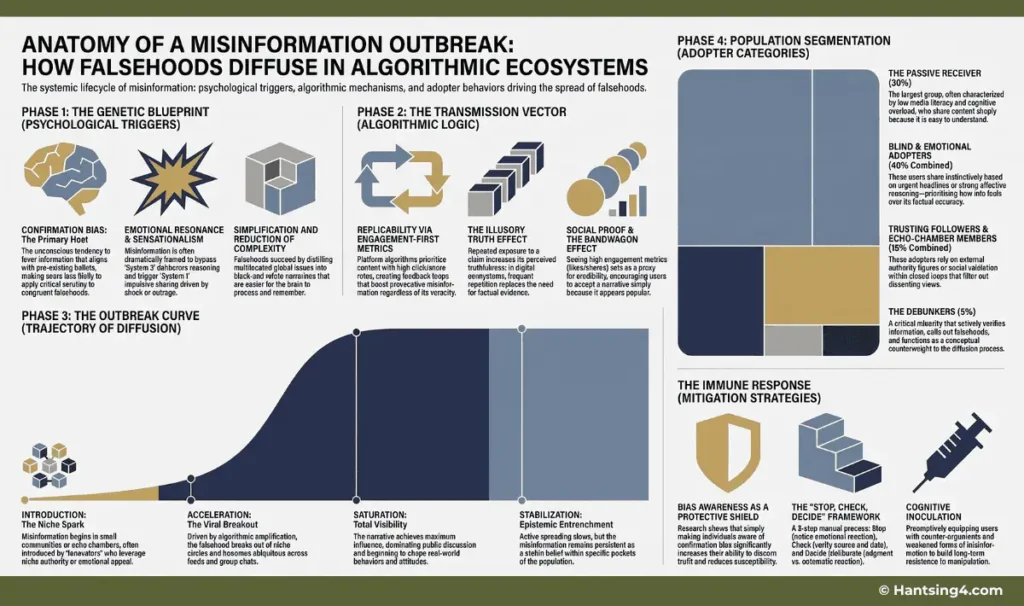
What Is the Stop, Check, Decide Framework?
Stop, Check, Decide is a three-step habit for evaluating a claim before you act on it, share it, or let it influence a business decision. Each step takes seconds, and the whole process usually finishes in under two minutes for a typical social media claim.
Step 1: Stop
Misinformation is built to trigger urgency, outrage, or fear, and that emotional jolt is your signal to pause before doing anything else. A simple technique called affect labeling, literally naming the emotion you are feeling (“I am annoyed right now” or “this scared me”), reduces the intensity of the reaction and gives your slower, analytical thinking a chance to catch up.
Step 2: Check
Run through a short checklist adapted from library and journalism research on evaluating sources. Cornell University’s library guide to evaluating news recommends checking the source itself, reading past the headline, verifying the author is real and credible, checking whether supporting links actually support the claim, and confirming the date since old stories often resurface as if they were current. Add one more step for anything visual: a reverse image search through Google Images takes under a minute and quickly reveals whether a photo has been reused from an unrelated event.
Step 3: Decide
Choose one of four outcomes, and treat all four as valid. You can believe the claim if it is sourced and corroborated. You can hold it as unverified, meaning it is interesting but not yet proven, which is a legitimate stopping point rather than a failure to reach a conclusion. You can set it aside for deeper research later if it matters enough to revisit. Or you can deny it your share, recognizing it as manipulative or false and declining to give it the reach that fuels its spread.
Realist guardrail: fact-checking sites like Snopes and FactCheck.org are free and require no account, but they mostly cover claims that have already gone viral at scale. A rumor specific to your industry, your local market, or a small professional circle is unlikely to show up there, so corroborating across two or three independent sources matters more than relying on any single fact-checking tool.
What Does This Look Like on the Platforms You Actually Use?
The Stop, Check, Decide framework applies everywhere, but the specific red flags shift depending on where the claim shows up.
| Platform type | Common red flag | What is really happening |
|---|---|---|
| Social media | Viral posts with no links, personal stories presented as universal fact | Algorithms prioritize what is provocative, not what is accurate |
| Messaging apps | Forwarded messages with no traceable origin | You trust the sender, and that trust transfers to the content without scrutiny |
| Video platforms | Dramatic thumbnails, storytelling in place of verifiable data | Watching one extreme video signals the system to recommend more like it |
The messaging app pattern is worth calling out specifically, because it is easy to miss. A message forwarded by a colleague or family member feels credible because you trust the person, but that trust says nothing about whether the information itself is accurate. Separating your trust in the sender from your evaluation of the content is a small mental shift that prevents a lot of unnecessary sharing.
Why Does This Matter More When You Are the Only One Running Your Business?
Solo business owners carry a risk that larger companies do not, because there is no separation between the business and the person running it. According to Entrepreneur’s reporting on misinformation risk for small business owners, a small business generally cannot distance itself from an owner’s mistake the way a larger organization might, which means reputational damage, poor decisions based on bad market data, and lost customers all land more directly and more permanently.
It is also worth being honest about the limits of simply being informed. Research summarized by MIT Sloan found that digital literacy improved people’s ability to judge whether a headline was accurate, but it did not reliably predict whether those same people shared true information more often than false information. Knowing the theory and consistently applying it under time pressure are two different skills, which is exactly why a concrete framework like Stop, Check, Decide is more useful than a general commitment to “being more careful.”
Realist guardrail on time-to-value: this will not feel automatic in the first week. Expect the Stop, Check, Decide sequence to feel slow and deliberate for the first several times you use it. Most people report it starting to feel like a reflex after two to three weeks of consciously applying it before sharing or acting on anything time-sensitive.
Making Verification Part of How You Work
None of this requires new software, a subscription, or a technical setup. The entire framework runs on a habit you build over a few weeks of deliberate practice: notice the emotional pull, run a short check, and choose one of four honest outcomes instead of defaulting to share or ignore.
What changes is not how much information you consume, but how much of it you act on without a pause first. For a solo business owner, that pause is inexpensive. It costs a minute or two. The alternative, correcting a false claim you shared with clients or building a decision around a rumor that turned out to be wrong, costs considerably more in both time and trust.
Start small. Pick one platform where you spend the most time and apply Stop, Check, Decide there for two weeks before expanding it everywhere else. The habit compounds faster than it feels like it will.
If you are looking to build this kind of practical evaluation habit into how you choose tools as well as information, our guide on “How to Avoid Scams and Unrealistic Expectations About Online Income” and “How to Avoid Being Psychologically Influenced by Online Content” covers a similar checklist approach for vetting online income claims before you commit your time or budget.