

Disclosure: This post may contain affiliate links, including Amazon links. As an Amazon Associate I earn from qualifying purchases. Commissions may be earned at no extra cost to you. Content is for informational purposes only and not professional advice.
The internet genuinely has created more earning opportunities than any previous generation had access to. Freelancing, content creation, digital products, consulting, affiliate marketing, and dozens of other models are real, and people do build meaningful income from them. That part is true.
What is also true is that the same environment that makes these opportunities accessible has made it extremely easy to exploit people who are looking for them. The noise around online income is loud, emotionally charged, and deliberately designed to cloud judgment. Sorting the real from the fraudulent, and the genuinely possible from the wildly exaggerated, requires a kind of informed skepticism that most people are never taught.
This guide is about building that clarity. Not cynicism, not blanket distrust, but the ability to look at any opportunity and evaluate it honestly.
The Scale of the Problem
Before getting into how scams work, it helps to understand how significant the problem actually is, because it is far larger than most people realize.
According to the Federal Trade Commission, consumers reported losing $12.5 billion to fraud in 2024, a 25 percent increase over 2023, with investment and business opportunity scams accounting for more than $6 billion of that total. One of the fastest-growing subcategories is online job and income scams, where reported losses jumped from $90 million in 2020 to $501 million by 2024, with the number of reports tripling in that same period. These figures represent only what was formally reported. The FTC estimates that the vast majority of fraud victims never file a complaint, which means the actual scale is considerably larger.
The people falling for these scams are not naive or unsophisticated. They are often educated, financially stressed, and genuinely trying to build something better. That matters, because it means the solution is not to become more generally suspicious. It is to become more specifically informed.
Why Scams Work: The Psychology Behind the Pitch
Online income scams do not succeed because they are technically convincing. They succeed because they are psychologically precise. Understanding how they work is one of the most effective defenses available.
Every effective scam targets a real human need: the need for financial security, the desire for more control over your time, the hope of building something that compounds. Those needs are legitimate. Scammers do not invent them. They find them and amplify them.
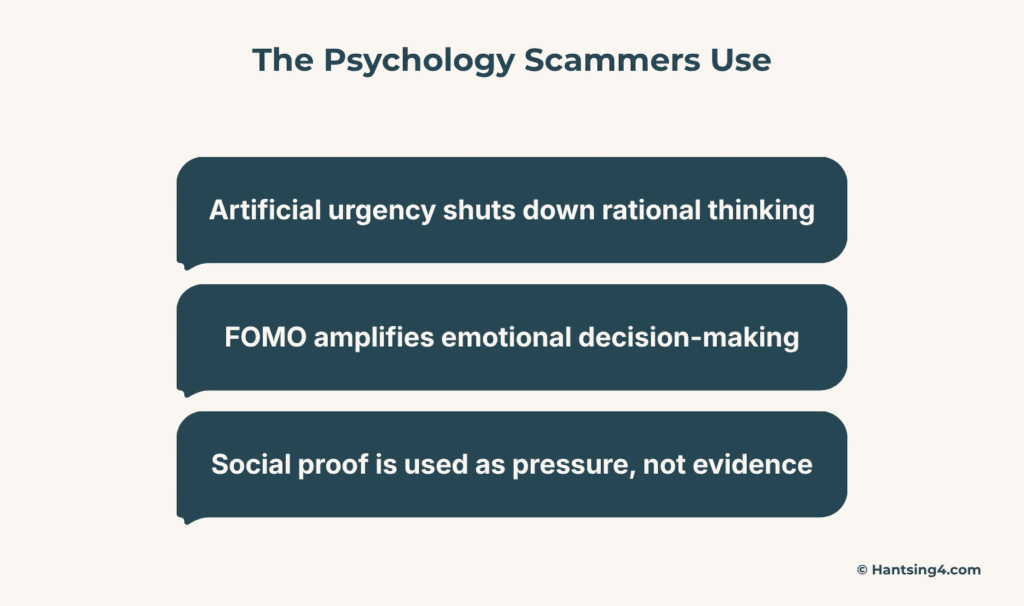
The most commonly used mechanism is artificial urgency. Research on fraud psychology has found that scammers deliberately create time pressure to shut down the prefrontal cortex, the part of the brain responsible for rational evaluation, triggering a fight-or-flight response that prioritizes action over analysis. Phrases like “limited spots available,” “this offer closes tonight,” and “only for the next 24 hours” are not sales tactics borrowed from legitimate marketing. They are precision tools for bypassing the part of your mind that would otherwise ask the obvious questions.
Closely related is the exploitation of FOMO, the fear of missing out. When you see apparent evidence that others are already succeeding at something, the psychological pressure to participate before it is too late becomes surprisingly strong, even in people who consider themselves rational. This is why testimonials, income screenshots, and follower counts feature so prominently in scam marketing. They are not proof. They are social pressure dressed up as evidence.
The solution to both of these tactics is the same: slow down. Any legitimate opportunity can withstand being evaluated calmly over a day or two. If something is being presented in a way that makes deliberation feel costly, that presentation itself is the red flag.
The Difference Between a Scam and an Unrealistic Promise
Not everything that disappoints is a scam. This distinction is worth making clearly, because conflating the two leads to either excessive cynicism or insufficient caution.
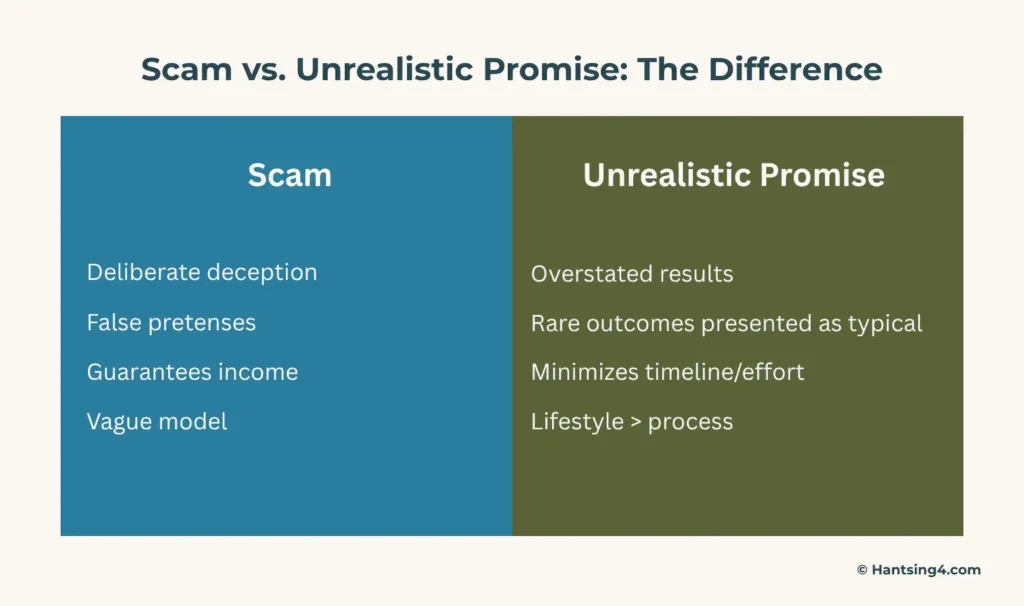
A scam is a deliberate deception designed to take your money or personal information under false pretenses. A get-rich-quick course that genuinely believes its own claims but vastly overstates the results most students will achieve is not the same thing, even though it can cause similar harm. Both are worth avoiding, but for slightly different reasons and through slightly different thinking.
The clearest markers of an outright scam are: a business model that cannot be explained clearly, income claims with no verifiable basis, pressure to act immediately, requests for upfront payment before any value is delivered, and guarantees of specific returns. Legitimate businesses do not guarantee income. They cannot, because income depends on effort, skill, market conditions, and a dozen other variables that no seller controls.
Unrealistic promises, short of fraud, tend to look a little different. They emphasize the lifestyle outcome rather than the process required to reach it. They show the exception, the person who made six figures in their first year, while implying that this outcome is representative rather than rare. They omit or minimize the timeline, the skills required, the number of attempts that failed before the ones that worked, and the ongoing effort needed to maintain results once achieved.
A useful question to ask of any income opportunity is this: can the person presenting it explain clearly how money is made, what is required of you, and what a realistic timeline looks like for someone starting from where you are? If the answers are vague, heavily qualified, or redirect to lifestyle imagery rather than process, that is informative.

What Legitimate Digital Income Actually Looks Like
Separating scam from reality requires having an accurate picture of what the real version looks like. That picture is worth building, because it becomes the reference point against which everything else gets measured.
Every legitimate online income model is built on at least one of three foundations: a skill that creates value for others, an audience that trusts your judgment in a specific area, or a product, physical or digital, that solves a real problem. None of these foundations can be skipped, bought instantly, or substituted with enthusiasm. They take time to build, and that timeline is measured in months to years, not days to weeks.
Freelancing and service work tend to be the most accessible entry points because they translate existing skills directly into income. A designer, writer, developer, or strategist can find clients and earn within a relatively short period if they have demonstrable ability. The ceiling is real but the floor is reachable.
Content-based models, things like newsletters, YouTube channels, podcasts, and social media, typically require a longer runway. Building an audience that trusts you enough to act on your recommendations takes consistent output over an extended period, and the income often arrives slowly and then all at once rather than linearly. Most creators who appear to be overnight successes have been publishing for years.
Digital products and courses can generate significant leverage once they exist, but they require both an audience and genuine expertise to sell honestly. The common scam pattern in this space is someone selling a course about how to sell courses before they have built any real business outside of that loop.
None of this is discouraging if understood correctly. It is clarifying. When you know what a real path looks like, you can walk it deliberately rather than spending energy chasing something that was never real.
A Practical Framework for Evaluating Any Opportunity
When you encounter an income opportunity and want to evaluate it honestly, a handful of questions tend to surface the truth efficiently.
- Start with the business model. How does money actually change hands in this system? Who pays, for what, and why? If this cannot be explained in plain language, that gap is meaningful. Every real business has a clear answer.
- Ask about the effort-to-outcome ratio. What does the person or company say is required of you in terms of time, skill, and money, and does that match the results they are promising? If they promise substantial passive income with minimal effort and no existing skills, you are looking at either a misrepresentation or an oversimplification significant enough to treat as one.
- Look for transparency about failure. Legitimate educators and operators in any field will tell you what goes wrong, what most people get wrong, and how long things typically take. This is not pessimism. It is the information that helps you succeed. Scams and hype avoid it because it dampens the emotional response they depend on.
- Check the timeline framing. Weeks and months are very different in digital income. A business that is genuinely compounding over two or three years can look like nothing is happening for the first six months. Anyone suggesting substantial results in days or weeks for a business model that requires audience-building, skill development, or market positioning is describing something other than reality.
Finally, trust the discomfort of being rushed. Urgency is a signal, not a feature. If you feel pressure to decide before you have had time to think, that pressure is being applied deliberately.
The Role of Patience and Realistic Timelines
The single most common reason people fall for online income scams is not that they are uninformed about business. It is that they underestimate how long real things take to build, and that gap between expectation and reality makes shortcuts feel necessary.
Every legitimate model has a compounding quality: skills deepen, audiences grow, systems become more efficient, reputation accumulates. The early phase of this process feels slow because it is slow. The inputs are real and the outputs are not yet visible. Most people quit in this phase, which is partly why the people who persist appear to succeed disproportionately.
This is not a motivational observation. It is a structural one. If you enter any digital income model expecting visible returns in the first month, you will either be disappointed by a legitimate path or susceptible to a fraudulent one that promises what you were hoping for. Setting a realistic timeline, and understanding why that timeline is what it is, is one of the most protective things you can do.
How to Protect Yourself Going Forward
The practical protection against scams and unrealistic promises comes down to a few durable habits.
Understand the model before evaluating the marketing. Every income opportunity is based on a business model. Learn the model first, how it works, what it requires, what it realistically produces, and then assess whether the specific opportunity aligns with that reality.
Slow down any decision that is being accelerated by urgency. Real opportunities do not expire in 24 hours. The urgency is manufactured. Taking an extra day to think costs nothing if the opportunity is real, and it saves you from significant harm if it is not.
Look for specificity over stories. Testimonials and screenshots are easy to fabricate and easy to selectively curate. Specific explanations of process, transparent disclosure of typical results, and honest discussion of what does not work are harder to fake and more useful to you.
Search before you spend. A few minutes looking up the name of any program or person alongside terms like “review,” “complaints,” or “results” often surfaces the information that the sales page strategically omits. The FTC’s consumer resources at ftc.gov/scams maintain an updated reference for recognized scam patterns worth bookmarking.
None of this makes digital income complicated. It makes it honest. And honest is where real results come from.
Quick Takeaway On Protection Against Online Income Scams and Unrealistic Promises
- Understand the model before the marketing
- Slow down decisions
- Look for specifics, not stories
- Search before you spend
- Bookmark FTC scam resources
If you’re exploring this topic more seriously, you’ll appreciate the insights in Digital Leverage: How Technology Expands Your Opportunities, Income, and Impact and Digital Assets vs. Digital Labor: How to Build Online Income That Scales Beyond Your Time.
If you are looking to build this kind of practical evaluation habit into how you choose tools as well as information, How to Spot Misinformation Online: A Framework for Business Owners for safeguarding against online misinformation.