

Disclosure: This post may contain affiliate links, including Amazon links. As an Amazon Associate I earn from qualifying purchases. Commissions may be earned at no extra cost to you. Content is for informational purposes only and not professional advice.
There is a version of your life that you are actively building, and there is a version that is simply happening to you. Most people spend far more time in the second category than they realize. Not because they lack ambition or care, but because the default settings of a busy modern life are powerful, and changing them requires something more deliberate than good intentions.
Life design is the practice of stepping back far enough to see those defaults clearly and then making conscious choices about which ones to keep. It does not require a dramatic overhaul or a sabbatical or a move across the country. The changes that tend to create the biggest shifts are often surprisingly small. They are about clarity, intention, and the slow accumulation of choices that gradually redirect the whole arc of how you live.
This guide explores the life design changes that carry the most leverage, and why they work.
The Autopilot Problem
Before getting into specific changes, it helps to understand what you are actually working against.
A 2025 study published in Psychology and Health tracked 105 people across a week using real-time phone prompts and found that roughly 65 percent of daily behaviors were initiated by habit rather than conscious decision-making, with nearly 90 percent carried out at least partly on autopilot. Most of what you do each day, the route you take, the way you spend your mornings, the things you reach for when you have a free moment, was not chosen. It was inherited from repetition.
This is not inherently bad. Habits are efficient, and the same study found that the majority of automatic behaviors actually aligned with what people consciously wanted to do. But when the habits running your days were never deliberately chosen, and when the life they are building is not quite the one you want, efficiency becomes a trap. You get very good at living a life you never fully designed.
The encouraging side of this research is the flip side of the same coin: because daily life is so habit-driven, intentional changes to your routines and environment have an outsized effect. You do not have to constantly fight your own behavior. You just have to set better defaults.
Clarify Your Values First
Every other change in this guide is downstream of this one. Values are the foundation that makes the rest of it coherent. Without them, lifestyle design is just rearranging the furniture.
Values, in practical terms, are not abstract ideals. They are the qualities you want to embody in the way you actually live, the things you want to prioritize when everything is competing for your attention. Research published in a multi-study paper on value clarity found that having a clear sense of your personal values was a strong predictor of wellbeing measured one and two months later, holding up independently of baseline wellbeing levels. Clarity about what matters is not just philosophically useful. It has measurable effects on how you feel.
The practical starting point is simple. Ask yourself what you want your life to feel like, not just what you want to have or achieve. Ask what you want to protect, what you want more of, and what you are currently tolerating that you would not consciously choose. You do not need a formal exercise to answer these questions. You need honesty and some quiet time.
Values also change. What mattered to you five years ago may not be what matters now, and that is not inconsistency. It is growth. Revisiting your values periodically, perhaps once or twice a year, keeps your life design current rather than built around a version of yourself you have already moved past.
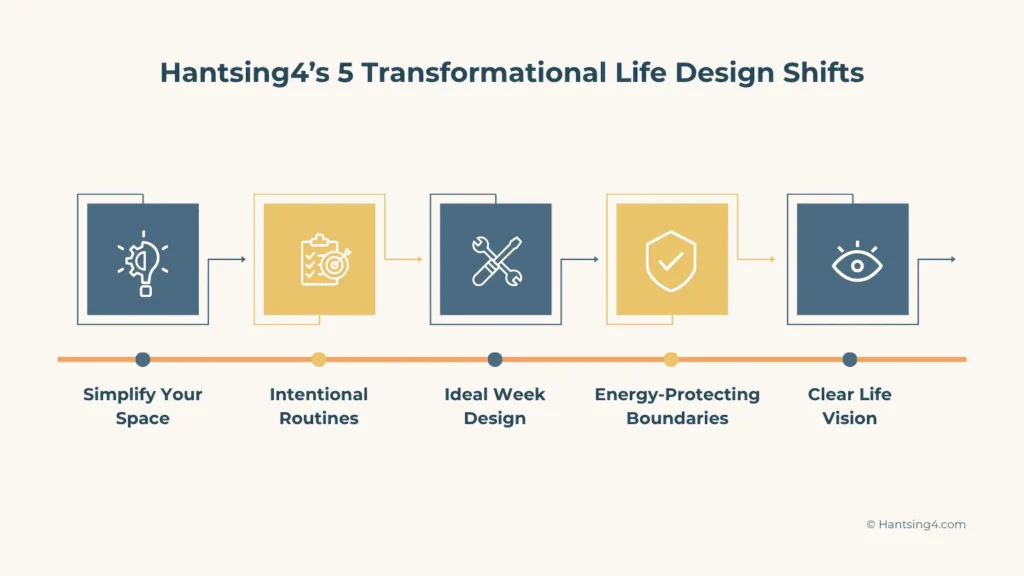
Simplify Your Environment
Your environment is doing more work on your behavior than you probably give it credit for. The things around you shape your mood, your habits, and the micro-decisions you make dozens of times each day. A cluttered, visually noisy space is not just an aesthetic problem. It is a behavioral one.
The principle here is not minimalism for its own sake. It is about removing friction from the life you want to live and adding friction to the patterns you want to change. If your space is calm and organized, moving through it feels easier. If your environment is set up to support the habits you care about, those habits require less willpower to maintain.
Start with one surface, one drawer, one corner. The goal of the first pass is not transformation. It is to experience the difference that a small patch of order makes, and to use that as a reference point for the rest. Simplifying your environment is also worth extending into the digital realm: fewer notifications, cleaner inboxes, and more intentional time with screens all reduce the ambient noise that pulls attention away from what you have decided matters.
Build Intentional Routines
Routines are the infrastructure of a designed life. They translate values and intentions into daily behavior, quietly, without requiring a fresh decision every time.
The key insight from habit research is that behavior change works best when it is engineered into the environment rather than left to motivation. Behavioral scientists describe the most effective approach as designing reliable cues in stable contexts, essentially making the right behavior the automatic one. A morning routine that grounds you before the day accelerates. An evening routine that creates genuine transition between work and rest. A weekly planning session that keeps the bigger picture visible. These are not rigid schedules. They are supportive rhythms that make your days feel more intentional without requiring constant effort to maintain.
The routines worth building are the ones that protect what matters most to you. If connection is a value, a routine that creates space for real conversation matters more than one that optimizes for productivity. If creative work is central to your sense of purpose, protecting time for it before the day fills up is a structural decision, not just a scheduling preference.
Start with one routine, preferably in the morning. A consistent start to the day has a stabilizing effect on everything that follows. Keep it simple enough to do on difficult days, not just ideal ones. The value of a routine is in its reliability, not its elaborateness.
Design Your Ideal Week
Most people plan day by day, reacting to what is already on the calendar and fitting everything else around it. Designing your ideal week is a different approach entirely. It means zooming out, deciding in advance what balance of work, rest, connection, creativity, and personal time you actually want, and then using that as a template to plan from rather than react to.
Research on intentional calendar design has found that people who proactively structure their weeks make meaningfully faster progress on high-priority work and report lower stress compared to those who work reactively. The mechanism is straightforward: when you have already decided what your week should look like, you are defending a plan rather than constantly making it up as you go.
Your ideal week does not need to be achievable every week. It functions as an aspiration and a diagnostic. When your actual week looks very different from your ideal one, that gap tells you something useful. Either your priorities have shifted, your commitments have crept, or something needs to change.
Map out the categories that matter to you: focused work, rest, relationships, physical movement, learning, whatever reflects your values. Assign them rough time in the week before filling in the specifics. The structure you create is not a constraint. It is a scaffold that makes the life you want more likely to actually happen.

Create Boundaries That Protect Your Energy
Boundaries get discussed primarily as an interpersonal skill, a way to manage relationships. But at the life design level, they are something more fundamental: a mechanism for protecting the time and energy that your values and routines require.
A boundary is not a wall. It is a decision made in advance about what you will and will not do, so you do not have to make that decision fresh every time under pressure. Protecting your mornings for the work that matters most. Limiting the hours in which you are reachable. Saying no to commitments that feel neutral at best and draining at worst. These are not acts of selfishness. They are acts of clarity.
The most impactful boundaries tend to be the ones around time, because time is the resource that all your other priorities depend on. If you do not deliberately protect time for what matters, it will be filled by what is merely urgent. That filling happens gradually and invisibly, and by the time you notice, the patterns are already established.
Start by identifying where your time and energy consistently go that does not align with your values. Not everything there is a problem, but some of it will be. Naming those patterns clearly is the first step toward changing them.
Keep a Vision of Where You Are Heading
Life design is not only about improving the present. It also involves having some sense of direction, a picture of what you are moving toward, even if the details are incomplete.
A life vision does not need to be a five-year plan with milestones and metrics. It can be as simple as a clear answer to the question: what do I want my life to feel like in a year, and what kind of person do I want to be by then? The purpose of a vision is not to predict the future. It is to give your daily choices a direction to point in.
Without some version of this, it is easy to make a lot of changes that individually seem reasonable but do not add up to anything coherent. Values give you the why. The ideal week gives you the structure. A vision gives you the orientation. Together, they create the conditions for a life that feels like it belongs to you.
Below is a quick reference for the concepts covered here.
How to Start
If all of this feels like a lot to hold at once, it is worth remembering that life design is not a project you complete. It is a practice you return to. You do not need to implement everything here at the same time.
The most useful starting point is usually the smallest one that feels honest. Spend 20 minutes writing down what actually matters to you right now. Look at last week and ask whether it reflected those things. Pick one change that would bring more alignment between the two. That is enough to begin.
The life that feels aligned and full of possibility does not arrive all at once. It is built in the small, repeated moments when you choose what you actually want over what is simply convenient or familiar. Those moments compound. Over time, they add up to something that looks a lot like a life you designed.
For a related perspective that strengthens this concept, explore Hidden Patterns That Shape Your Life and The Simplified Life.