

Disclosure: This post may contain affiliate links, including Amazon links. As an Amazon Associate I earn from qualifying purchases. Commissions may be earned at no extra cost to you. Content is for informational purposes only and not professional advice.
Most people spend their weeks waiting. Waiting for Friday. Waiting for the next holiday. Waiting for a long weekend to finally feel like themselves again. Life becomes something to escape from rather than something to inhabit. If that pattern feels familiar, it is worth asking a harder question: what if the problem is not the pace of your life, but the design of it?
A life you do not need a vacation from is not a perfect life or a life without hard days. It is a life built with intention, where your choices reflect what actually matters to you, your routines support your energy rather than drain it, and your days feel like they belong to you rather than to a schedule someone else wrote.
That kind of life does not happen by accident. It is designed.
What Lifestyle Design Actually Means
Lifestyle design is not about aesthetics or luxury. It is about clarity. It is the deliberate practice of shaping your daily existence around your actual values, rather than drifting through a script handed to you by circumstance, expectation, or habit.
Psychologist Tom Gilovich and his colleague Shai Davidai, whose research on regret was published in the journal Emotion, found that when asked to name their single biggest regret in life, 76 percent of participants cited a failure to live up to their ideal self rather than something they had actively done wrong. The regrets that haunt people most are not mistakes. They are unlived versions of the life they could have chosen.
Lifestyle design is the practice of closing that gap, asking what you actually want your days to look and feel like, and taking consistent steps to build toward it.
The Problem With the Default Path
Most people inherit a life script they never consciously chose. School, career ladder, packed schedule, weekends as recovery from the week, occasional holidays as recovery from everything else. The script is not inherently wrong, but for many people it creates a quiet, persistent sense of disconnection: working in ways that drain rather than energise, filling time with obligations rather than intention, and chasing goals that do not actually reflect what they value.
Living out of alignment with your values tends to show up not as a dramatic crisis but as a low hum of dissatisfaction, and research in Acceptance and Commitment Therapy consistently shows that values-based living is one of the most powerful drivers of psychological wellbeing, flexibility, and life satisfaction. When your daily life is misaligned from what genuinely matters to you, that gap tends to manifest as low energy, a vague sense of emptiness, or the feeling of being stuck even when nothing is obviously wrong.
Lifestyle design begins the moment you stop accepting the default and start writing your own version.
Values as the Foundation
You cannot design a meaningful life without knowing what you actually value. Not what you think you should value, or what looks good on paper. What genuinely matters to you, what gives you energy, what you want more of in your daily experience.
A few useful questions to sit with:
- What experiences make you feel most alive?
- What do you want more of in a typical week?
- What would you remove from your life if you could?
- What do you want your days to feel like?
- What consistently drains your energy, and what restores it?
Your values become the compass for every lifestyle choice you make. When your life is aligned with them, even ordinary days carry a sense of meaning. When it is not, even impressive-looking days can feel hollow.
A Three-Layer Framework for Intentional Living
Our three-layer model for designing a life you don’t need a vacation from.
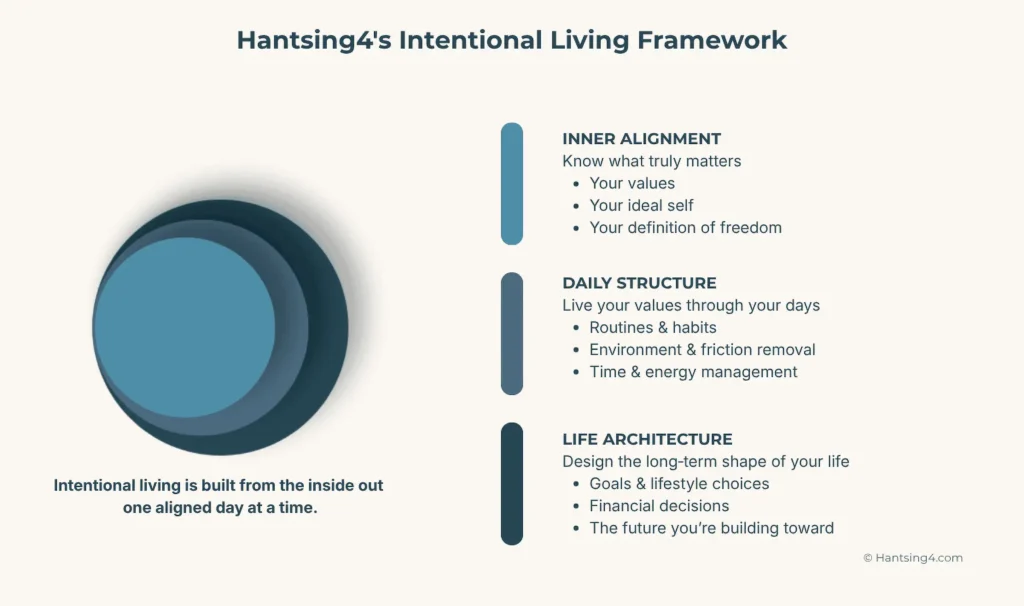
Lifestyle design works best when approached in layers, starting from the inside and building outward.
- The first layer is inner alignment. This is the foundation. It covers your values, your personal definition of freedom, and your honest understanding of what kind of life feels right for you. Without this layer, everything else is just rearranging the furniture.
- The second layer is daily structure. This is the practical layer: your routines, your habits, your immediate environment, and how you manage your time and energy from day to day. Daily structure is where your values either get lived or get abandoned.
- The third layer is life architecture. This is the longer horizon: your goals, your broader lifestyle choices, your financial decisions, and the shape of the future you are working toward. Life architecture builds the container your values and structure will eventually fill.
Most people try to change their lives by starting with goals. Lifestyle design tends to work better when you start with alignment, then build structure, then extend to the longer view. Each layer supports the next.
Designing Your Ideal Day
A life you do not need a vacation from is built one day at a time. The most practical place to start is with a clear picture of what your ideal day would actually look and feel like. Not a fantasy day, but a realistic one that genuinely reflects your values and priorities.
Ask yourself: What time would you wake up? What would your morning feel like? What kind of work would you do, and for how long? How much of your day would be spent on health, on relationships, on things that matter to you? What would you remove from your current day if you could? What would you add?
Your ideal day becomes the blueprint for your lifestyle. Experts in intentional living and lifestyle design suggest overlaying your current typical day against your vision for an ideal one, then focusing on small, sustainable shifts rather than dramatic overhauls. Every wall is built one brick at a time.
Removing Friction and Simplifying on Purpose
Friction is anything in your environment or schedule that drains your energy, creates unnecessary stress, or pulls your attention away from what matters. It can be physical clutter, a disorganized digital space, too many commitments, unclear priorities, or habits that work against you. Removing it is one of the highest-leverage things you can do in lifestyle design.
Simplification is the tool for this. It is not about owning less for its own sake. It is about deliberately reducing the noise in your life so that what remains has room to matter.
Psychologist Roy Baumeister’s foundational research on decision fatigue shows that the quality of our decisions deteriorates after extended periods of choosing, and that the mental energy required for deliberate thinking is a finite resource that depletes over the course of a day. When you simplify your schedule, your space, and your commitments, you conserve that resource for the things that genuinely require it. A simpler life is not an empty one. It is a spacious one.

Designing Your Environment for How You Want to Live
Your environment influences your behavior far more reliably than motivation does. Stanford researcher Dr. BJ Fogg, whose Fogg Behavior Model has shaped how designers and psychologists think about habit formation, shows that a behavior occurs when motivation, ability, and a prompt come together at the same moment. What this means in practice is that if your environment makes the right choices easy and the wrong ones harder, your behavior will follow with very little mental effort required.
This applies to your physical space, your digital environment, your social environment, and the routines and cues you have embedded in your day. A workspace designed for focus, a phone that is not engineered to steal your attention, relationships that energise rather than deplete, a morning that starts on your terms rather than someone else’s: these are not small details. They are the architecture of how you actually live.
A life that feels aligned becomes easier to build when you adopt daily habits that create more freedom and mental space. Design your environment to reflect who you want to become, not to accommodate who you used to be.
Time Freedom and Energy Management
Time freedom is not about having unlimited free time. It is about having real control over how your hours are spent. That control is created through choices: setting clear boundaries, simplifying your commitments, reducing distractions, prioritizing what matters, and delegating or automating whatever genuinely does not need your personal attention.
But time alone is not enough. You can have time for something and not have the energy for it. Energy management is the other side of the equation, and it often gets overlooked.
The most useful questions here are honest ones: What activities genuinely energise you, and which consistently drain you? What environments support your focus and creativity? What habits are quietly reducing your capacity day by day? When you design your life around your energy as well as your time, the quality of your hours changes significantly. Energy is your most valuable resource. When you protect it deliberately, everything else becomes easier to sustain.
What an Intentionally Designed Life Actually Feels Like
When your life is designed with intention, the shift tends to be quieter than people expect. It is not dramatic. You do not suddenly have a perfect day every day. What changes is the underlying texture of ordinary time.
You feel more grounded in your choices. More present in your days. More aligned between what you say matters and how you actually spend your hours. Less reactive, more deliberate. The challenges do not disappear, but they stop feeling like proof that something is fundamentally wrong. Your days begin to feel like they belong to you.
That feeling, that sense of genuine ownership over your own life, is what lifestyle design is ultimately trying to create.
Bringing It All Together
Designing a life you do not need a vacation from is not a one-time project. It is an ongoing practice of knowing what matters, removing what does not, and making small intentional adjustments as your life evolves. It starts with understanding your values, builds through your daily structure and environment, and extends outward toward the longer future you are working toward.
It does not require a perfect life or an extraordinary set of circumstances. It requires a willingness to stop accepting the default, and to make deliberate choices, consistently over time, that close the gap between the life you are living and the life you actually want.
That gap is narrower than most people think. And the bridge across it is built one intentional day at a time.
If this idea resonates, you may find even more clarity in my post on Life Design Changes That Create the Biggest Impact.