

Disclosure: This post may contain affiliate links, including Amazon links. As an Amazon Associate I earn from qualifying purchases. Commissions may be earned at no extra cost to you. Content is for informational purposes only and not professional advice.
Most people design their homes by default. They arrange what they already own. They keep what came with the apartment. They add pieces when something breaks or when a sale happens. The result is a space that reflects accumulated circumstance rather than conscious choice, and it shapes daily behavior in ways its occupants rarely stop to examine.
Intentional home design starts from a different place entirely. Instead of asking what fits in the room, it asks what kind of person you are working to become and what kind of daily environment would support that. It is not about aesthetics or expensive renovations. It is about clarity: understanding what matters to you and arranging your space so that the life you want to build feels natural rather than forced.
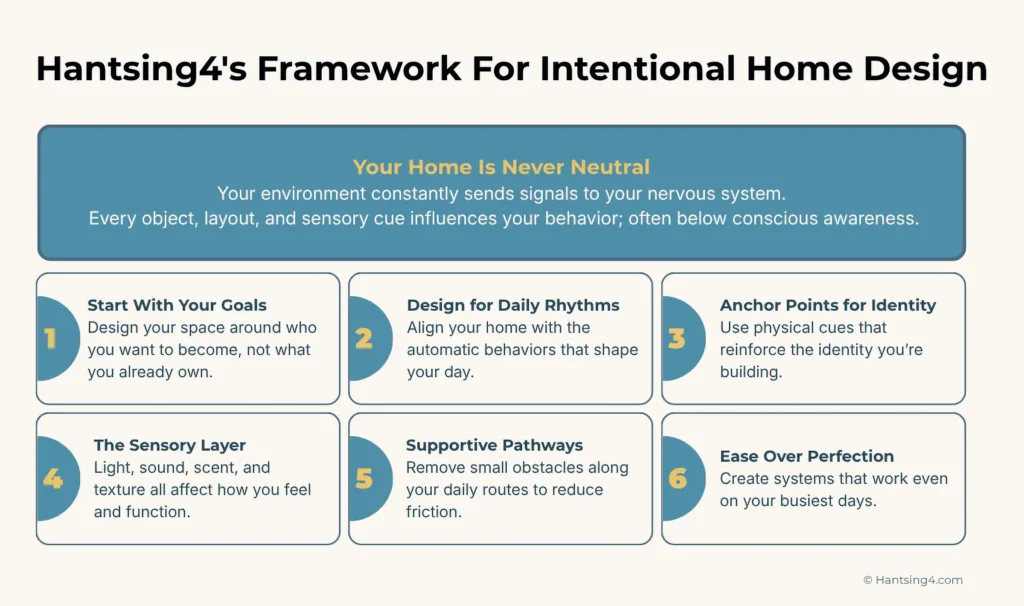
Why Your Home Is Never Neutral
Your physical environment is always influencing you, whether you are aware of it or not. The layout of your rooms, the placement of objects, the quality of your light, the state of your surfaces: all of these are sending constant signals to your nervous system and shaping your behavior in ways that operate largely below conscious awareness.
Research from the American Society of Interior Designers on the neuropsychology of space describes how intentional design choices shape mental wellbeing across three distinct layers: physical comfort, psychological safety, and emotional fulfillment. A space can look appealing and still fail on every one of those layers if its sensory and functional design is working against the people who inhabit it.
The inverse is also true. A space does not need to be beautiful or expensive to be genuinely supportive. It needs to be designed with an understanding of how it is being used and what it is intended to produce in the people who live in it. A home designed without that understanding tends to create friction where ease should exist, distraction where focus is needed, and a low-level sense of disorder that compounds throughout the day.
When your home is designed with that kind of intention, it becomes something more than a place to live. It becomes an active participant in your growth.
Start With Your Goals, Not Your Furniture
The most common mistake in home design, whether decorating, organizing, or rearranging, is beginning with what you already have. Intentional design reverses this sequence. You begin with your goals and work backward from there.
Before touching anything in your space, spend time with a few honest questions. What do you want more of in your daily life? What do you want less of? What habits are you trying to strengthen? What kind of energy do you want different rooms to give you? What does a good day feel like, and what does your environment currently do to support or undermine it?
The answers to these questions become your design brief. If you want more focus, your workspace needs simplicity and clear visual boundaries. If you want more calm in the evenings, your living areas need warmth and a reduction of stimulation. If you want to read more, you need a chair and a light that make reading genuinely comfortable and accessible. Your goals determine the choices. Everything else is just execution.
Design Around Your Daily Rhythms
Every person moves through their day with a natural rhythm: times of higher energy, times when focus comes easily, transitions that feel smooth or jagged depending on how the environment supports them. Intentional home design takes these rhythms seriously rather than fighting against them.
If your mornings feel consistently rushed and chaotic, the design question is not about discipline. It is about what friction exists in your morning environment that could be removed. A streamlined station near the door with everything you need to leave the house. A kitchen configured for a fast, low-decision breakfast. A bathroom counter with only what belongs there. If your afternoons tend to stall, the question is what your environment offers in that moment: is there a clear place to reset, a change of scene, a physical cue that signals a shift in mode?
Research from the National Council on Complementary and Observational Research’s behavioral design white paper notes that intentions are only weakly correlated with actual behaviors, and that the automatic system of cognition, the one that responds to environmental stimuli rather than deliberate reasoning, drives far more of our daily behavior than most people realize. Designing your environment to align with your natural rhythms is designing for the automatic system, and that is where most of your behavior actually lives.
Anchor Points: Designing for Identity
One of the most powerful and most underused tools in intentional home design is what designers sometimes call an anchor point: a deliberate, specific element in your space that connects your environment to the identity you are building.
An anchor point is not decoration. It is a functional cue. A small shelf near your desk holding only the books that are shaping your thinking right now. A visible yoga mat in a clear space that signals movement as a daily practice. A tray on the kitchen counter with everything needed for your morning routine, arranged so the routine requires no decisions. A reading corner with good light and a comfortable chair that communicates, every time you walk past it, that you are someone who reads.
These cues work because the brain builds associations between physical contexts and behaviors through repeated experience. As the psychology of interior design research from RMCAD confirms, intentional environments that engage the right senses in the right context can support emotional balance, enhance focus, and consistently reinforce the behaviors you want to make habitual. The anchor point is the physical manifestation of the identity you are working toward. Seeing it daily is a quiet but persistent reminder of who you are becoming.
The Sensory Layer of Your Home
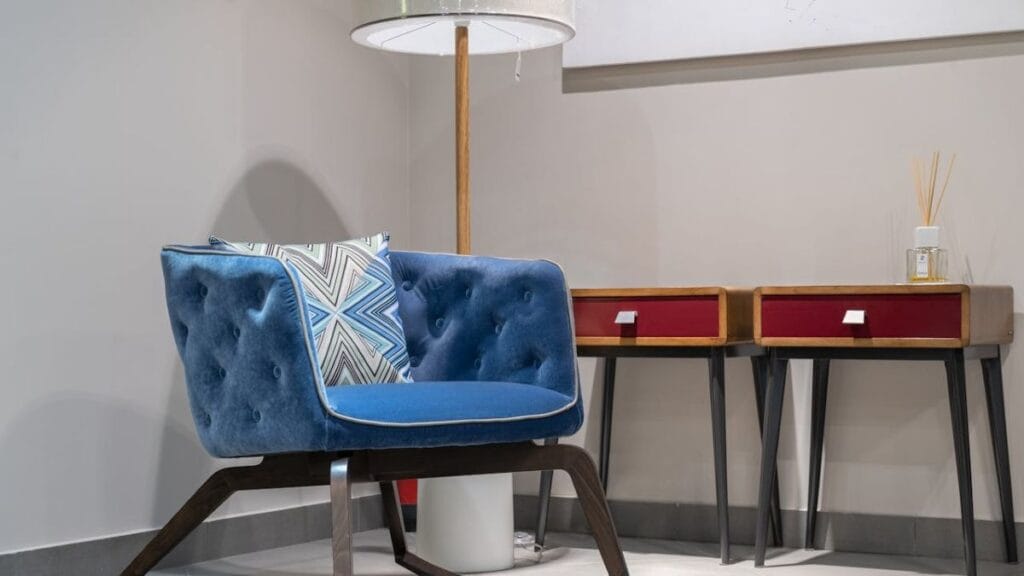
Most people think about home design in visual terms: color, layout, furniture, and tidiness. But your home communicates with all of your senses simultaneously, and each channel has a measurable effect on how you feel and how you function.
Lighting shapes your alertness, your mood, and your sleep quality through the circadian system, as covered in depth in our earlier post on home environment mistakes. Sound is equally significant. Research published in the journal Buildings on sensory design and architectural wellbeing found that sensory noise, defined as any non-informative sensory input that distracts from meaningful signals, directly affects the ability to concentrate, think clearly, learn, and regulate emotions. Noise from outside, from appliances, from adjacent rooms: these are not background details. They are active competitors for the cognitive resources your intentional behavior requires.
Scent is perhaps the most direct sensory channel of all. As the Centre for Conscious Design notes in its research on olfaction and architecture, odor information travels directly to the limbic system, the brain region associated with memory and emotion, bypassing the analytical processing that governs the other senses. This makes scent one of the most potent and most overlooked tools for shaping the emotional tone of a space. A scent you associate with calm in your bedroom, a fresh or energizing scent in a workspace, the absence of synthetic or unpleasant odors throughout: these are genuine design decisions with real effects on your emotional baseline.
Texture and temperature round out the sensory picture. Natural materials and soft fabrics signal comfort and safety to the nervous system. A room that is consistently too warm or too cold creates a low-level physiological stress that compounds over time. None of these details are trivial. Together, they determine whether your home feels like a place your nervous system can genuinely rest.
Supportive Pathways and Reducing Friction
A supportive pathway is the route you take through your home that either helps or hinders what you are trying to do. Intentional design pays attention to these paths because they are where the friction or the ease of your daily routines is actually determined.
A clear, organized route from your bedroom to the kitchen in the morning removes the small frustrations that set the wrong tone for the day. A distraction-free path from the front door to your workspace removes the decision about what to do first. A calming transition between your work area and your living area helps your nervous system shift out of the mode required for productivity and into the mode that supports genuine rest.
Reducing friction in these pathways is not about obsessive organization. It is about removing the small obstacles that accumulate across a day and gradually deplete the mental energy you need for the things that matter. One well-placed hook. One clear surface. One consistent place for everything you use daily. The individual changes are small. Their collective effect on your daily experience is not.
Designing for Ease Over Perfection
One of the most important principles of intentional home design is that the best systems are the simplest ones. A system that requires constant maintenance, precise arrangement, or significant effort to sustain will eventually collapse under the weight of a busy week. A system that is easy, flexible, and forgiving will continue working even when your attention is elsewhere.
Designing for ease means keeping frequently used items within immediate reach. It means reducing the number of steps required for the daily tasks you want to make effortless. It means choosing storage solutions that make it easy to put things away quickly, not just to find them. It means creating zones that do not require constant upkeep to remain functional.
Ease creates consistency. Consistency is what allows your environment to do its work over the long term.
Bringing It All Together
Intentional home design is not a project you complete and then leave alone. It is an ongoing practice that evolves as you evolve. The goals that matter most to you today may shift. The rhythms of your day will change. The person you are working to become will grow more defined over time, and your environment should grow with it.
Review your space periodically with fresh eyes. Ask what is working and what is quietly creating friction. Ask whether the anchor points in your home still reflect the direction you are moving. Ask whether the sensory quality of your space is supporting the emotional baseline you need to live and work well.
A home that is truly designed with intention does not need to be large, expensive, or magazine-worthy. It needs to be honest. It needs to reflect where you are going rather than where you have been, and it needs to make the daily behaviors that support that direction feel as natural and effortless as possible.
That is what a supportive home actually looks like. And building it is within reach for anyone willing to approach their space with the same care and intentionality they bring to the rest of their life.
If you want to see how this connects to your daily life, you’ll appreciate Home Organization for Busy People.