

Disclosure: This post may contain affiliate links, including Amazon links. As an Amazon Associate I earn from qualifying purchases. Commissions may be earned at no extra cost to you. Content is for informational purposes only and not professional advice.
There is a version of the future that most people are sleepwalking toward. They are working harder than ever, learning reactively rather than strategically, and relying on manual effort for tasks that technology could handle in a fraction of the time. They are not failing. They are simply operating in a linear way, in a world that has become exponential.
Digital leverage is what changes that equation.
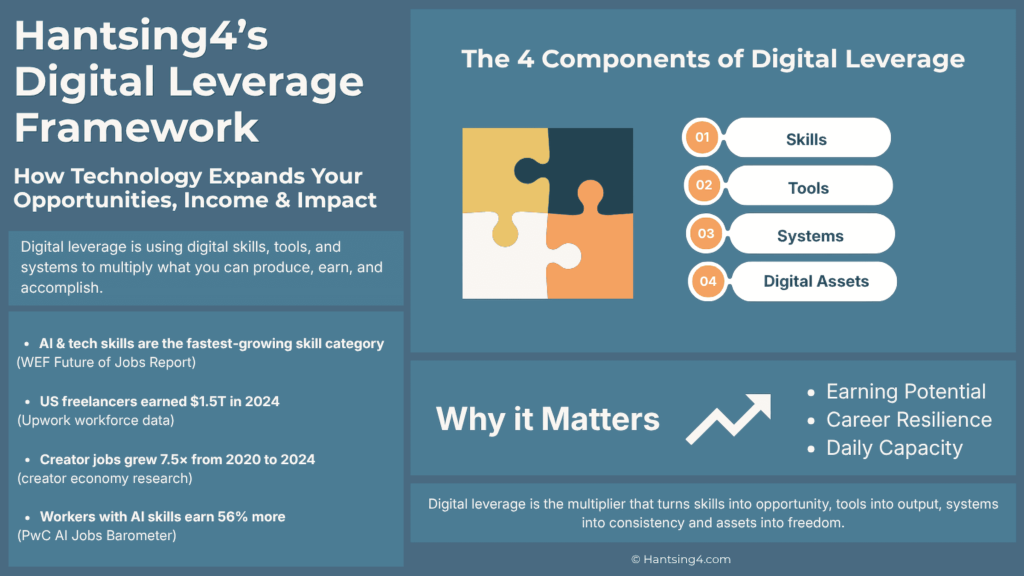
Not through shortcuts or hacks, and not by turning you into a tech expert. Digital leverage is the deliberate use of digital tools, skills, and systems to multiply what you can produce, earn, and accomplish without simply multiplying the hours you put in. It is the ability to do more with what you already have, and to grow your capabilities in a world that is moving faster than any single person can keep up with through effort alone.
This post is the foundation of the Digital Leverage pillar. It explains what digital leverage is, why it matters more right now than at any previous point in history, and how the three layers it is built on work together to create something genuinely compounding.
Why This Moment Is Different
Technology has always changed the nature of work. The printing press, the industrial revolution, electricity, the personal computer: each created new leverage for those who adopted it early and new obsolescence for those who did not. The difference today is speed.
The World Economic Forum’s Future of Jobs Report 2025, drawing on perspectives from over 1,000 major employers representing more than 14 million workers, found that technological skills are projected to grow in importance more rapidly than any other skill category over the next five years, with AI and big data leading the list. These are not niche technical skills being demanded of specialists. They are increasingly the baseline expectations placed on professionals across every industry and function.
What makes this moment particularly significant for individuals, not just organizations, is that the tools creating this shift are more accessible than they have ever been. The same AI tools, automation platforms, and digital skill sets that large organizations are investing billions into are available to any individual with a laptop and an internet connection. The gap between what a digitally capable individual can accomplish and what a less digitally capable one can accomplish has never been wider, and it is still growing.
Digital leverage is how you get on the right side of that gap.
What Digital Leverage Actually Is
Digital leverage is not a single skill or a single tool. It is a relationship between three things that compound when they work together.
The first is skills: your ability to use digital tools with confidence, communicate clearly in digital environments, learn faster through technology, and adapt as the landscape shifts. Skills are the foundation. They determine what is possible.
The second is tools: the software, platforms, and AI systems that multiply the output of your skills. A person with strong writing skills and no tools has a ceiling. The same person with AI assistance, automation, and a distribution platform can produce, reach, and earn at a scale that simply was not available to individuals a decade ago.
The third is systems: the repeatable workflows and processes you build by combining your skills and tools in a structured way. Systems are what turn sporadic capability into consistent output. They are what allow you to deliver at a higher level without having to apply maximum effort every single time.
When these three layers work together, something changes. Your output begins to scale independently of your hours. Your learning compounds instead of plateauing. Your opportunities multiply rather than staying fixed to what your immediate time and energy allow. That is what leverage means in practice. True leverage begins when you combine the right tools with a strong digital toolkit that multiplies your output.
The Individual Opportunity
The most important shift in the digital economy over the past decade is not what it has done to organizations. It is what it has made possible for individuals.
The freelance and independent work economy is the most visible expression of this. According to data tracked by Upwork and reported across multiple workforce studies, US freelancers generated approximately $1.5 trillion in earnings in 2024, with over 64 million Americans now working independently, representing 38% of the total US workforce. These are not people who failed to find traditional jobs. A growing proportion are skilled professionals who discovered that digital leverage, applied through their own skills and systems, allows them to earn more, work with greater flexibility, and build something that belongs to them.
The creator economy tells a similar story from a different angle. Research tracking digital creator activity found that the number of full-time equivalent creator jobs in the US rose from approximately 200,000 in 2020 to around 1.5 million by 2024, a 7.5-fold increase in just four years, with the global creator economy valued at over $200 billion and projected to approach $900 billion by 2032. These numbers reflect people who built audiences, products, and income streams using digital tools and skills available to anyone.
Neither of these paths requires technical expertise or a large startup investment. They require digital leverage: a combination of the right skills, the right tools, and the discipline to build systems that make the output sustainable.
The Career Opportunity
Digital leverage is not only for people building independent businesses. For professionals inside organizations, it is one of the most reliable ways to become harder to replace, more capable of advancing, and better positioned for wherever the labor market moves next.
PwC’s 2025 Global AI Jobs Barometer, which analyzed close to a billion job advertisements across six continents, found that workers with AI skills commanded a 56% wage premium over colleagues in the same roles who lacked those skills, a figure that had risen from 25% just the year before. That is not a marginal advantage. That is a structural difference in earning potential, and it is growing.
The professionals who are building this advantage are not necessarily learning to code or becoming AI specialists. They are learning to use AI tools effectively, automate the repetitive parts of their work, communicate more clearly and at greater scale, and make better decisions using data that is already available to them. These are learnable, accessible skills. The barrier is not aptitude. It is awareness and intention.
What Stands in the Way
If digital leverage is this accessible, why do most people not have it?
The honest answer is that most people are overwhelmed before they begin. The volume of tools available is genuinely staggering. The pace of change creates a sense that anything you learn today will be obsolete by next year. And the way most people approach learning, trying to understand everything before committing to anything, produces very little actual progress.
The other barrier is the linear mindset. Most people have been conditioned to think about their output in terms of the hours they put in. More results require more time. Digital leverage breaks that relationship, but it requires a shift in how you think about your skills, your time, and what you are trying to build before the tools can actually do their work.
Neither of these barriers is permanent. They dissolve the moment you pick one thing, start small, and let the compounding do what compounding does.
The Three Areas Digital Leverage Changes
Digital leverage creates meaningful change in three areas of your working life, and understanding each one helps clarify where to focus your energy.
The first is your earning potential. The shift from time-based income to value-based income is one of the most significant financial changes digital leverage enables. When your skills are supported by tools and systems, your output is no longer directly proportional to the hours you spend. You can build digital assets, including content, courses, products, and automated systems, that generate value independently of your time. This is the foundation of financial flexibility.
The second is your career resilience. A professional with a strong digital skill stack is not dependent on a single employer, a single industry, or a single moment in the labor market. They can adapt, pivot, and create opportunities rather than waiting for them. In a labor market that the World Economic Forum projects will see nearly 40% of core job skills change by 2030, that adaptability is not optional. It is the defining career skill of this decade.
The third is your daily capacity. Digital leverage does not just change what you can earn or where your career can go. It changes the quality of your daily working life. When you use AI tools to accelerate the cognitive parts of your work, automation to handle the repetitive parts, and clear systems to reduce decision fatigue, you do more in less time and with less friction. The space that creates is real. It shows up as mental bandwidth, creative energy, and the ability to focus on the work that actually requires you.
How to Build It Without Overwhelm
Digital leverage is not built in a weekend. It is built gradually, through small and deliberate choices made consistently over time.
The most effective approach is to start with one skill or tool that is directly relevant to work you are already doing. Not a skill you think you should have, or a tool that looks impressive. One that solves a real friction point in your current week. Practice it until it feels natural. Then add the next layer.
The posts in this pillar cover the specific areas worth building: skill stacking, AI tools, automation, digital income paths, and the learning systems that accelerate all of the above. Each post goes deeper into one area of the framework. Together they form a complete picture of how to build digital leverage practically, sustainably, and in a way that actually fits your life.
Start where you are. Build what matters. The compounding takes care of the rest.
If you’re exploring this topic more seriously, you’ll appreciate the insights in How to Avoid Scams and Unrealistic Expectations About Online Income.