

Disclosure: This post may contain affiliate links. Commissions may be earned at no extra cost to you. Content is for informational purposes only and not professional advice.
We now live in a world where every person, regardless of age, profession, or background, must navigate an information environment more complex than any previous generation has faced. The same digital systems that give us instant access to global knowledge also expose us to an unfiltered stream of rumors, recycled narratives, emotional triggers, and engineered falsehoods. This is not a problem limited to experts, journalists, or business owners; it is a universal human challenge.
Our feeds, group chats, and video platforms are not designed to help us understand the world. They are designed to keep us engaged. In this environment, misinformation and disinformation are not anomalies; they are structural byproducts of how digital ecosystems operate.
To build resilience, we must first understand the landscape itself:
Misinformation — false content spread unintentionally
Disinformation — false content created deliberately to manipulate
Both travel through the same channels, and both exploit the same vulnerabilities in human cognition. The real challenge is not simply identifying falsehoods, but recognizing how our own psychological architecture, our emotional triggers, cognitive shortcuts, and social identities make us susceptible to them.
Digital resilience is no longer optional. It is a core skill for modern life.
The Psychology of Deception: Why Our Brains Bypass Logic
At the core of our susceptibility is the conflict between two mental operating systems. System 1 is our fast, intuitive, and emotion-driven mode of thinking. System 2 is our slower, analytical, and more deliberate reasoning. Misinformation is designed to hijack System 1, bypassing our critical filters before System 2 can even engage.
To regain control, we must identify the “Expertise Shortcuts” and cognitive hooks used to manipulate us:
- Confirmation Bias: The tendency to favor information that aligns with our pre-existing beliefs.
- Learner Insight: We are naturally less critical of news that “feels right,” leading us to share content without rigorous verification.
- The Expertise Shortcut (Authority Bias): A predisposition to trust claims from those who display markers of credibility.
- Learner Insight: Superficial signals—like a “verified” badge or professional graphic design—can trick us into assuming a source is reliable even when it lacks evidence.
- The Bandwagon Effect: Adopting a belief simply because many others appear to hold it.
- Learner Insight: High engagement metrics (likes and shares) act as social proof, making a falsehood appear normalized and legitimate.
- The Illusory Truth Effect: The psychological tendency to perceive a statement as more truthful the more often we are exposed to it.
- Learner Insight: Repetition creates familiarity, and our brains often mistake that familiarity for factual accuracy.
Research from Frontiers in Public Health offers a vital breakthrough: simply being aware of these biases serves as a “protective shield.” This intervention was found to be most effective among individuals who were initially most negative toward a topic (such as vaccines), proving that cognitive awareness can bridge even the deepest ideological divides.
Once we map these internal vulnerabilities, we can begin to see how social structures, the groups we belong to, harden these biases into digital walls.
Mirror in the Screen: Identifying Your Adopter Category
According to AI & Society research, we all fall into specific behavioral categories regarding how we consume and share information. Self-reflection in this area is the first step toward resilience.
- The Passive Receiver (30%): Overwhelmed by information overload. Identifying Trait: Low media literacy and high cognitive load.
- Blind Followers (20%): Accept and share content instinctively based on shocking headlines. Identifying Trait: Reliance on emotional cues and social momentum.
- Emotional Adopters (20%): Prioritize “affective truth” (how it feels) over factual accuracy. Identifying Trait: Strong connection to fear or moral outrage.
- The Trusting Follower (10%): Rely on specific authority figures (influencers, pastors, or leaders). Identifying Trait: Deference to reputational trust over independent checking.
- Skeptical Adopters (10%): Question content generally but stay susceptible if it matches their worldview. Identifying Trait: Skepticism easily overridden by confirmation bias.
- The Social Echo-Chamber Member (5%): Exist in environments where dissenting views are filtered out. Identifying Trait: Finds “psychological comfort” in shared narratives that reinforce identity.
- The Debunker Groups (5%): View verification as a civic responsibility. Identifying Trait: Proactive use of digital literacy to halt the spread of falsehoods.
By understanding these social categories, we can see that our digital identity directly influences the “Diffusion Curve”: the speed and reach of information contagion.
The Anatomy of a Viral Falsehood: The Diffusion Curve
Misinformation travels along a Steep S-Curve, meaning it outpaces accuracy not by minutes, but by the very nature of algorithmic prioritization of outrage.
- Introduction: Falsehoods begin in niche communities or trusted micro-networks.
- Platform Trigger: Initiators trigger a “Cognitive Cascade,” using authority or novelty to plant the initial seeds of doubt.
- Acceleration: The claim breaks into the mainstream.
- Platform Trigger: Engagement loops (likes, comments) signal algorithms to boost visibility. Because outrage travels faster than nuance, the falsehood gains an insurmountable lead.
- Saturation: The claim becomes ubiquitous across feeds and group chats.
- Platform Trigger: High engagement creates the bandwagon effect, normalizing the misinformation as common knowledge.
- Stabilization: The active spread slows, but the belief becomes entrenched.
- Platform Trigger: Algorithmic “rabbit holes” keep the content alive in specific pockets long after it has been debunked.
Because accuracy cannot win through speed, your only path to leverage is a deliberate intervention in the process.
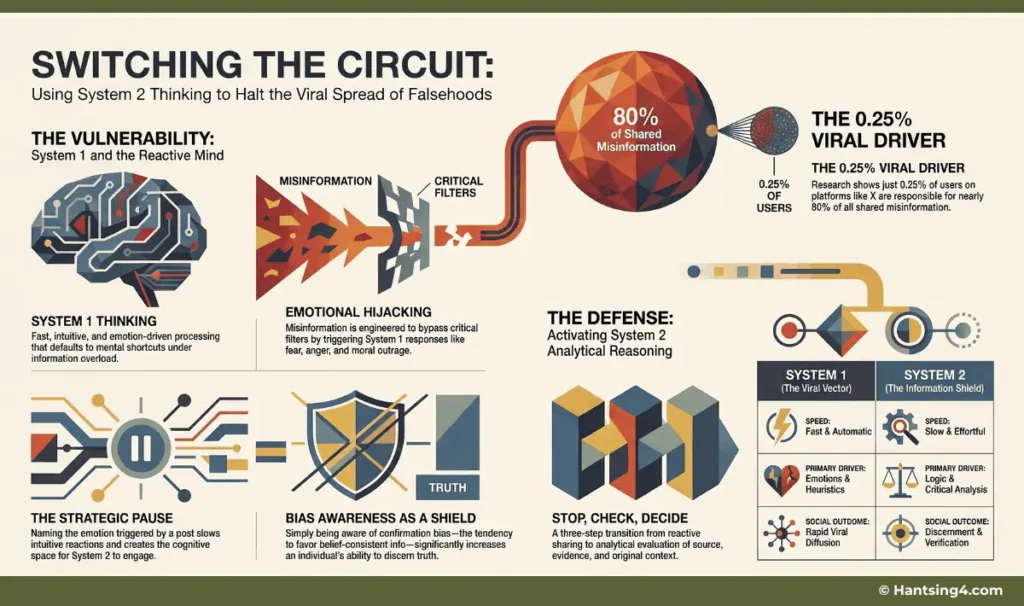
The ‘Stop, Check, Decide’ Framework: Your Practical Protocol
This framework moves you from a reactive System 1 state to a deliberate System 2 state.
Step 1: STOP (Emotional Regulation)
Misinformation is designed to trigger fear, outrage, or urgency. When you feel a “jolt” of emotion, that is the signal to pause.
- Practice “Affect Labeling”: Literally name the emotion you are feeling (e.g., “I am feeling outraged right now”). This simple act reduces emotional intensity and re-engages your analytical brain.
Step 2: CHECK (The Verification Checklist)
Analyze the content for the “Attributes of Misinformation” identified in current research:
- Source & Context: Is there identifiable authorship? Is this an old story resurfacing (Context)?
- Evidence & Cross-Checking: Are there links to primary research? Are credible independent outlets reporting this?
- Look for Simplification: Be wary of “black-and-white claims” that turn complex issues into simple narratives.
- Look for Sensationalism: Identify “hyperbolic language” (all-caps, excessive punctuation, dramatic appeals) intended to provoke a reaction rather than inform.
Step 3: DECIDE (Deliberate Judgment)
Choose one of four valid outcomes. Remember: “Skepticism” is a productive final state.
- Believe: The content is verified, evidence-based, and sourced.
- Skepticism: The claim is interesting but lacks sufficient proof. You choose to hold it as “unverified.”
- Investigate Further: You set the content aside for deeper research later.
- Set Aside: You recognize the content as manipulative or false and choose to deny it the “share” that fuels its spread.
This framework is your primary weapon, but its application must be tailored to the specific digital environment you inhabit.
Platform-Specific Survival Guide
| Platform Type | Misinformation Red Flags | Critical Concept |
|---|---|---|
| Social Media | Viral posts without links; personal anecdotes presented as universal truth. | Engagement-First Logic: Algorithms prioritize what is provocative, not what is true. |
| Messaging Apps | Forwarded messages with “invisible origins.” | Social Trust Transfer: We trust the sender (our friend) and unthinkingly trust the content. |
| Video Platforms | Dramatic thumbnails; narratives that rely on storytelling over verifiable data. | Algorithmic Rabbit Holes: The system assumes interest in one extreme video means interest in all of them. |
The “Social Trust Transfer” in messaging apps is particularly dangerous; just because a family member sent it does not mean the information is credible. Recognizing this allows you to separate the relationship from the data.
Reclaiming Digital Leverage as a Modern Citizen
Digital resilience is not just a defense against fake news—it is a foundational skill for navigating modern life with clarity, confidence, and emotional stability. Every time you apply the Stop, Check, Decide framework, you reclaim a small piece of your cognitive environment from algorithms designed to overwhelm it.
This is the work of digital citizenship.
It means pausing before reacting. It means verifying before sharing. It means choosing deliberate judgment over emotional reflex.
In a world where information spreads faster than truth, your greatest leverage is not speed—it is intention. By understanding how misinformation travels, how cognitive biases operate, and how social networks amplify emotion, you become the kind of digital citizen who moves through online spaces with discernment rather than confusion.
Whether you are a student, a parent, a professional, or simply someone trying to stay grounded in a noisy world, this framework gives you the tools to protect your attention, your judgment, and your peace of mind.
The digital landscape will not slow down. But you can learn to move through it wisely.
If you are looking to build digital resilience, you will find below two posts helpful:
“How to Avoid Being Psychologically Influenced by Online Content” and “How to Identify Misinformation Online and Protect Your Emotional Well‑Being”.