

Disclosure: This post may contain affiliate links, including Amazon links. As an Amazon Associate I earn from qualifying purchases. Commissions may be earned at no extra cost to you. Content is for informational purposes only and not professional advice.
When most people hear the phrase flexible lifestyle, they picture something specific: a remote worker at a cafe in Lisbon, a digital nomad with a backpack, someone who has traded a traditional career for something unrecognizable by conventional standards. That picture captures one version of flexibility. But it misses the more universal and more attainable version that most people are actually looking for.
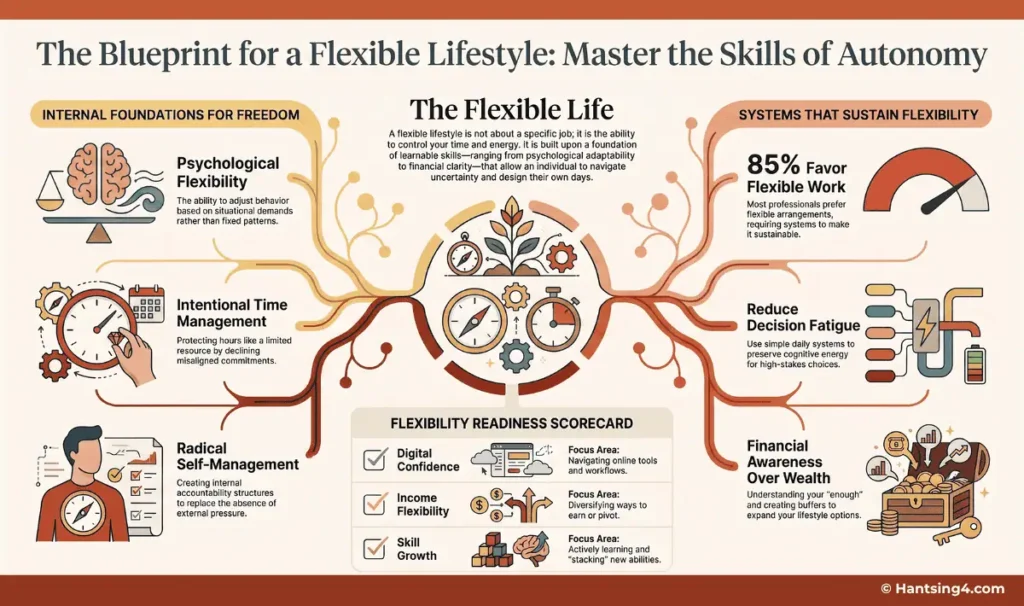
A flexible lifestyle, in its most practical sense, is simply one where you have more genuine control over your time, your energy, and the way you move through your days. It means having room to breathe, space to make real choices, and the ability to adjust when life shifts in ways you did not plan for. That kind of flexibility is not dependent on a specific job, a particular income level, or a dramatic life change. It is built from a set of learnable skills, and it is available to anyone willing to develop them deliberately.
This post explores the skills that make a genuinely flexible life possible, and why each one matters more than most people realize.
Managing Time in a Way That Creates Freedom
Time is the foundation of any flexible lifestyle. When your schedule is packed wall to wall with obligations that were never quite consciously chosen, flexibility becomes structurally impossible. There is simply no room for it. Building time flexibility begins not with productivity hacks or scheduling tools, but with the harder and more fundamental work of getting honest about what actually deserves your time and what has accumulated through habit, obligation, or the difficulty of saying no.
Intentional time management means learning to protect your hours the same way you would protect any other limited resource. It means becoming genuinely comfortable declining commitments that do not align with your priorities, creating clear boundaries around the parts of your day that matter most to you, and designing your schedule in a way that serves your goals rather than simply filling available space.
The result is not a sparse or under-committed life. It is a life with pockets of genuine freedom built into it, space that is not pre-allocated, that can be used for rest, exploration, unexpected opportunity, or simply the kind of unstructured time that turns out to be where a great deal of the best living happens.
Building Personal Systems That Reduce Daily Friction
A flexible lifestyle is not a chaotic one. Counterintuitively, the people who have the most freedom in their daily lives tend to have strong underlying systems that make the ordinary parts of life run smoothly without requiring constant attention.
Research on decision fatigue published in the Proceedings of the National Academy of Sciences consistently demonstrates that making decisions over extended periods depletes the cognitive resources available for subsequent choices, leading to a preference for default options and a measurably reduced quality of judgment as the day progresses. When your daily life runs on smooth, predictable systems, you spend significantly less of that cognitive budget on decisions that do not matter, which means more remains for the ones that do.
Simple systems are worth far more than complex ones. A morning routine that sets the tone for the day without requiring decisions. A consistent way of organizing your digital files so you can find what you need in seconds. A weekly rhythm that handles recurring tasks without deliberation. These are not constraints on a flexible life. They are the infrastructure that makes one possible.
Emotional Adaptability: Staying Grounded When Plans Change
Of all the skills that support a flexible lifestyle, emotional adaptability may be the most underrated. It is also the one most directly tested by life, because plans change. Circumstances shift. Things that seemed settled become uncertain again. The question is never whether disruption will arrive. It is whether you have the internal resources to navigate it without losing your bearings.
Research published in Scientific Reports in 2024 on psychological flexibility in young adults found that adaptive variability in behavior, the ability to adjust your responses based on what a situation actually demands rather than defaulting to fixed patterns, was the key distinguishing feature of people who navigated uncertainty and change effectively. Psychological flexibility is not the absence of a stress response. It is the ability to notice that response, regulate it, and choose how to proceed rather than simply reacting.
In practice, emotional adaptability looks like noticing when a plan has changed and responding to the actual situation rather than the situation you expected. It looks like staying clear-headed enough to make a good decision when circumstances are imperfect. It looks like recovering from setbacks without losing your sense of direction. These are not innate temperament traits. They are skills, and like all skills, they develop through practice.
Decision Making That Frees You From Overthinking
A flexible lifestyle requires the ability to make decisions and keep moving. Overthinking is one of the most common and most underacknowledged sources of rigidity in daily life. When every minor choice becomes a prolonged deliberation, the mental energy required accumulates quickly, and the freedom to act spontaneously or pivot quickly becomes harder to access.
Psychology Today’s analysis of decision fatigue research identifies analysis paralysis as one of the primary ways decision fatigue manifests: overanalyzing options, delaying action, and treating low-stakes choices as if they carry high stakes. The cost is not just the time spent deliberating. It is the cognitive depletion that follows, which makes every subsequent decision harder.
Learning to make small decisions quickly, to trust your judgment on matters that do not genuinely require extended analysis, and to distinguish between decisions that deserve careful thought and those that do not, is one of the most practically freeing skills you can develop. It preserves mental energy, reduces stress, and keeps life moving with the kind of fluidity that rigid, over-deliberated decision-making cannot produce.
Financial Awareness That Expands Your Options
Flexibility and finances are connected in ways that are worth being honest about. Financial pressure does not eliminate the possibility of a flexible life, but it does narrow the available choices. When your lifestyle requires a specific level of income to sustain, every financial decision becomes higher stakes, and the room to make different choices shrinks accordingly.
Financial awareness, in the context of a flexible lifestyle, is not about wealth accumulation or extreme frugality. It is about clarity: understanding what your life actually costs, identifying where money is going to things that do not genuinely matter to you, and creating enough of a buffer that your financial situation supports your goals rather than limiting them.
Research from the IIM Ranchi Journal of Management Studies on flexible work culture found that up to 85% of individuals aged 29 to 56 favored flexible work arrangements and wished to continue them beyond the pandemic period. The financial structures that support that preference, lower fixed costs, diversified income where possible, and a clearer understanding of what enough actually looks like, are what make the wish into a sustainable reality rather than a temporary arrangement.
Communication Skills That Support a Flexible Life
Flexibility rarely exists in isolation. It exists within relationships, within professional contexts, within the expectations of the people around you. How effectively you communicate your needs, your boundaries, and your choices within those relationships has a direct bearing on how much flexibility you are actually able to exercise.
Clear communication helps you set and maintain boundaries without damaging relationships. It helps you negotiate commitments, express what you need from a situation, and adjust plans without creating unnecessary friction. It makes it possible for the people in your life to work with you rather than inadvertently against you, not because they mean harm, but because they do not know what you actually need unless you tell them.
This is one of the most overlooked dimensions of a flexible lifestyle. You can have the time management, the systems, the financial clarity, and the emotional adaptability, and still find your flexibility significantly constrained by an inability to communicate what you want and need clearly and confidently to the people who matter.
Curiosity and the Willingness to Keep Learning
A flexible lifestyle grows naturally from curiosity, because curiosity is what keeps you from getting stuck. When you are genuinely open to learning new skills, exploring new tools, and trying different approaches to familiar problems, your available options expand continuously. When you stop being curious, options quietly contract.
This matters practically in a world that changes as quickly as the current one does. Skills that were sufficient five years ago may not be sufficient now. Approaches that worked in one context may not transfer to the next. The people who maintain genuine flexibility over time are not necessarily the most talented or the most experienced. They are the most willing to keep adapting, which requires a sustained orientation toward learning that curiosity makes sustainable in a way that discipline alone cannot.
Curiosity also keeps you from the specific kind of rigidity that comes from over-identifying with what you already know. When your identity is tied to your current skills and approaches, changing them feels threatening. When your identity is that of someone who is always learning, change feels like the natural order of things.
Self-Management and Personal Accountability
A flexible lifestyle, by definition, involves fewer external structures dictating your time and behavior. That freedom is only genuinely liberating if you have developed the internal structures to replace them. Without self-management, the absence of external pressure does not produce freedom. It produces drift.
Self-management means setting your own goals and following through on them without waiting for external accountability. It means tracking your own progress honestly, adjusting your approach when something is not working, and maintaining the kind of steady follow-through that allows a self-directed life to actually move forward.
This is the quiet discipline that makes flexibility possible. It is not the rigidity of a packed, over-scheduled life. It is the internal reliability that gives you the freedom to shape your days on your own terms, because you have demonstrated to yourself that you can be trusted to do what you decide to do.
Creating Space for Rest, Recovery, and Reflection
The final skill on this list is the one most likely to be overlooked by people who associate flexibility with doing more, exploring more, and fitting more into their days. But a genuinely flexible lifestyle is not about doing more. It is about having enough space that you can choose what to do, including choosing to rest.
Rest is not inactivity. It is the recovery that makes sustained engagement possible. Reflection is not navel-gazing. It is the process by which you stay oriented toward what actually matters rather than drifting toward whatever is immediately in front of you. Both require space, and space has to be protected deliberately, because the default tendency of a busy life is to fill every available opening.
When you build genuine rest and reflection into your lifestyle, you maintain the clarity to make good decisions about where your time and energy go. You stay connected to what you actually value rather than responding to the loudest demands of the moment. And you preserve the mental and emotional resources that all the other skills on this list depend on.
Flexibility Is a Skill Set, Not a Personality Type
The most important thing to understand about a flexible lifestyle is that it is not reserved for a particular kind of person, a certain personality type, or a specific set of circumstances. It is built from skills. Skills that are learnable, developable, and available to anyone willing to approach them with intention.
None of these skills are mastered quickly or perfectly. They develop gradually, through practice and reflection, and they tend to reinforce each other in ways that compound over time. Better time management reduces decision fatigue. Reduced decision fatigue improves emotional adaptability. Stronger emotional adaptability makes communication easier. Clearer communication creates more room for the rest and reflection that keep everything else sustainable.
FLEXIBILITY READINESS SCORECARD
Rate yourself 1–5 on each:
- Digital Confidence — Can you navigate tools, platforms, and online workflows?
- Adaptability — How quickly do you adjust to new situations?
- Self‑Management — Can you stay productive without external structure?
- Skill Growth — Are you actively learning and stacking new skills?
- Income Flexibility — Do you have multiple ways to earn or pivot?
Scoring:
- 20–25: You’re ready for a highly flexible lifestyle
- 15–19: You’re close — build 1–2 key skills
- 10–14: You need foundational skill development
- Below 10: Start with digital basics + self‑management
©Hantsing4
A flexible life is not a destination you arrive at. It is the ongoing result of developing these skills and applying them consistently to the life you are actually living. The more deliberately you build them, the more room you create for the kind of life that feels genuinely yours.
To continue building clarity in this area, take a look at The Simplified Life, 5 Everyday Habits That Create More Freedom and Value-Driven Minimalism.