
Disclosure: This post may contain affiliate links, including Amazon links. As an Amazon Associate I earn from qualifying purchases. Commissions may be earned at no extra cost to you. Content is for informational purposes only and not professional advice.

Home organization is not about perfection. It is about creating a home that works with your life instead of against it. Most people do not struggle because they are inherently disorganized. They struggle because their home has not been designed to support the way they actually live.
That distinction matters. It shifts the conversation away from personal failure and toward something far more useful: systems, structure, and intentional design. When your home is set up thoughtfully, staying organized stops being a constant act of willpower and becomes something closer to a natural outcome of the way your space is arranged.
This guide is for people who want a calm, functional home without spending their weekends maintaining it. Whether you live in a small apartment, a busy household with multiple people, or somewhere in between, the principles here apply. The goal is not a picture-perfect home. The goal is a home that feels easy to live in, day after day.
Why Most Homes Feel Hard to Maintain
Before getting into specific strategies, it helps to understand what is actually happening when a home feels perpetually messy or exhausting to manage.
Clutter Is a Systems Problem, Not a Character Flaw
The most important reframe in home organization is this: clutter is rarely about laziness or messiness. It is almost always about the absence of systems. When items do not have designated places, they float. When storage is inconvenient, things get left out. When routines are vague, tasks accumulate.
Research increasingly supports the idea that disorganized environments do something measurable to the brain. Studies have described clutter as a form of visual distraction that increases cognitive overload and reduces working memory capacity, meaning the piles of things you are not consciously looking at are still consuming mental resources. Your brain registers every item in its visual field, even when you think you have stopped noticing. Over time, that constant low-level processing adds up to real fatigue.
There is also what researchers call the Zeigarnik Effect, a tendency for the mind to fixate on unfinished tasks. Every visible item that needs to be dealt with, put away, or decided about registers in the brain as an open loop. The result is mental background noise that makes it genuinely harder to relax or focus, even in your own home.
Research from UCLA’s Center on Everyday Lives and Families found a direct correlation between household clutter and elevated cortisol levels throughout the day, the body’s primary stress hormone. That is not a vague feeling. It is a physiological response to a disorganized environment.
The Decision Fatigue Factor
Beyond stress, clutter has a specific effect on decision-making. Researchers at the University of Minnesota found that people working in cluttered environments showed measurably reduced self-control compared to those in tidier spaces, suggesting that the cognitive cost of navigating visual disorder depletes the mental resources we use for all kinds of choices throughout the day.
This is what behavioral economists describe as decision fatigue: the more small choices and micro-decisions you have to make, the less capacity you have for larger, more important ones. A cluttered home multiplies these micro-decisions constantly. Where did I put that? Should I deal with this now or later? Does this belong here? Each question is small, but collectively they are expensive.
Understanding this changes the goal of home organization entirely. You are not just trying to make things look tidy. You are trying to reduce the number of decisions your environment forces you to make each day.

Start With Decluttering: A Room-by-Room Approach
You cannot organize clutter. The first step in any meaningful home organization effort is to reduce what you own to what genuinely deserves space in your home.
Decluttering does not have to be overwhelming. Approaching it room by room, or even one area at a time, makes the process manageable and builds momentum naturally. Start with something small: one drawer, one shelf, one surface. Small wins create energy for larger ones.
A useful framework for moving through any space is to ask three questions about each item: Do I know where this belongs? Is that place easy to reach? Do I use it often enough to justify keeping it? If the answer to any of those is no, the item is likely already becoming clutter, or will soon.
When moving through a room, work through categories rather than deciding item by item on instinct. Remove trash. Remove items that belong in another room. Remove duplicates. Remove anything broken, expired, or no longer used. Remove items that made sense at a different point in your life but no longer match how you actually live.
The neutrality of a category-based approach is useful because it bypasses the emotional friction that often stalls decluttering. You are not deciding whether to throw something away. You are deciding what earns a permanent place in your home.
Building Systems: The Backbone of an Organized Home
Once you have cleared the excess, the real work begins: designing systems that make it easy to maintain order without constant effort.
A system, in this context, is simply a repeatable process that removes the need for a decision. When your keys have a hook by the door, you never have to decide where to put them. When laundry has a designated day, you never have to think about when to start it. Behavioral research consistently shows that habits are most durable when they are triggered by environmental cues rather than relying on conscious motivation, which means the physical design of your home can either make good habits automatic or make them unnecessarily hard.
This is the core insight behind what designers and behavioral scientists call environment design: by arranging your space so that the best choices are the easiest choices, you can shape daily behavior without relying on willpower. When the path of least resistance leads to order, order becomes the default.
The Concept of a “Home” for Every Item
One of the most foundational principles of home organization is that every item needs a designated place, what organizers often call its “home.” This is not a complicated idea, but it is powerful in practice. When everything has a place that is easy to access and consistently used, putting things away becomes automatic rather than a decision.
Psychology Today notes that creating designated spots for items eliminates the cognitive overhead of figuring out where things go, which is a significant source of clutter accumulation. The item lands on the counter not because anyone is being careless, but because there is no clearly established alternative.
The “home” principle also guides storage placement. Items should be stored as close as possible to where they are used. Coffee mugs belong near the coffee maker. Charging cables belong where devices are charged. Keys belong near the door. This sounds obvious, but many homes are organized around aesthetics or habit rather than logic, which creates invisible friction in daily life.
Core Home Systems Worth Building
A few systems, consistently maintained, are enough to keep most homes running smoothly. You do not need an elaborate routine. You need a small number of reliable ones. This section pairs well with the ideas I covered in The Power of Intentional Home Design That Supports Your Goals, especially if you’re building momentum.
A daily reset is one of the most effective. This is not a cleaning session. It is a 10 to 15-minute sweep at the end of each day that returns the home to a baseline: surfaces cleared, items returned to their places, the kitchen reset, and a few small tasks done so they do not pile up. The specific actions matter less than the consistency. When the reset becomes a habit, it prevents clutter from accumulating in the first place rather than requiring periodic large-scale organizing sessions.
A laundry rhythm that fits your actual week, rather than an ideal schedule, prevents the common pattern of clothes piling up and then requiring a half-day to address. A mail and paperwork system, even a simple inbox tray with a designated weekly processing time, prevents paper from spreading across every horizontal surface. A weekly fridge reset, clearing out what has gone off and noting what needs to be used, reduces waste and makes the kitchen easier to navigate.
None of these systems need to be elaborate. Research on habit formation suggests that simpler routines become automatic faster, with straightforward daily actions taking root in a matter of weeks when repeated in consistent contexts.
Small Space Organization: Working With What You Have
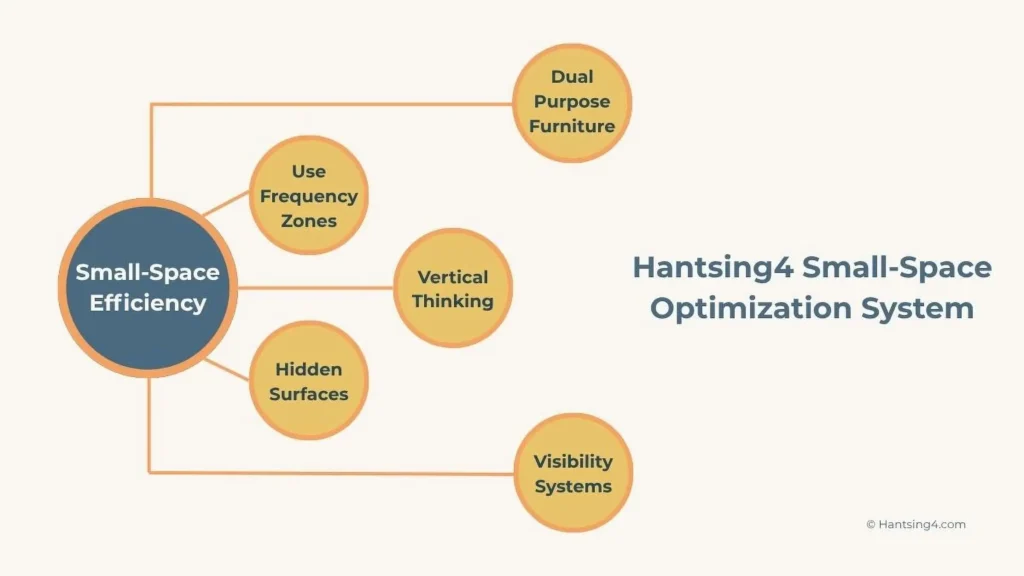
Small spaces present a specific kind of organizational challenge. There is less room for error, less tolerance for excess, and a steeper price for poor storage decisions. But they also respond quickly and dramatically to good systems.
The most important shift in small-space thinking is moving from floor-based to vertical organization. Apartment Therapy notes that pegboards, floating shelves, stacked cube organizers, and tall bookcases can immediately expand storage capacity without consuming floor space, and keeping clutter off floor level makes rooms feel significantly larger. Steelcase research on workplace design suggests that frequently used items should live within 24 to 48 inches above the floor, the natural reach envelope, while less-used items can move higher without harming usability. That same logic applies at home.
Doors are among the most underused surfaces in a home. The back of a closet door, a pantry door, or a bathroom door can hold an over-door organizer, hooks, or slim racks without taking up any additional space. Cabinet doors can hold cutting board racks, foil and wrap dispensers, or small shelves for spices.
Furniture that serves multiple purposes reduces the number of pieces a small space needs to accommodate. An ottoman with internal storage, a bed frame with built-in drawers, a coffee table with shelving underneath, all of these reduce clutter while maintaining function. Research published in the Frontiers for Sustainability Journal notes that multifunctional furniture increases effective square footage while reducing the visual and physical accumulation of separate storage pieces.
Clear containers are worth mentioning specifically. In small spaces where storage is often tucked away in cabinets, bins, or drawers, the inability to see what you own leads to duplicates, forgotten items, and the constant minor frustration of searching. Clear bins in the fridge, pantry, bathroom, and closet eliminate that friction and make restocking more accurate.
Organizing by frequency of use is a principle that applies to any space but is especially important in small ones. Daily items should be at eye level and easy reach. Weekly items can go slightly higher or deeper. Seasonal or rarely used items belong in the least accessible spots: high shelves, under-bed storage, or the back of closets.
If you want practical support, the items in 10 Storage Solutions for Small Apartments are the ones we trust.
Room-by-Room Organization Strategies
Each room in a home has a different function and therefore a different set of organizational priorities. What works in the kitchen would be strange in the bedroom. The following is a practical breakdown by room.
Kitchen
The kitchen is among the highest-traffic areas in any home and one of the most prone to accumulation. The counter is the most valuable surface in the room and should be treated accordingly. Keep only items that are used daily on the counter. Everything else, even things used frequently, belongs in a cabinet or drawer.
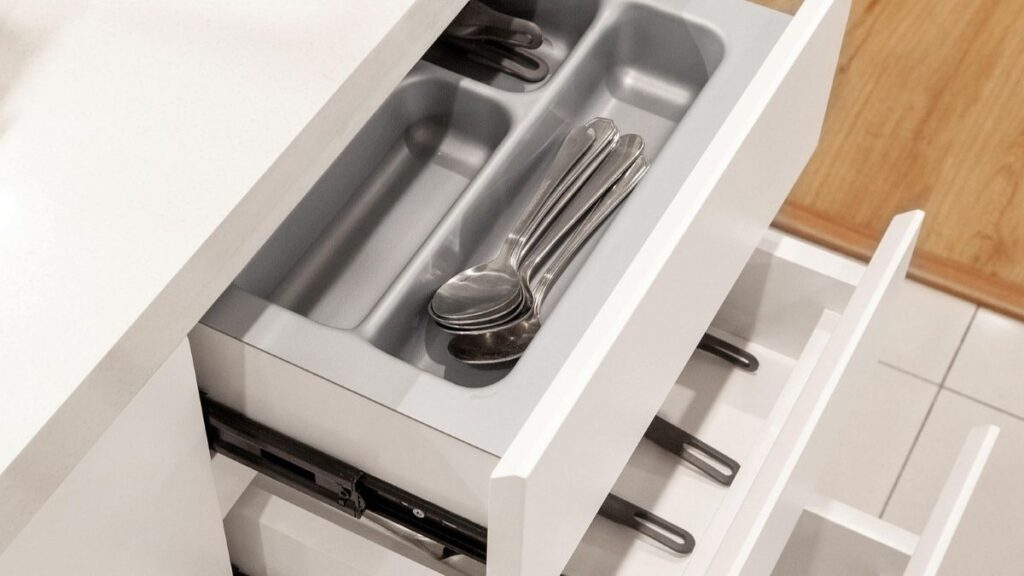
Drawer organizers for utensils prevent the common problem of a catch-all drawer that requires excavation to use. Storing items near where they are actually used, cutting boards near the prep area, oils and spices near the stove, reduces the number of steps required for everyday cooking and makes the kitchen feel more intuitive to use.
In the pantry, grouping items by category and using airtight containers for dry goods makes inventory visible and reduces waste. Labels on containers and shelves help everyone in the household maintain the system, not just the person who set it up. Lazy Susans on corner shelves and risers for cans and jars make the back of shelves accessible rather than a dead zone where things go to be forgotten.
Closet
Closets are often organized by default rather than by design, which means they tend toward inefficiency. Slim velvet hangers instead of bulky plastic ones can effectively double hanging capacity in a standard closet. Sorting clothing by category rather than by outfit, all shirts together, all pants together, makes it faster to find what you need and easier to see what you actually own.
Seasonal items belong on higher shelves or in under-bed storage, freeing prime real estate for daily and weekly use. Shoes stored in a rack or angled shelf organizer take up significantly less space than shoes piled on the floor and are faster to find. Accessories stored in bins or small boxes rather than draped on hooks or piled on shelves stay organized more naturally.
Bathroom
Bathrooms benefit enormously from the principle of keeping only daily essentials visible. Counters that are clear except for what is used every morning and evening feel calmer and are easier to clean. Everything else belongs in a drawer, cabinet, or basket.
Drawer dividers for toiletries prevent the common problem of a drawer that becomes a jumbled mess within days of being organized. Shelving above the toilet and behind doors adds storage in rooms that often have almost none to spare. A shower caddy or built-in shelving keeps the shower clear of the bottle accumulation that tends to cluster on every horizontal surface.
Entryway
The entryway is the first line of defense against clutter spreading through the home. If items come in and have nowhere to go, they migrate to tables, chairs, counters, and floors. A well-designed entryway intercepts this.
A dedicated drop zone, with hooks for jackets and bags, a tray or bowl for keys, and a rack or basket for shoes, gives everything that comes through the door a designated place. Mail and packages deserve their own surface or tray so they do not colonize the nearest flat surface. The entryway should stay minimal by design, because the more it accumulates, the less functional it becomes.
The Long Game: Habits That Sustain Organization
Getting organized is the project. Staying organized is the habit. These are different challenges.
The good news is that the habits required to maintain an organized home are not time-consuming. Most of them take seconds. The compounding effect, however, is significant. A few reliable habits prevent the drift that causes homes to require periodic large-scale reorganizing.
The most foundational habit is putting things back immediately rather than setting them down with the intention of dealing with them later. Later almost never comes on schedule, and the item becomes the first piece of a pile. Returning something to its designated place in the moment takes the same amount of effort as setting it down, with none of the accumulation.
The one-in, one-out rule is a structural habit rather than a behavioral one: when something new comes into the home, something comparable leaves. This prevents gradual accumulation from undoing organized systems. It also encourages more intentional purchasing, since bringing something new in now carries a small cost.
A monthly review of key areas, closets, pantry, bathroom cabinets, and paper, catches drift before it becomes disorder. Things shift. Life changes. What made sense six months ago may no longer fit. Regular light reviews are far less effortful than periodic large-scale reorganizing.
Research on habit formation notes that automaticity, the point at which a behavior becomes effortless and self-sustaining, develops through consistent repetition in a consistent context, and that simpler actions reach automaticity faster than complex ones. This is worth keeping in mind when building organizational habits. Smaller, more specific actions, return keys to hook, clear counter before bed, are far more likely to stick than ambitious routines that require sustained motivation.
If You Feel Overwhelmed: How to Start
If your home feels far from where you want it to be, the gap between where you are and where you want to be can make starting feel impossible. It is not. It just requires beginning somewhere specific rather than everywhere at once.
Choose one small area. One drawer. One shelf. One surface. Set a timer for 10 to 15 minutes and work through only that space. The goal is not to transform your home in a single session. The goal is to experience what a small, completed area feels like, and to use that as momentum for the next one.
Progress creates motivation, not the other way around. You do not need to feel ready or inspired to begin. You need to begin, and the feeling follows.
The most organized homes are not the ones maintained by people with more time or more discipline. They are the ones designed so that order is the natural result of everyday life rather than a constant effort against it. That is a design problem, and design problems have solutions.
To continue building clarity in this area, take a look at Home Environment Mistakes That Drain Your Energy and A Simple Home Organization System Anyone Can Set Up in One Weekend.