
Disclosure: This post may contain affiliate links, including Amazon links. As an Amazon Associate I earn from qualifying purchases. Commissions may be earned at no extra cost to you. Content is for informational purposes only and not professional advice.
Your home is doing something to you right now. Not dramatically, not obviously, but consistently. The layout of your rooms, the state of your surfaces, the quality of your lighting, the objects you have held onto for years without quite knowing why: all of it is sending signals to your nervous system, moment by moment, that either support your energy or quietly erode it.
Why it Matters
Most people attribute their tiredness, distraction, or low-level irritability to stress, poor sleep, or a demanding schedule. And those things matter. But the environment you spend most of your time in is also a factor, and it is one that most people never think to examine.
This post covers seven of the most common home environment mistakes that drain your energy without you realizing it, what the research behind each one reveals, and what you can do to fix them without overhauling your entire home.
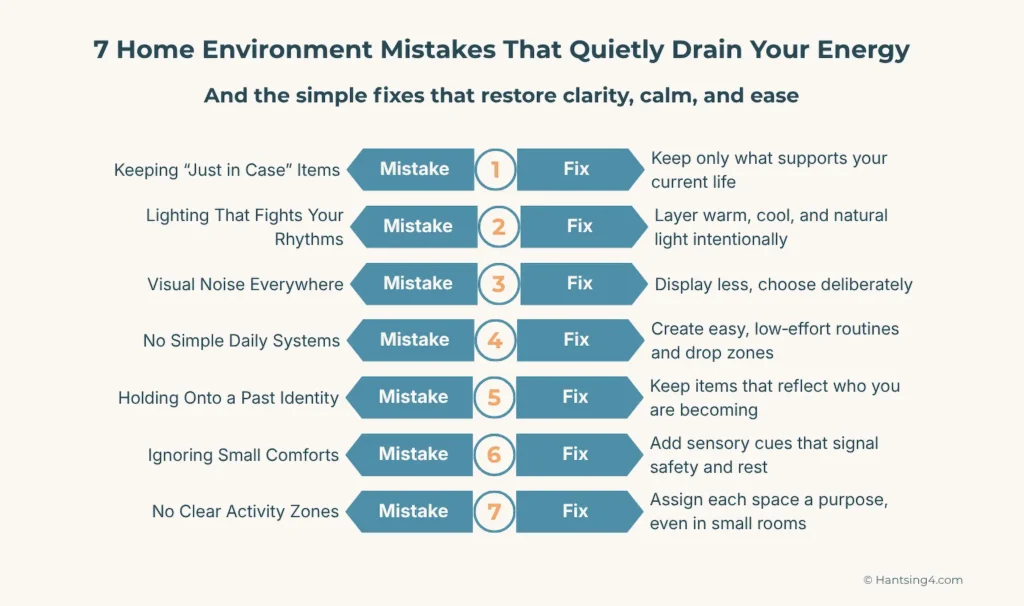
Mistake 1: Keeping Too Many “Just in Case” Items
Most homes contain a significant number of objects that no one actively uses. Clothes that no longer fit. Gadgets bought with good intentions. Duplicates of things kept in case the first one breaks. Items inherited from a previous chapter of life that no longer applies. Each of these objects feels harmless on its own. Collectively, they create a burden that is surprisingly measurable.
Research on possession clutter and subjective wellbeing published in the Journal of Environmental Psychology found that clutter, defined as an overabundance of possessions that collectively create chaotic and disorderly living spaces, had a strong negative impact on psychological home and perceived wellbeing. The mechanism is not purely aesthetic. Every object in your environment represents an unresolved question your brain has to process, a micro-decision about whether it belongs, what to do with it, and whether you are the kind of person who owns it.
The practical approach is not minimalism for its own sake. It is intentionality. Keep what you use regularly and what genuinely supports your current life. Let go of what belongs to a version of you that has already moved on. The space that it creates is not empty. It is clear.
Mistake 2: Poor Lighting That Works Against Your Natural Rhythms
Light is one of the most powerful environmental variables in your home, and one of the least deliberately managed. Most people live under whatever lighting came with the space without considering what it is actually doing to their energy, focus, and sleep.
Your body’s circadian rhythm, the internal clock that regulates your sleep-wake cycle, alertness, and hormone production, is synchronized primarily through light. According to the 2024 Healthy Buildings Barometer published by the Buildings Performance Institute Europe for the VELUX Group, greater exposure to daylight improves performance by as much as 10% in workplaces and 9 to 18% in schools, and over 30 million Europeans currently live in buildings that are too dark to support basic health and cognitive function.
Bright, blue-enriched light during the day supports alertness and focus. Warm, dim light in the evening signals your brain to begin winding down and supports the natural melatonin rise that prepares your body for sleep. A home that uses harsh overhead lighting in the evening, or that stays dim throughout the day, is working directly against both. Layering your light sources, adjusting the color temperature across the day, and maximizing access to natural light during working hours are among the highest-leverage and lowest-cost changes you can make to your home environment.
Mistake 3: Visual Noise That Keeps Your Brain on Alert
You do not have to live in a messy home for visual noise to be draining you. Busy patterns, open shelves crowded with objects, mismatched items, exposed cables, stacks of paper, and surfaces covered with things that do not belong together all create a form of sensory stimulation that your brain has to continuously process, even when you are not consciously paying attention to any of it.
Two decades of research by Princeton neuroscientist Professor Sabine Kastner found that visual clutter competes directly with the brain’s ability to focus, leading to cognitive fatigue over time. Her work demonstrated that neurons activate based on what you are looking for, while simultaneously working to suppress competing visual information. In a visually noisy environment, this suppression effort is constant and cumulative. Your brain is never fully at rest.
The fix does not require stripping your home of personality. It requires being more deliberate about what you display and where. Clear one surface. Group objects that belong together. Move visual complexity away from the areas where you need to focus. The effect on your mental clarity tends to be noticeable within days.
Mistake 4: No Simple Systems for Everyday Tasks
A home without systems creates a specific kind of low-level friction that accumulates across the day. You spend a few extra minutes looking for your keys. You make a decision about where the mail goes every time it arrives. You clean up the same area repeatedly because nothing has a designated place. None of these individual moments feel significant, but together they create a consistent drain on mental energy that compounds over time.
Research on decision fatigue and cognitive load consistently shows that the mental energy available for deliberate thinking is a finite resource that depletes with use. Every unnecessary decision your home environment forces you to make draws on the same pool of cognitive resources you need for the things that actually matter. A home with simple systems in place removes these micro-decisions before they occur.
Simple systems do not need to be complicated or elaborate. A designated spot for everything you use daily. A weekly reset routine that takes thirty minutes. A consistent way to handle incoming mail and paperwork. A clear protocol for the end of each workday. Each of these is a small investment that pays back in mental bandwidth every single day.
Mistake 5: Holding Onto Items That Reflect a Past Version of You
Of all the home environment mistakes on this list, this one tends to carry the most emotional weight, and it is also the most underestimated in terms of its daily impact. Your possessions are not neutral. They carry meaning, and the meaning they carry influences how you feel in your own space.
Research published in the Journal of Consumer Psychology on psychological ownership describes personal possessions as extensions of the self, integrated into a person’s sense of identity and belonging. When the possessions in your home reflect a version of yourself that no longer exists, a former hobby, a past relationship, a life chapter that has closed, they can create a subtle but persistent sense of incongruence. Your environment is signaling one identity while you are living another.
Letting go of items that no longer reflect who you are is not about discarding the past. It is about making space for the present and the direction you are moving toward. When your home reflects your current values and the person you are becoming, the environment reinforces rather than conflicts with your sense of self.
Mistake 6: Ignoring Small Comforts That Make Your Home Feel Safe
A home that supports your energy does not need to be expensive or aesthetically impressive. But it does need to feel like a place where your nervous system can genuinely rest. Many people overlook this entirely, treating comfort as a luxury rather than a functional requirement of a supportive environment.
Mental Health America’s guidance on healthy home environments identifies comfort and sensory safety as foundational to a space that restores rather than drains. The specifics are highly personal: a soft blanket, a candle in a scent you associate with calm, a chair that is genuinely comfortable, a plant, a small object that brings you pleasure every time you see it. These are not indulgences. They are environmental signals that communicate safety to your nervous system, helping it move out of the low-level alertness that a purely functional or aesthetically harsh space tends to maintain.
The distinction worth drawing here is between comfort that clutters and comfort that restores. A home full of things accumulated without intention can feel chaotic even if each individual item is pleasant. Comfort chosen deliberately, placed where you will actually experience it, creates a qualitatively different effect.
Mistake 7: Not Creating Zones for Different Activities
Your brain learns to associate spaces with activities through repeated experience. When the same space is used for work, rest, eating, entertainment, and scrolling, your brain receives no clear signal about what mode it should be in. The result is a persistent difficulty switching between states: work feels less focused, rest feels less restorative, and the boundaries between different parts of your day blur in ways that gradually erode your energy.
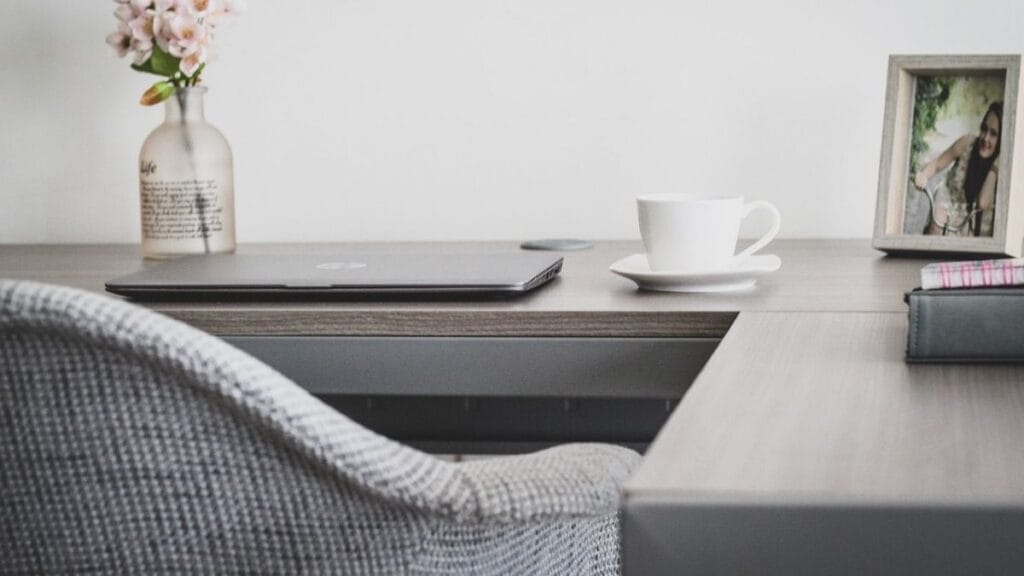
Creating dedicated zones for different activities, even in small spaces, uses this associative learning deliberately. A specific chair for reading. A clear surface used only for focused work. A section of the living area designed for rest and not for screens. A defined space for movement. Over time, the spatial association strengthens, and the act of moving into that zone becomes a cue that helps your brain shift into the corresponding mode with less deliberate effort.
The zones do not need to be large or formally defined. They need to be consistent. Use the same space for the same activity repeatedly and the association builds itself. The environment begins to do the mode-switching work that currently costs you mental energy every time you try to transition between tasks.
Bringing It All Together
None of these mistakes require a renovation to fix, and none of them need to be addressed all at once. The most effective approach is to start with one area where the drain is most noticeable, make a specific and immediate change, and observe the effect before moving to the next.
Your home should be a place that restores your energy, not one that slowly depletes it. When you design it with intention, removing what no longer serves you, managing your light, reducing visual noise, building simple systems, surrounding yourself with objects that reflect who you are now, and creating spaces that help your brain know what to do, the cumulative effect on your daily energy, focus, and sense of wellbeing is significant.
The most powerful wellness upgrade in your life might not be a new supplement or a new routine. It might be the decision to look honestly at the space you come home to every day, and ask what it is actually doing to you.
For a deeper look at how this plays out in daily life, take a moment to read Simple Home Organization Tips for Busy People.