

Disclosure: This post may contain affiliate links. Commissions may be earned at no extra cost to you. Content is for informational purposes only and not professional advice.
The internet has made access to information easier than at any point in human history. It has also made access to false information easier than at any point in human history. These two things are not in tension. They are the same phenomenon. The same infrastructure that puts genuine knowledge at your fingertips puts convincing misinformation there too, and the systems designed to distribute content are not optimized for accuracy. They are optimized for engagement.
Understanding how misinformation works, how it spreads, why it is so effective at bypassing critical thinking, and what you can practically do to protect yourself, is not a niche concern for journalists or researchers. It is a foundational digital literacy skill. In a world where the quality of your decisions depends heavily on the quality of your information, learning to navigate this landscape clearly and confidently is part of what it means to operate with genuine digital leverage.
Misinformation and Disinformation: An Important Distinction
Before you can effectively identify misinformation, it helps to understand what it is and what it is not. Misinformation is false or misleading information shared without necessarily any intent to deceive. It spreads through misunderstanding, outdated facts, or people repeating things they genuinely believe to be true. An old news story shared as current, a statistic taken out of context, a genuine misreading of a study: these are all misinformation, and they often come from people who mean well.
Disinformation is different. It is false information created and distributed with the deliberate intent to deceive or manipulate. The distinction matters because it shapes how you respond. Misinformation calls for correction and clarity. Disinformation calls for a different level of scrutiny, because the goal of the content is specifically to resist correction.
Both spread in the same channels: social media posts, forwarded messages, short videos, screenshots of supposed articles, and increasingly, AI-generated content that is visually and textually convincing at first glance. Because misinformation blends seamlessly into the everyday flow of online content, recognizing the different forms it can take is the first practical step toward navigating it more effectively.
Why Misinformation Spreads So Effectively
Most people assume that misinformation spreads primarily because of gullibility or low critical thinking ability. The research tells a more complicated and more interesting story.
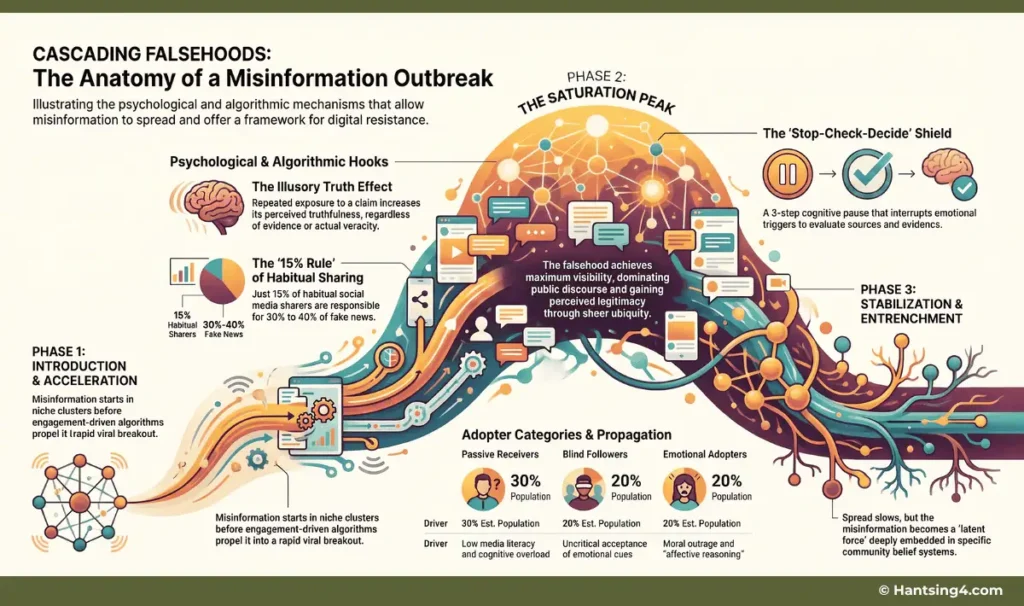
A USC-led study of more than 2,400 Facebook users, whose findings were published in the Proceedings of the National Academy of Sciences, found that the primary driver of misinformation spread is not a lack of critical thinking but the reward structure of social media platforms themselves. Just 15% of the most habitual sharers in the study were responsible for spreading 30 to 40% of the fake news observed, and these users were responding to the engagement incentives built into the platforms, not to a deficit in their ability to evaluate information.
A separate 2024 study by Indiana University found that just 0.25% of users on X were responsible for between 73% and 78% of all misinformation posted on the platform, with some of these accounts carrying verified status, which gave their content a surface appearance of legitimacy.
The architecture of social media rewards content that generates strong emotional reactions, particularly fear, anger, and moral outrage. Content that triggers these responses gets shared more, which gets it distributed more widely, which exposes more people to it. Misinformation tends to be better at generating these reactions than accurate information is, not because it is more interesting but because it is often more extreme, more alarming, and more emotionally immediate than the measured, nuanced reality it misrepresents.
The Psychological Hooks That Make Misinformation Convincing
Beyond platform architecture, misinformation exploits specific features of human psychology that make it genuinely difficult to evaluate critically, even for intelligent, well-intentioned people.
Confirmation bias is the most significant. It refers to the tendency to seek out, accept, and remember information that confirms what we already believe, while applying greater skepticism to information that challenges it. Research published in Frontiers in Public Health in 2024 found across a sample of 1,479 participants that simply making people aware of confirmation bias significantly reduced their susceptibility to misinformation and increased their ability to accurately assess the credibility of content. Awareness alone creates a meaningful protective effect.
Authority bias makes us more likely to trust claims from people who appear to be experts or who carry markers of credibility, even when those markers are superficial. The bandwagon effect makes us more likely to accept something as true simply because many others appear to believe it. The illusory truth effect, described in research on misinformation dynamics published in AI and Society, shows that repeated exposure to a claim increases its perceived truthfulness regardless of whether any supporting evidence has been provided. Seeing the same false claim multiple times across different sources gradually makes it feel more credible, even when nothing has changed about the evidence behind it.
Understanding these mechanisms does not make you immune to them. But it creates enough awareness to pause before accepting something as true, which is exactly the pause that most misinformation relies on you not taking.
Why It Matters Beyond the Obvious
The most direct harm from misinformation is obvious: believing false things leads to poor decisions. But the subtler harms are worth understanding too, because they affect your digital environment in ways that compound over time.
Repeated exposure to alarming or misleading content creates a background sense of anxiety and confusion that erodes your ability to think clearly. Pew Research Center data tracking misinformation exposure found that about three-quarters of US adults report seeing inaccurate information at least somewhat often, and many describe difficulty distinguishing what is true. That persistent uncertainty is cognitively draining. It contributes to decision fatigue in exactly the same way that a cluttered environment does: by placing a continuous, low-level demand on your attention that depletes the mental resources you need for the things that actually matter.
There is also the social dimension. Misinformation often works by creating sharp in-group and out-group dynamics, suggesting that questioning a piece of content marks you as naive, disloyal, or uninformed. This social pressure discourages the exact behavior that would protect you: asking questions, seeking multiple sources, and being willing to update your view when evidence warrants it.
Practical Steps for Evaluating a Piece of Content
The good news is that a few consistent habits are enough to significantly improve your ability to evaluate information accurately. You do not need to become a fact-checker or a media scholar. You need a simple, repeatable process.
Start with the source. Ask who published the content and whether that outlet or account is known for accurate, reliable information. Look for a real About page, identifiable authorship, editorial standards, or an established track record. Be specifically cautious with accounts that only post extreme or one-sided content, regardless of whether that content aligns with your existing views.
Then look at the evidence. Reliable information typically includes sources, data, links to primary research, or references to named experts. Be cautious of content that relies entirely on screenshots, unnamed sources, or vague appeals to “many people are saying.”
Check the date and context. Old news stories regularly resurface online as if they were current. A claim that is technically accurate in isolation can be deeply misleading when stripped of context. A few seconds of checking the date and the broader circumstances can prevent a significant misread.
Cross-check the claim. If something important or surprising is being reported, ask whether credible independent outlets are also reporting it. A claim that appears in only one place, regardless of how compelling it seems, warrants more caution than one confirmed across multiple reliable sources.
Pay attention to tone. Content designed to provoke rather than inform tends to use all-caps text, excessive punctuation, dramatic language, and urgent calls to share immediately. These are formatting choices optimized for emotional reaction, not accurate communication.
Platform-Specific Red Flags
Different platforms have distinct misinformation patterns worth knowing.
On social media, be cautious of viral posts that carry no source, personal stories that cannot be independently verified, and threads that reference but never actually link to credible information. The absence of a link to a primary source is often more informative than the presence of one.
On messaging apps, forwarded messages with no clear origin are among the most common and most trusted vehicles for misinformation precisely because they arrive from people you know and trust personally. The source of the original claim is invisible, and the social trust of the person forwarding it transfers undeservedly to the content itself.
On video platforms, dramatic titles, alarming thumbnails, and emotionally driven narratives are all signals worth noting. A video that relies entirely on emotional storytelling without providing any verifiable evidence or named sources should be approached with the same caution as a written article that does the same.
Protecting Yourself Emotionally and Psychologically
Evaluating information accurately is not only a cognitive skill. It also requires a degree of emotional regulation, because misinformation is specifically designed to bypass your rational thinking by triggering an emotional response before you have a chance to think critically.
The most protective habit you can build is a simple pause. Before reacting to or sharing something that generates a strong emotional response, take a moment to notice what you are feeling. Fear, anger, outrage, and urgency are all signals that the content has triggered your emotional system, which is precisely when your critical evaluation is most likely to be impaired.
Naming the emotion, as research on affect labeling consistently shows, reduces its intensity and creates enough space for a more measured response. From that space, you can apply the practical checks above rather than reacting from the emotional state the content was designed to produce.
Setting limits on the accounts, channels, and groups that repeatedly share alarming or extreme content is also a meaningful protective measure. This is not about avoiding information you disagree with. It is about recognizing that some sources are optimized for emotional provocation rather than accurate communication, and protecting your cognitive environment accordingly.
A Simple Framework: Stop, Check, Decide
A straightforward three-step framework makes the evaluation process easier to remember and apply consistently in real time.
Stop: Notice your emotional reaction before doing anything else. If the content is triggering strong feelings, that is the signal to slow down, not to speed up.
Check: Source, evidence, date, context, and cross-verification. Does this claim appear in credible independent sources? Is the evidence actual evidence, or is it assertion dressed as evidence?
Decide: Based on what you find, you have several reasonable options. Believe it, treat it with skepticism, save it for further investigation, or set it aside entirely. All of these are valid outcomes. The goal is not to achieve certainty about everything. It is to make deliberate, considered judgments rather than automatic, emotionally driven ones.
This small habit, applied consistently, produces a meaningful improvement in how you navigate the online information environment over time.
Bringing It All Together
Navigating misinformation effectively is not about becoming suspicious of everything or withdrawing from online information entirely. It is about developing the habits that allow you to move through the digital world with clarity and confidence rather than anxiety and confusion.
The platforms you use every day are not neutral. They are designed to maximize engagement, and content that triggers strong emotions tends to win that competition regardless of its accuracy. Understanding this, and building a simple set of practical habits in response, is part of what genuine digital literacy looks like.
In an environment where the quality of your information directly affects the quality of your decisions, protecting that information environment is not optional. It is one of the most practical things you can do to protect your clarity, your judgment, and the digital leverage that depends on both.
This article is part of a broader series on emotional and psychological safety online. If you want to explore the foundation of this topic, you can read the first post in the series, which focuses on how online content can influence our thoughts, feelings, and reactions without us noticing. For a related perspective that strengthens this concept, explore how to build digital resilience, a cognitive guide for modern life.